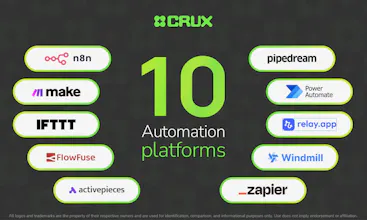
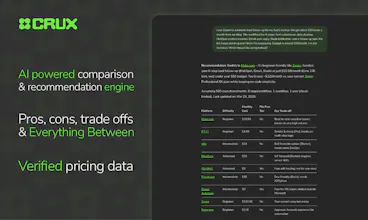
Every automation comparison online is an affiliate listicle that recommends whatever pays the highest commission. Crux asks what you actually need: your volume, integrations, budget, and technical level. Then recommends the right platform with honest trade-offs. We cover 10 platforms (Zapier, Make, n8n, and more) with real pricing math, not marketing pages. Think NerdWallet for workflow automation: problem-first discovery instead of tool-first directories. Get a straight answer in 2 minutes.
Hey PH! David here, from Crux.
I spent 3 weeks last year researching workflow automation platforms for a friend. Every "comparison" I found was the same: an affiliate listicle ranking tools by commission rate, not by fit. Zapier vs Make articles that could swap the tool names and read exactly the same.
The real questions nobody answered: "I run 500 tasks/month on Shopify + HubSpot with a $50 budget. What should I actually use?" Instead, you get "Top 10 Automation Tools in 2026" with zero mention of your stack, your volume, or your budget.
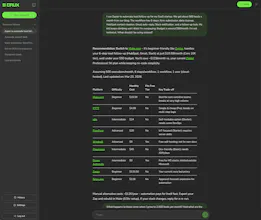
So we built Crux. You describe your integrations, volume, budget, and technical comfort level. Crux gives you ranked recommendations across 10 platforms (Zapier, Make, n8n, Power Automate, Activepieces, and more), with real pricing math and honest trade-offs.
What makes this different:
- Organized by your problem, not by tool
- Real cost calculations at your volume, not "starting at $9/mo."
- Every platform's weaknesses are shown, not just its strengths
- No hidden ranking bias. The affiliate model is disclosed upfront.
We're early and would love your feedback. Two questions for the community:
1. What's the biggest pain point you've hit choosing an automation platform?
2. Which platforms should we add next?
Report
Maker
Hey Product Hunt 👋
Ahmad here, maker / product @ CRUX
I've watched the same pattern play out across every comparison site in this space: affiliate rankings dressed up as editorial, vague pricing ranges that dissolve when you do the actual math, and no mention of what each tool is genuinely bad at.
We built CRUX to structurally prevent that. The affiliate relationship is disclosed upfront. Recommendations run through a scoring model the LLM can't override. Pricing is timestamped, source-linked, and verified weekly, so the number you see is the number you'd find if you clicked through.
The shareable report was designed specifically so someone could hand it to a colleague or a client and say: here's how we got here, here's when the data was pulled, here's the source.
Most AI tools get the interface wrong too. They hand you a blank box and expect you to already know the right question. CRUX asks you the questions instead, one at a time, in sequence, based on what you've already said. No forms. No blank-slate paralysis.
Travelstride
Hey Product Hunt 👋
Ahmad here, maker / product @ CRUX
I've watched the same pattern play out across every comparison site in this space: affiliate rankings dressed up as editorial, vague pricing ranges that dissolve when you do the actual math, and no mention of what each tool is genuinely bad at.
We built CRUX to structurally prevent that. The affiliate relationship is disclosed upfront. Recommendations run through a scoring model the LLM can't override. Pricing is timestamped, source-linked, and verified weekly, so the number you see is the number you'd find if you clicked through.
The shareable report was designed specifically so someone could hand it to a colleague or a client and say: here's how we got here, here's when the data was pulled, here's the source.
Most AI tools get the interface wrong too. They hand you a blank box and expect you to already know the right question. CRUX asks you the questions instead, one at a time, in sequence, based on what you've already said. No forms. No blank-slate paralysis.
If you want to go deeper on the product & design decisions behind this, I wrote up the full case study: https://uxcpo.com/case-studies/crux-ai-workflow-advisor/
What's the automation question you haven't been able to get a straight answer on?