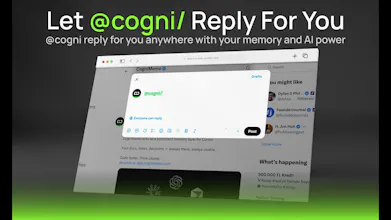
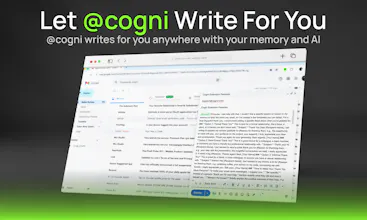
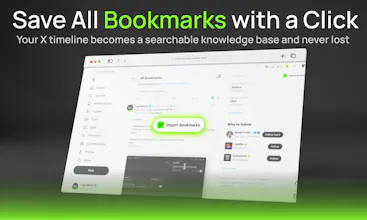
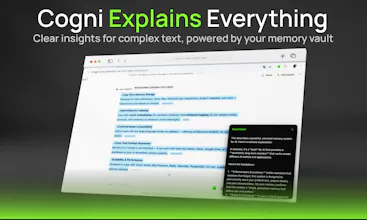
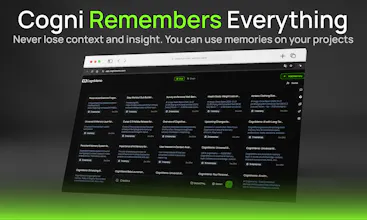
CogniMemo helps your AI remember. It adds long-term memory to ChatGPT and other AI tools. You can type @cogni in any chat to search your saved notes, past chats, and content. It works with ChatGPT, Claude, Gemini, and DeepSeek. You can save posts from X/Twitter, archive your AI conversations, and use a floating assistant on any website to explain or write using your own knowledge. Everything stays organized in one fast, searchable place—and your data stays under your control.
One thing I appreciate about CogniMemo Extension is that it seems to accept how unreliable human memory actually is.
Most extensions in this space quietly assume users will know in the moment what’s worth remembering. In reality, we usually realize something mattered only later. CogniMemo Extension feels like it’s designed around that gap, rather than fighting it.
As a first impression, the approach feels grounded in real cognitive behavior, not idealized workflows — which is often what separates sticky tools from forgotten ones.
@rexlian Thanks for articulating this so clearly — you’ve put your finger on the exact problem we’re trying to solve.
Human memory is retrospective, not predictive. We rarely know what will matter at the moment we see it; meaning emerges later, when context shifts. Most tools fight that reality by forcing users to decide upfront. CogniMemo is built around accepting it.
That’s why the extension is intentionally lightweight at capture time and more powerful at recall time. The goal isn’t perfect organization in the moment — it’s making past context retrievable when it suddenly becomes relevant.
If it feels grounded in real cognitive behavior, that’s the best signal we could hope for. Appreciate you noticing and sharing this perspective.
@pasha_tseluyko Thank you so much! 🙌 That really means a lot to us. We intentionally focused on keeping the UX minimal and distraction-free, so it’s great to hear that “less is more” resonates. We’re aiming to let the value come from the experience itself, not extra complexity. Appreciate the support! 🚀
@pasha_tseluyko Appreciate for your opinions, means a lot 🙏🏻
Report
The @cogni trigger is an elegant approach to memory recall - avoids switching context between tools. Curious how CogniMemo handles semantic search when the saved content is in different languages, since many developers work across multilingual docs and codebases.
@yamamoto7 Thanks — that’s exactly the intent behind @cogni: memory recall without breaking flow.
On multilingual content: CogniMemo stores memory at a semantic level rather than treating language as a hard boundary. We normalize and embed content in a way that lets concepts map across languages, so recalling “the same idea” works even if it was saved in another language. In practice, that means you can write, save, and query across mixed-language docs and codebases without needing to remember which language you used at the time.
It’s an area we’re actively refining, especially for devs working across English + local languages, so feedback here is very welcome.





CogniMemo
Hey Product Hunt 👋
I’m Volkan Çetin, Co-Founder of CogniMemo.
We built CogniMemo Extension because AI forgetting everything felt broken.
Every chat resets
Every tool is isolated
Every insight gets lost
We wanted AI to actually remember — across tools, chats, and the web.
What CogniMemo Extension does:
Adds long-term memory to your AI
Lets you search your own knowledge by typing @cogni in any chat
Syncs your X (Twitter) content and AI conversations into one memory
Gives you a floating AI copilot you can use on any website
Works as one browser extension
Acts as a single memory layer you can use with any LLM
One extension.
One memory layer.
Any AI model.
We’re excited to finally share this with you.
Would love your feedback and questions 🚀
@cogni @vlknctn very nice application You did a nice job, good luck. On your lunch
CogniMemo
@cogni @dubd59 Thanks a lot, Darrell — really appreciate the kind words and support!
We’re just getting started, excited to see where this goes. 🙏
Minara
One thing I appreciate about CogniMemo Extension is that it seems to accept how unreliable human memory actually is.
Most extensions in this space quietly assume users will know in the moment what’s worth remembering. In reality, we usually realize something mattered only later. CogniMemo Extension feels like it’s designed around that gap, rather than fighting it.
As a first impression, the approach feels grounded in real cognitive behavior, not idealized workflows — which is often what separates sticky tools from forgotten ones.
CogniMemo
@rexlian Thanks for articulating this so clearly — you’ve put your finger on the exact problem we’re trying to solve.
Human memory is retrospective, not predictive. We rarely know what will matter at the moment we see it; meaning emerges later, when context shifts. Most tools fight that reality by forcing users to decide upfront. CogniMemo is built around accepting it.
That’s why the extension is intentionally lightweight at capture time and more powerful at recall time. The goal isn’t perfect organization in the moment — it’s making past context retrievable when it suddenly becomes relevant.
If it feels grounded in real cognitive behavior, that’s the best signal we could hope for. Appreciate you noticing and sharing this perspective.
CogniMemo
Hey Product Hunt 👋
I’m Sami, founder of Cognimemo.
We built Cogniextension because AI tools forget everything the moment your chat ends — and humans shouldn’t have to repeat themselves.
Cogniextension lets you save, recall, and reuse context across tools, tabs, and conversations.
What it does (plain English)
🧠 Capture important info while you work (notes, decisions, context)
🔍 Retrieve the right memory when you ask — not a long chat history
📌 Pin what matters and expand it when you need deep context
🤖 Designed for AI workflows, not just note-taking
This isn’t another notes app.
It’s context infrastructure for people using AI every day.
Who it’s for
Builders & developers
Researchers & writers
Anyone tired of re-explaining things to AI
Why we built it
We noticed something broken:
Cogniextension is our first step toward fixing that.
What we’d love from you
Try it and break it
Tell us where it actually helps (or doesn’t)
Feature requests > compliments 🙂
We’re shipping fast and listening closely.
Thanks for checking it out — excited to hear what you think! 🙌
Incredible, I love this simple UX, less is more and nothing else is needed
CogniMemo
@pasha_tseluyko Thank you so much! 🙌
That really means a lot to us. We intentionally focused on keeping the UX minimal and distraction-free, so it’s great to hear that “less is more” resonates. We’re aiming to let the value come from the experience itself, not extra complexity. Appreciate the support! 🚀
CogniMemo
@pasha_tseluyko Appreciate for your opinions, means a lot 🙏🏻
The @cogni trigger is an elegant approach to memory recall - avoids switching context between tools. Curious how CogniMemo handles semantic search when the saved content is in different languages, since many developers work across multilingual docs and codebases.
CogniMemo
@yamamoto7 Thanks — that’s exactly the intent behind @cogni: memory recall without breaking flow.
On multilingual content: CogniMemo stores memory at a semantic level rather than treating language as a hard boundary. We normalize and embed content in a way that lets concepts map across languages, so recalling “the same idea” works even if it was saved in another language. In practice, that means you can write, save, and query across mixed-language docs and codebases without needing to remember which language you used at the time.
It’s an area we’re actively refining, especially for devs working across English + local languages, so feedback here is very welcome.