
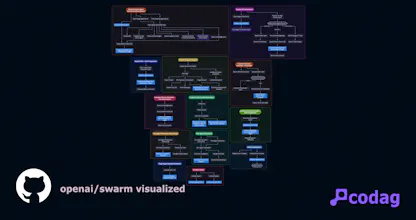
Visualize your LLM workflows as interactive & shareable graphs. Point Codag at your codebase — it maps every LLM call, branch, and data flow. Click any node to jump to source. Live updates as you code. Self-hosted, open source.




Free
Launch Team / Built With


Customer.ioAutomate Messaging Everywhere — Startups Get 12 Months Free
Promoted

Hey ProductHunt!
I'm Michael, Founder of Codag, prev @Shopify and @Okta. I've been building startups for the past couple months and and I keep running into the same problem.
I built Codag because I couldn't keep up with my own AI code anymore.
The problem: You vibe code an agentic workflow with Cursor or Claude. It works. But now there's 5 files, 3 LLM calls, branching logic everywhere. Your teammate asks "how does it work?" and you're like... let me ask my agent...
Other workflow tools need you to instrument your code, deploy it, send traces to their cloud. That's fine for prod monitoring, but terrible for understanding code you just wrote, and horrendous if you need to migrate to use someone else's infrastructure 😱😱😱
Codag is different:
→ Point it at your repo — that's it
→ Instant workflow graph from static & LLM analysis
→ Live updates as you edit (tree-sitter + AST diffing)
→ Click node → jump to source
→ Export PNG to share in PRs, docs, Slack
No SDK. No traces. No cloud. Just your code.
Works with OpenAI, Anthropic, Gemini, LangChain, CrewAI, Mastra, and 20+ more providers/frameworks.
Fully open source (MIT) and free, host the backend yourself! Would love feedback — what should we build next?
@ruhao_lou1 Hi! Thanks for the thoughtful question. Similarly with @seoyunyang31's question, external API calls will be captured if its within the providers we use, and you'll see it on the visualization as such. If you want to capture the whole workflow, you'll have to analyze all the directories/repos together (we support that!).
Hi Michael! This looks very cool. I was wondering if this also works for polyrepo? If not, are you planning to expand its coverage?
@seoyunyang31 Thanks! Codag can visualize the connection to repos outside of your current one, as long as you're using APIs to communicate! But if you want to visualize the whole polyrepo you're going to have to up one parent directory to include all of them.
@withjae There is! Every time you select files to analyze we show a cost estimate based on the number of tokens for input/output from Gemini, so you can decide whether to run it. We also log the actual cost via the output channel in VS Code, under Codag.
This is what I was looking for - thank u. Does it work with self-hosted models?
@pink_koala It does! are you talking GGUF files or llama.cpp? We just shipped that due to a user request. If you need something more let me know
This is really cool! Gonna try it on my codebase soon!
Good luck with the launch @michaelzixizhou !
@miro_k Thanks Myro! Still got Orchestra installed, beautiful app. I'm sure the visualization would be stunning too.