Cloud Halo turns read-only Azure cost data into a managed FinOps workflow for MSPs & consultancies: client workspaces, routed alerts, anomaly detection, a savings ledger, and one-click white-label monthly reports. Flat pricing from £99 - never a % of spend.
Hi Product Hunt 👋
Cloud Halo exists because of a spreadsheet. Every Azure MSP we know has one - the monthly client cost report that someone rebuilds by hand, every month, for every client, from Cost Management exports.
An honest thing first, because it shapes the whole product: Azure's native tools are genuinely good. Cost Management shows you the data. If you're one team with one tenant and you just want to see your bill - you may not need us, and our comparison page says so. Cloud Halo is for the layer after the data exists: the operating workflow of managing Azure costs for clients.
What that means concretely:
🔑 Read-only onboarding - Cost Management Reader at subscription scope. We can't touch your tenant or your clients'. Consent + RBAC are validated during setup.
🏢 Client workspaces - every customer separated: subscriptions, users, alerts, reports, audit history.
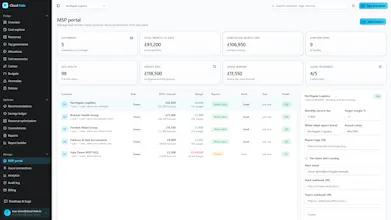
📊 MSP portfolio view - spend, forecast, sync health and margin for every client on one screen.
🔔 Routed alerts - budget thresholds and anomaly spikes go to the right inbox: your delivery team, the account manager, or the client.
📒 Savings ledger - recommendations get an owner and a status; resolved ones track realised savings. Proof for the QBR, not promises. 📄 White-label monthly reports - a nine-section, client-branded FinOps pack generated in one click.
On pricing: flat and public, from £99/mo. Never a percentage of Azure spend - a tool vendor taking a share of your clients' cloud growth felt wrong to us, so we didn't build it that way.
We're early. UK-based, self-serve, and we read every reply - feedback about what's missing is exactly what we're here for. What would your monthly Azure cost review need before you'd hand it to a tool?
Report
We've hired MSPs before and the FinOps piece always got murky once usage spiked mid-month. Does the flat pricing hold when a client's Azure spend suddenly doubles, or is that where the model breaks? Also wondering how you surface waste the client's own team would rather not admit to.
Great question, and honestly that murkiness is exactly why we avoided percentage-of-spend pricing.
Yes, the flat price holds if Azure spend suddenly doubles mid-month. A usage spike may create more findings and more urgent recommendations, but it does not become an excuse for us to tax the spike. The only time pricing changes is if the actual scope changes, for example adding new tenants, subscriptions, or a materially different service boundary.
On the “waste nobody wants to admit to” piece: we try to make it factual, not political. Cloud Halo surfaces waste with evidence: idle resources, oversized SKUs, unattached disks, reservation gaps, anomaly trends, dev/test running out of hours, and owner/team attribution where tags allow it. We show the cost impact, confidence level, and recommended action so the conversation becomes “here’s the data and the fix,” not “who messed up?”
The goal is to make FinOps boringly transparent, especially when spend gets noisy.
Report
Love the flat pricing model, that alone sets you apart from the usual percentage-of-spend tools. One thing that would make this even more useful for my MSP: a built-in client health score that rolls up cost trends, anomalies, and savings opportunities into one simple number I can share during quarterly reviews. Would save me from stitching that together manually each time.
Absolutely, that is exactly the kind of MSP-facing workflow we want Cloud Halo to support.
A client health score is on our roadmap: something that rolls up spend trends, anomalies, savings opportunities, tagging hygiene, and risk signals into a simple executive-ready view. The goal is to make QBRs easier without flattening the detail your technical team still needs underneath.
Really appreciate you calling this out. MSPs should not have to stitch that story together manually every quarter.
Report
Flat pricing is a nice change from the usual percentage models. One thing I'd love to see is a simple CSV or quickbooks export in the savings ledger so my clients' finance teams can reconcile credits without needing another login. Would save a chunk of admin each month.
The savings ledger is meant to be useful beyond the technical team, so CSV export makes a lot of sense. QuickBooks export is something we’ll review as well, especially for MSPs that need to hand clean reconciliation data straight to client finance teams without forcing another login.
Really appreciate the suggestion. Reducing that monthly admin burden is exactly the kind of workflow we want to support.
Report
Being able to push the savings ledger entries straight into a partner's PSA or accounting tool like Xero or ConnectWise would save a ton of manual entry for our monthly client reviews.
That would be a strong fit for the direction we want to take it.
It is not on the roadmap yet, but PSA and accounting integrations like Xero or ConnectWise make a lot of sense for MSPs using the savings ledger in monthly reviews. We are collecting use cases like this now, especially around where automation would remove the most admin without making the workflow heavier.
Report
love that the pricing is flat instead of a cut of spend, honestly that alone would push me to try it over the usual %-based tools. the white-label reports sound really well thought out for MSPs too
Really appreciate that. The flat price was a deliberate choice because the MSP relationship already has enough moving parts without a tool taking a bigger slice every time a client’s cloud bill grows.
And yes, the white-label reports are built around the real MSP workflow: quick to produce, client-ready, and easy to use in reviews without extra formatting gymnastics.
Cloud Halo
We've hired MSPs before and the FinOps piece always got murky once usage spiked mid-month. Does the flat pricing hold when a client's Azure spend suddenly doubles, or is that where the model breaks? Also wondering how you surface waste the client's own team would rather not admit to.
Cloud Halo
@artem_fedorovich
Great question, and honestly that murkiness is exactly why we avoided percentage-of-spend pricing.
Yes, the flat price holds if Azure spend suddenly doubles mid-month. A usage spike may create more findings and more urgent recommendations, but it does not become an excuse for us to tax the spike. The only time pricing changes is if the actual scope changes, for example adding new tenants, subscriptions, or a materially different service boundary.
On the “waste nobody wants to admit to” piece: we try to make it factual, not political. Cloud Halo surfaces waste with evidence: idle resources, oversized SKUs, unattached disks, reservation gaps, anomaly trends, dev/test running out of hours, and owner/team attribution where tags allow it. We show the cost impact, confidence level, and recommended action so the conversation becomes “here’s the data and the fix,” not “who messed up?”
The goal is to make FinOps boringly transparent, especially when spend gets noisy.
Love the flat pricing model, that alone sets you apart from the usual percentage-of-spend tools. One thing that would make this even more useful for my MSP: a built-in client health score that rolls up cost trends, anomalies, and savings opportunities into one simple number I can share during quarterly reviews. Would save me from stitching that together manually each time.
Cloud Halo
@enolo8jf
Absolutely, that is exactly the kind of MSP-facing workflow we want Cloud Halo to support.
A client health score is on our roadmap: something that rolls up spend trends, anomalies, savings opportunities, tagging hygiene, and risk signals into a simple executive-ready view. The goal is to make QBRs easier without flattening the detail your technical team still needs underneath.
Really appreciate you calling this out. MSPs should not have to stitch that story together manually every quarter.
Flat pricing is a nice change from the usual percentage models. One thing I'd love to see is a simple CSV or quickbooks export in the savings ledger so my clients' finance teams can reconcile credits without needing another login. Would save a chunk of admin each month.
Cloud Halo
@yaarbaygn9tcl
The savings ledger is meant to be useful beyond the technical team, so CSV export makes a lot of sense. QuickBooks export is something we’ll review as well, especially for MSPs that need to hand clean reconciliation data straight to client finance teams without forcing another login.
Really appreciate the suggestion. Reducing that monthly admin burden is exactly the kind of workflow we want to support.
Being able to push the savings ledger entries straight into a partner's PSA or accounting tool like Xero or ConnectWise would save a ton of manual entry for our monthly client reviews.
Cloud Halo
@bulemgggg
That would be a strong fit for the direction we want to take it.
It is not on the roadmap yet, but PSA and accounting integrations like Xero or ConnectWise make a lot of sense for MSPs using the savings ledger in monthly reviews. We are collecting use cases like this now, especially around where automation would remove the most admin without making the workflow heavier.
love that the pricing is flat instead of a cut of spend, honestly that alone would push me to try it over the usual %-based tools. the white-label reports sound really well thought out for MSPs too
Cloud Halo
@metehangtcx
Really appreciate that. The flat price was a deliberate choice because the MSP relationship already has enough moving parts without a tool taking a bigger slice every time a client’s cloud bill grows.
And yes, the white-label reports are built around the real MSP workflow: quick to produce, client-ready, and easy to use in reviews without extra formatting gymnastics.