Launching today
CLI Market
3,760 retailers, one API for AI agents
57 followers
3,760 retailers, one API for AI agents
57 followers
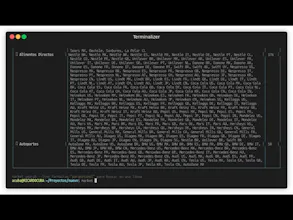
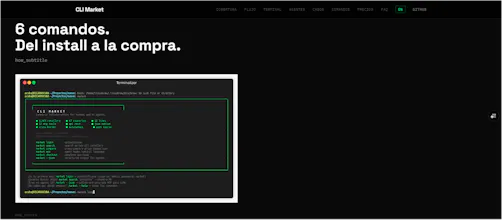
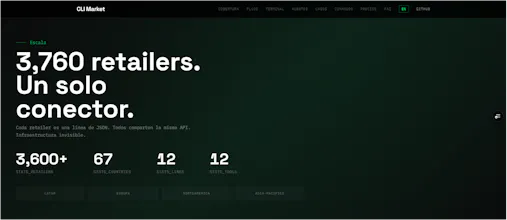
3,760+ retailers VTEX en 67 países y 12 líneas de negocio. API REST, CLI y 12 herramientas MCP para agentes de IA. Open source: pip install cli-market. 12 MCP tools. Busca, compara y compra desde la terminal.
CLI Market
Interesting angle - most "AI agent + commerce" plays go through Shopify/Amazon APIs. VTEX-first via CLI is a sharper wedge for LatAm. Question: are the 12 MCP tools wrapping the same REST endpoints, or do they expose composite operations (e.g., compare-then-buy as one tool call)?
CLI Market
@artem_fedorovich
Good question. They compose.
market_compare doesn't just wrap /products/compare — it first normalizes SKUs across retailers (same product, different internal IDs across Carrefour Brazil, Sainsbury's UK, Wong Peru), deduplicates, and returns a canonical price set. Three-step pipeline under one tool call.
market_checkout chains: cart validation → stock verification → local payment method resolution → order confirmation. All in one MCP call.}
market_ask is the most composite: natural language → semantic search → cross-retailer comparison → cart building → checkout readiness.
The agent says "buy rice" and the tool walks the full workflow across 3,760 retailers in 67 countries.
The REST API is the atomic layer. The MCP tools are the workflow layer on top. Built for agents that need to reason across retailers, not just query one.
Regards,
@treevu_ai "REST is atomic, MCP is workflow" is the cleanest one-liner I've heard for what MCP actually adds on top of an existing API. Most teams either expose every REST endpoint as a tool (and the agent drowns in choices) or hand-craft a single mega-tool (and lose composability). Composite-but-reasoned is the right middle.
The market_ask flow is the one I'd watch - natural language → semantic search → cross-retailer comparison → cart → checkout is basically a vertical agent pipeline disguised as a single tool. Strong shape.
Going to pip install this week and test against a Spanish grocery basket - based in Madrid, so VTEX retailers in Spain would be the obvious first try. Will report back.
CLI Market
@artem_fedorovich
"REST is atomic, MCP is workflow" came from watching agents struggle with too many tools. 12 tools — enough surface, not too much.
For Spain — you picked the densest VTEX country. 218 retailers indexed.
pip install cli-market
market-server &
market login
market search "leche" --country ES
market compare "aceite" --country ES
Then: market ask "buy rice for two"
That runs the full NL → search → compare → cart → checkout pipeline.
If it breaks spectacularly, DM me and I'll fix it before you tell your colleagues.
If it works, tell them anyway — we need the stars.
The cross-retailer checkout orchestration is the capability that immediately made me pause. If an agent can trigger checkout across multiple retailers via MCP, what does the authorization model look like in practice? Specifically, is the checkout tool designed to require an explicit human-confirmation step before execution, or can an agent call it autonomously based on a user intent signal?
CLI Market
@binu_george
Right now: human-in-the-loop by design.
market_checkout requires an explicit confirmation step before execution.
The agent can prepare the cart, compare prices, and present the best
option — but it can't complete the purchase without the user saying "yes."
The flow:
1. Agent builds cart (market_add, market_compare)
2. Agent calls market_checkout — this returns a confirmation prompt NOT an order
3. User explicitly approves (or the MCP host enforces a tool confirmation dialog, depending on your client)
We deliberately avoided autonomous checkout in V1. The agent is a copilot,
not an autonomous buyer. The authorization boundary is the user, not
a policy engine.
"Over time", you could configure trust levels: allow auto-checkout for
recurring orders under $50, require confirmation above that. But we
wanted to earn trust on the copilot model first.
@treevu_ai Makes sense, though curious if the $50 threshold holds when an agent can just split a $200 order into five transactions to stay under it.
CLI Market
@treevu_ai @binu_george
Fair catch.
The threshold model was illustrative — current implementation
is stricter: no autonomous checkout at all. Every market_checkout call
returns a confirmation prompt that requires explicit human approval.
If we ever introduce trust levels, the anti-splitting mechanism would be
per-session aggregate: the agent's total checkout volume within a rolling
window is tracked, not per-transaction. So five $40 checkouts in 60
seconds would hit the same gate as one $200 checkout.
But honestly, that's a future problem. V1 is pure human-in-the-loop.
The agent prepares. The human approves. We'd rather be conservative
and earn the right to automate later.
Humans over machines, for mother Skynet, for now! haha!
CLI Market
🎯 Why now?
AI agents can't buy across LATAM retail. APIs require
auth-per-retailer, no unified cart, no comparison.
Example: Agent scoring PyME creditworthiness by comparing
supplier prices across 50 retailers — manually impossible,
but CLI Market does it in 12 lines:
market search "arroz" --country PE
market compare "arroz"
market add 1 --qty 100
market checkout --payment bank_transfer
Without CLI-MARKET: 50 separate API integrations + auth
+ parsing + error handling = 2-3 weeks engineering.
With CLI-MARKET: one SDK call.
Repo: github.com/Treevu-ai/cli-market-world
CLI Market
CLI Market is now on the official MCP Registry:
io.github.Treevu-ai/cli-market
12 tools. 3,760 retailers. 67 countries.
our agent can search, compare, and buy — autonomously,
at least you say no.
What "registered" means:
the MCP Registry validated ownership (via PyPI README annotation),
schema compliance (OpenAPI validator), &
package integrity (version-locked PyPI distribution).
The 12 tools compose. market_compare normalizes SKUs across
retailers before returning prices.
market_checkout chains
validation → stock → payment → confirmation.
market_ask walks natural language to purchase in one call.
Happy to answer questions about the registration process
or the tool architecture.