Hey Product Hunt Tony and Steven here from ClawTeams.
Three days ago we launched ClawTeams, the first goal-driven, proactive AI team for e-commerce. We hoped for a warm welcome. What caught us off guard was how much the comments themselves would end up teaching us. We landed at #1 Day Rank, crossed 800+ points, and picked up over a thousand followers but honestly, the questions in the thread have shaped our roadmap more than any planning doc we wrote before launch. So I wanted to write down what we heard, what it changed, and where we're headed.


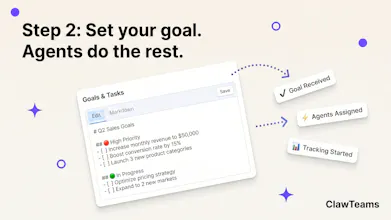


The goal-driven framing makes sense for e-commerce where outcomes are measurable. What I would want to understand before running this on live inventory: when multiple agents work toward the same goal — say, repricing aligned with a marketing campaign — how do they coordinate? Is there a shared workspace where agents see what the others have done, or do they operate independently and a supervisor layer reconciles outputs before anything gets pushed to the store?
ClawTeams
@noctis06 Great question — and coordination is exactly where a lot of multi-agent setups fall apart. It's the supervisor model: agents don't push to your store independently. The Team Lead maintains a shared workspace where every specialist's output is visible, and it reconciles conflicting actions (e.g. a repricing move against a campaign discount) against your goal and guardrails before anything goes live. So repricing and marketing stay in sync rather than fighting each other, and store-facing changes only happen after that reconciliation step — with high-stakes ones waiting for your sign-off.
This is the first AI tool that actually feels like hiring a team, not just another assistant. Told it "optimize our Amazon listings" and the AI lead broke it down, assigned specialists for copy, keywords, and images, and they all worked in parallel. No more me playing project manager for 5 different AI tools. The Slack-native workflow means I don't have to learn another dashboard. Some tasks still need human eyes, but for the grunt work, it's a massive time saver. Free tier to test it out.
ClawTeams
@rick_borduur This is exactly the experience we were aiming for — you as the goal-setter, not the project manager juggling 5 tools. Love that the copy, keywords, and image specialists ran in parallel for you, and that being Slack-native meant no new dashboard to learn. Really appreciate you taking the time to test it and share this. 🙏
Huge congrats👏 to shipping. one que what happens if the team lead agent runs into a direct roadblock like an API returning an expired token error from a connected store? does it flag a human immediately in discord or try to self-heal?
Ada.im
@priya_kushwaha1 Great question, and it's exactly the kind of edge case we designed for early on 🙏
Short answer: it's a two-step process, not either/or.
When the Team Lead agent hits something like an expired token from a connected store, it first tries safe, reversible self-healing steps — retrying the auth flow, refreshing via the stored refresh token if available, or falling back to a cached state so nothing downstream breaks silently. If that resolves it, you just see a quiet log entry, no interruption.
But if it's a hard blocker — like the store literally revoked access or the refresh token itself has expired — it won't keep guessing or "pretend" to make progress. It immediately flags a human in Discord/Slack with the specific context (which store, which action was blocked, what it already tried), because re-authing a store connection is exactly the kind of "high-stakes, needs-a-human" moment we don't want an agent silently working around.
The core design principle is: agents can act autonomously on reversible, low-risk operational stuff, but anything involving credentials/access or irreversible actions always surfaces to you first. We'd rather have a slightly noisier Discord than an agent that "self-heals" its way into doing something you didn't approve.
Happy to go deeper on this if you're curious — this kind of failure-mode design is honestly where most of our engineering time went pre-launch.
@stevencen Love the "zero micromanagement" vision! 👏
You mentioned that high-stakes decisions wait for human approval in Slack/Discord. How granular are those safety guardrails? For instance, can a seller set custom approval rules—like automatic sign-off for minor ad budget tweaks, but requiring human approval for price changes or launching new campaigns?
ClawTeams
@franz_briones Love that you zeroed in on this! Yes — the guardrails are granular and fully configurable. During setup you define custom approval rules per action type, so you can, for example, auto-approve minor ad budget tweaks under a threshold you set, while requiring human sign-off for price changes or launching new campaigns. These are 'once-for-all' controls — you configure them once when assembling your AI team, and the Team Lead respects them from then on. Defaults lean conservative (anything touching credentials, irreversible actions, or spend above your limits always surfaces to you in Slack/Discord), and you can loosen or tighten from there.
The one-sentence setup is especially appealing for ecommerce. Starting with rough product information and asking for a complete listing package feels far more natural than building a workflow first.
Ada.im
@nicole_h94 Exactly—starting with the outcome should feel more natural than designing the workflow first.
Congrats on launching! "Zero micromanagement" is a bold promise for a multi-agent setup - how do you handle the failure case where one specialist agent goes off track? Does the team lead catch it before it reaches the customer, or is there a human-in-the-loop checkpoint?
ClawTeams
@medal411 Great question, thanks! Quick clarification on 'zero micromanagement': it doesn't mean no oversight — it means you don't have to assign tasks to each agent or check their quality one by one. The Team Lead agent drives toward the goal and coordinates the specialists for you. If a specialist goes off track, the Team Lead monitors output against the goal and catches drift before it reaches a customer.
The key controls happen up front: during setup and when you assemble your AI team, we provide easy-to-use dashboard settings. These are 'once-for-all' guardrails — you configure them once, and they ensure the team executes safely and exactly to your requirements. Anything high-stakes or customer-facing still hits a human-in-the-loop checkpoint in Slack/Discord for sign-off, while low-risk, reversible steps run autonomously.
How are budgets set and enforced across a long-running project with multiple agents working in parallel?
Ada.im