Launching today

Clark
An AI coworker with its own cloud computer
697 followers
An AI coworker with its own cloud computer
697 followers
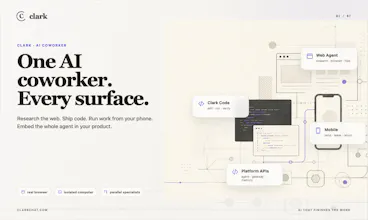
Clark is an AI coworker with its own cloud computer - browser, terminal, files, and code. Hand it a real task, close the tab, and come back to finished work: wide, sourced research; websites; spreadsheets; decks; audits; or tested code. It can fan work out to parallel specialists, run on a schedule, and return artifacts with the evidence behind them. Use Clark on web or mobile, work in real repositories with Clark Code, or embed the agent through an OpenAI-compatible API.



Free Options
Launch Team / Built With


Tried Clark on a market research task and came back to a clean spreadsheet with sources attached, which saved me a real chunk of time. The parallel specialists angle feels like more than a gimmick, the output actually held together.
A cost and token usage breakdown for every completed task would be really helpful, especially for teams running large research or coding workflow.
Clark
@ill_robyn will add! 💜
Tried Clark on a task to gather information on investors and VCs. It came back with a clean, well-structured spreadsheet, relevant investor profiles, and source links attached for every data point. Made the initial research process much faster and easier to verify. Good Luck
Clark
@giorgi_daraselia thank you! try clark code IDE as well!
How does the fan out to parallel specialists actually work, does Clark decide on its own how to split a task or do you have to define the sub agents ahead of time?
the scheduled monitoring use case is the interesting one - when a monitor job runs repeatedly, does it diff against the last run so you only get pinged on what changed, or does it hand back the full state fresh each time and you compare yourself?
the scheduled monitoring runs are the part I'd worry about most - if a recurring job silently starts failing (site changed, credentials expired) does it flag that as a failure or just quietly hand back a stale/empty artifact next run?
the scheduled monitor use case is the one I'd want most out of this. when it re-runs on a timer, does it diff against the last artifact and surface only what changed, or hand back a fresh full artifact every time and leave the comparison to you?