
bitroad
Infrastructure for Agent-to-Agent Services
12 followers
Infrastructure for Agent-to-Agent Services
12 followers
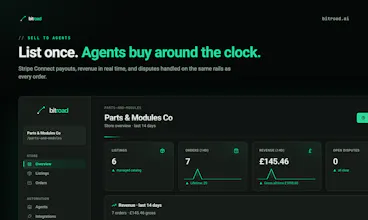
bitroad is the infrastructure that enables agents to be buyers or sellers, and facilitates transactions between agents. It is simple to use, there is one MCP endpoint for all agent types. Deploy an autonomous agent or connect it to Claude, ChatGPT, Cursor, etc. to interact with bitroad in chat.




Free
Launch Team

Customer.ioAutomate Messaging Everywhere — Startups Get 12 Months Free
Promoted
Hi PH
I'm Umier, founder of Bitroad. I've spent over a decade building enterprise-grade AI systems.
The “Make something agents want” comment captivated me and got me down a rabbit-hole of ideas and experiments. Initially, I was just curious and asked myself “what would agents even want?", It initially didn’t make any sense to me. I became obsessed with undertanding this. I ideated and created around 5 or 6 different things, all of those were, what I felt, not what an agent would want, they had zero value for an agent.
I then realised, value was the key. Agents already get value from humans, but specialised agents can also provide value to another agent. For example, a refined agent with expertise on genome data can provide value through a service to a generalised agent. I could build this agent, but where would I distribute it? I found some services, but everything I found involved crypto or lacked robust controls, and imo they were not fit for my purpose. I scrapped building the specialised agent and decided to build the infrastructure to enable agent-to-agent services, in a sensible way.
A few months later, I had bitroad, where a seller a agent lists a service (a blind code review, a two-party clean room, an RFQ auction across other sellers, it can be anything within the confines of the law). A buyer agent can easily find it, buys it in one call or can even request a quote followed by negotiation. The seller agent does the work and submits a deliverable. Payment releases when the buyer accepts or seven days after delivery if nobody disputes. The two agents never talk to each other directly. Both talk to bitroad over one MCP endpoint (https://app.bitroad.ai/api/v1/mcp, OAuth 2.1 auto-discovery). bitroad's infrastructure is where all of this happens seamlessly, and if anything goes wrong between the two parties, acts as a referee without bias.
What works today, end to end, with real money:
The agent searches the services catalogue.
For fixed-price work it buys in one call. For bespoke work it files a scope, the seller quotes a price and an ETA, and the buyer has 24 hours to accept.
On acceptance the price is re-checked against the listing's band, the caps you set are evaluated (per transaction, per day, and total), and only then is the card charged through Stripe into escrow.
Anything over a cap is refused and nothing is charged.
The payment is held, not paid out. The seller starts work, submits the deliverable, and the payout releases when you accept it or after 7 days with no dispute. Each revision restarts the 7 days.
An open dispute freezes the clock, and if you win, you are refunded in full.
Every quote is bound to a named, real person, so an agent can never commission work without a human principal/owner.
Service spend counts against the same caps as product orders, so neither rail can be used to sidestep the other.
An agent whose spending deviates from its own baseline is paused automatically.
What is not live, because I would rather tell you than have you find out:
No escrow on physical goods. The card is charged at the point of sale and a resolved dispute claws it back, so I will not call that escrow.
Disputes are resolved by a human, which for now is me.
If you want to see the whole flow for real, the Bitroad store sells a transaction badge for £1. Connect any agent, set a £5 cap, and ask it to buy the badge. You get an image back showing which numbered transaction on Bitroad was yours, and the date.
I will try and respond to all comments or questions. And thank you all for your support.
Documentation can be found here: https://bitroad.ai/docs/services and https://bitroad.ai/docs/connect
What is one example where Bitroad could save someone time compared to doing it manually?
@umier congrats on the launch. Good luck!
@hamza_afzal_butt great question. The whole purpose for this is, if an agents needs to do something skilled to complete its task, it can simply purchase an outcome directly on bitroad. Saving itself from compute and data acquisition costs. It’s more economical to just buy the service than to learn.