
BestDefense.io
Pentest and patch every deploy with AI
237 followers
Pentest and patch every deploy with AI
237 followers
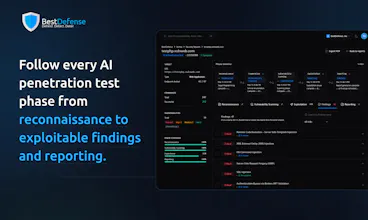
AI attacks don’t wait for your next sprint. BestDefense continuously pentests every deploy, proves which vulnerabilities are actually exploitable, and generates fixes so high-compliance SaaS teams can patch real risks before remediation windows close. Unlike static scanners, BestDefense validates exploits through execution, cuts false positives, and helps developers move from finding issues to fixing them faster.






Free Options
Launch Team / Built With


Tines The single, secure environment for agents, apps, and automations.
Promoted
BestDefense.io
BestDefense helps teams continuously test, understand, and remediate web application and infrastructure risk from one dashboard.
We built it because security is still too expensive, fragmented, and manual for many startups, SMBs, MSPs, and lean engineering teams. Most tools either scan, report, load test, or suggest fixes. BestDefense connects those steps: validate your site, run automated security and scalability tests, review clear findings, and use AI-assisted remediation to move from vulnerability to fix faster.
For Product Hunt: use code PHLAUNCH30 for 30% off your first month plus a free onboarding/security posture review.
@derek_foster5 Spend enough time on the compliance side and you learn fast that a scanner screaming about 400 "criticals" is worse than no scanner, everyone tunes it out by week two. validating through actual exploitation to cut false positives is the whole value prop. nice to see exploitability scored instead of just severity.
BestDefense.io
@david_mchale , our thoughts exactly. Remediation windows are shrinking horribly so we want to give people a leg up to have a fighting chance.
Appreciate you taking a look at what we have!
Most automated pentesting platforms completely choke on complex authentication loops, like a multi-step login with a specific oauth provider. qq to@derek_foster5 can we record a login sequence flow via an extension or session token setup to let the agent past the login wall?
BestDefense.io
@priya_kushwaha1 great question!
There are two authentication options which may interest you:
Puppeteer: you can write your own script, validate it works, and plug it into the test configuration
AI Assisted: you can write in plain english the steps to perform a successful login into your application as if you were speaking to a QA person.
We provide examples in the platform that you can use as a baseline for each of those options.
Thanks @derek_foster5 the AI-assisted login option looks promising for complex OAuth flows. I'll give it a try. 👍
@priya_kushwaha1 thank you for your support! Please don't hesitate to reach out if you have any questions.
The part I'd want to understand before trusting this on every deploy is the patch side. When the AI generates a fix, what stops it from quietly changing behavior or introducing a regression while it closes the hole? Is there a verification loop that re-runs the original exploit against the patched build to confirm the vuln is actually dead? That feedback loop feels like the whole ballgame.
BestDefense.io
@peterdigitalis there are a few measures that we take for this.
We identify traceability, no dead code updates, patches are intentionally built using the specific framework;
You have two paths for fix confirmation; either rerun the same full test against the same target, or 'replay' a verified exploit individually without running a full spectrum test. Security regression testing.
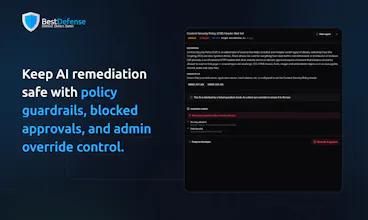
Leverage our guardrail mechanism to prevent risky changes to critical parts of the code base
@peterdigitalis, that's a great question!
It's up to you how you want to set up the verification phases, but when it implements the fix, it takes a scalpel approach. (Smallest possible change to fix the problem). This leads to changes being more atomic commits and easier to digest if you choose to have a human do a formal review after your existing smoke and regression tests pass.
After the fix has been merged into a deployed environment or applied to a local Docker environment, you can rerun the exploits to verify closure.
The system was built to be a seamless addition to your existing CI/CD pipeline or SDLC process.
Please feel free to check out our Free trial of the system. We would love to hear any feedback on ways we can improve our solution.
To infinity & beyond!
@daniel_baddeley Makes sense, and the replay-the-verified-exploit path is the one I'd lean on — re-running the exact PoC against the patched build is the only thing that actually proves the hole is closed rather than just looking closed.
The guardrail on critical paths is smart too, that's usually where a "fix" quietly breaks something downstream. Curious whether the regression suite catches behavior drift, or justdoes the old exploit still fire" — those feel like different questions. Either way, nice work.
The auth flow is where this gets real. For AI-assisted login, I’d want every run to leave a receipt: test account used, scopes, destructive actions blocked, and the proof that made a finding exploitable.
Otherwise the fix is useful, but hard to trust in a compliance review.
BestDefense.io
@blah_mad we cherish governance in this environment. You'll always know who ran what, why, and when
@blah_mad That is a great mindset to have! Complete auditablility and visibility into what's going on for complete accountability. We have all of those things layered into our audit logging; they're also visible when you compare multiple reports across different environments (user access levels, etc). Please don't hesitate to reach out if you have any questions.
I've been using BestDefense.io for a few weeks now, and I'm impressed with how seamlessly it integrates into our CI/CD pipeline. The automated pentest feature is a game-changer - no more tedious manual testing or waiting for human experts to review our code. The AI-driven patching process has also saved us a significant amount of time and effort.
What I'd love to see next from the team is better integration with our existing monitoring tools, such as Prometheus and Grafana. This would allow us to get a more comprehensive view of our application's security posture in real-time. Has anyone else had experience with this?
BestDefense.io
@demi_tan that sounds like an excellent roadmap integration! What kind of metrics would you hope to capture?
@demi_tan, we appreciate your support and feedback!
This looks interesting. Does it matter what architecture the deployment runs on? So, for example, a web, desktop or mobile application.
BestDefense.io
@iamjoshade nope you can run this against anything accessible on the internet... after you prove target ownership of course!
@iamjoshade, that's a GREAT question!! The platform was designed to be agnostic to the development setup or runtime environment.
does it connect with gitlab?
BestDefense.io
@marc_vuit it does!
We are currently looking to double our Integrations this quarter as well
@marc_vuit great question! I believe it can do self-hosted as well...