
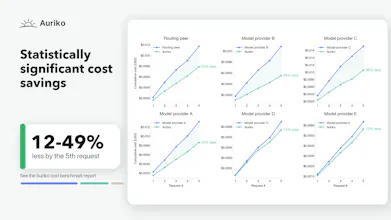
Auriko treats LLM providers as trading venues and arbitrages the spread. Built by ex-quant traders, Auriko’s cost-arbitrage engine calibrates to each user’s request patterns and selects optimized inference paths based on token price, cache behavior, latency, reliability, and request quality. Auriko benchmarks show average 30% cost reduction against industry peers and direct providers. See the source: https://www.auriko.ai/reports/llm-cost-arbitrage




Love the “trading desk for LLM calls” framing. Cost optimization across providers is becoming a real pain point as AI apps scale.
How do you balance cost savings with output quality and latency, especially for production workloads?
@longway1 Thanks for the question Kevin! Our data engine actively tracks model performance - latency, throughput, reliability, etc. The routing engine computes a composite score for each available route.
Users can choose preset routing strategies depending on what matters most for a workflow, like cost, TTFT, or throughput. Power users can also set custom routing weights for more fine-grained control.
@thys_beesman Thanks and great question! It's both.
The routing engine decides where the llm request should go before it is sent. For each request, Auriko builds the eligible provider set, applies hard constraints like capabilities, data policy, budget rules, parameter support, and availability, then scores the viable routes accounting for expected cost, latency, throughput, capacity headroom, and cache economics. The cost model accounts for provider-specific prompt caching mechanics and the workload’s reuse patterns, so routing is based on expected request-level economics, not just static model prices.
We then feed the request metadata back into our signal generation engine for future routing decisions. This helps us maintain a dynamic and effective awareness of the routing candidates.
How do you measure quality when routing across models? Do you use developer feedback, user behavior, retries, or some kind of evaluation layer?
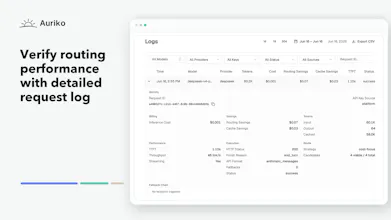
@phoenixhu We measure metadata such as latency, throughput, error rate, fallback, cache-hit and use that to inform our routing engine. And user can check all information in detailed request logs
Congrats on the launch! , Doesn't cheapest-per-request routing fight with caching though? If you hop providers to save on one call you lose the warm cache you built at the last one, and the next 20 calls cost more. Curious if the router accounts for that or just prices each call on its own.
@irahimiam Very sharp question! In a nutshell, we model expected cost across the full session, not just the first request.
For example, a heavy coding-agent user with rapid-fire requests, large context, and long sessions will usually have a very different cache-hit profile from someone running periodic deep research. Auriko calibrates routing against each user’s usage pattern, and that pattern becomes an input to the expected cost computation. So in some cases, our routing engine may choose a provider with a deeper cache discount instead of choosing a provider with the lowest headline token price.
Congrats on the launch!
For teams running agents that have really strict latency requirements, can you set a hard ceiling on response time and let Auriko optimize cost within that constraint, or is it more of a balance between the two?
@abod_rehman Definitely. There are two ways to control this in Auriko.
1. you can set hard constraints, such as a TTFT ceiling. 2. you can use softer control by increasing the weight of response time (TTFT) in the composite routing score. Both affect the routing decision!
How does Auriko handle providers with different caching rules? Some make caching easy to reason about, while others expose less detail. Does Auriko normalize all of that for developers?
@withshawn Thanks for the comment! Our data engine tracks and tests provider-specific behavior like token thresholds, block granularity, read/ write pricing, expiration windows, and pricing tiers.
Auriko also handles the provider-specific steps needed to activate caching where possible, like cache directives, cache keys, or session affinity. Developers still see a normal OpenAI-compatible API and consistent cache usage/saving fields in the response.
The prompt caching focus sounds valuable. A lot of teams know caching exists but do not optimize around it.
@yolo_xiao Exactly. Caching is easy to know about but hard to price correctly, because every provider handles prompt caching differently, and cost is also a function of the user’s request pattern.
If we had a crystal ball and knew the exact content and timing of a user’s future requests, as well as each provider’s exact caching mechanism, we could compute the cost of the same workload across providers and pick the cheapest path. In reality, the problem is much harder because the information is incomplete. The user’s request pattern has to be estimated, and each provider’s prompt caching mechanism has to be probed and modeled correctly. That is where Auriko’s quant-trading-inspired infrastructure comes in, and how we are able to drive around 30% cost reduction.
@yolo_xiao Caching is exactly one of the most important factor in model routing - nice catch!