
Atelier faster runtime for coding agents
25% faster while cutting token costs by 30%-67%
41 followers
25% faster while cutting token costs by 30%-67%
41 followers
One shot to the right code. Atelier is a context runtime and cost-optimization layer for AI coding agents. Instead of passive indexing or simple output compression, it manages the full context window end-to-end — making it 25% faster while cutting cost by 30% (up to 67% on some workloads), audited head-to-head on SWE-bench. It also ships the strongest code search we've measured: 0.727 MRR vs the best of 10 rival tools' 0.557. Works with Claude Code, Codex, Cursor, and any MCP-compatible agent.




Hey Product Hunt!
If you use AI coding agents heavily, you have probably tried tools that promise "efficient context" or big token savings, but still noticed your subscription limits disappearing fast.
I got tired of measuring only tiny slices of the problem, so I built Atelier.
Atelier is a context runtime for AI coding agents. It manages what gets sent to the model end-to-end, with the goal of reducing real task cost instead of only reducing tokens in one step.
The core idea is simple: measure the full workflow.
Across six audited benchmarks — SWE-bench, Terminal-Bench, and real exploration/Q&A workloads — Atelier shows about 30% average end-to-end cost reduction, with up to 67% on some workloads. The full per-task breakdown is public, including wins and losses.
It is not just cheaper either. On SWE-bench, Atelier resolved more tasks than the baseline: +12pp on Verified, +6.7pp on Lite, and +2pp on Pro. So the cost reduction is not coming from simply doing less work.
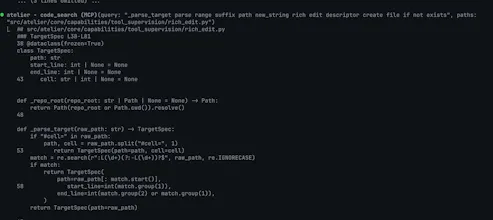
Atelier also includes code search evaluation. It achieved 0.727 MRR against 10 named tools, with the best rival at 0.557, measured on the same ~7,200 queries (15 repos, including linux kernel) instead of a cherry-picked set.
Why it works:
Atelier reduces cost on both sides of the LLM call.
It cuts noisy input by skipping irrelevant context and giving the model what it actually needs. In exploration tasks, this cuts cache-read context by up to 92%.
It also reduces output cost through telegraphic responses (short, no fluff), helping the model respond with less unnecessary text. In Q&A tasks, this reduces output tokens by up to 45%.
The result is a more practical metric: real end-to-end task cost.
the end to end savings numbers are compelling, especially the public per-task breakdown. curious about the other side of the tradeoff though - if it's actively evicting/compressing context that looks irrelevant right now, what happens when something from way earlier turns out to matter again later, like an architectural decision or constraint mentioned once and never repeated? does it ever have to re-derive that, or is some amount of that risk just the cost of the token savings?
@galdayan No information is lost. It is removing those fillter words, even wihtout them we human can easily understand, it is just hard to read. It is Telegraphic style means zero fluff, maximum info. clip articles, drop pronouns, ditch helping verbs, pack core meaning into fewest words.
What matters is the code output and anything important, decisions, security etc they are kept byte identical. Here is the instruction response-economy.
On the input side nothing is lost. It is just one shot give LLM what it needs at that time. More turns it makes to make any decision more tokens it wastes. Every tool calls should result in a decision and every tool call should give llm what it is asking for or want to execute. thats the core of atelier. Give llm what it needs else llm will keep take turns after turns.
@pankaj4u4m good to know important stuff is kept byte identical rather than compressed. one more angle though - that classification of what counts as "important" has to be made at some point, presumably by a model call. what happens if that classifier itself misjudges something as filler when it wasn't, like an offhand constraint mentioned once in passing that turns out to matter three tasks later? is there any recovery path for that, or does it stay lost since the classification only runs once on the way in.
@galdayan #1 if it is only for the model (no human reading it) no information is lost. Telegraphic style keeps every details and looses only fillter words. example: "I am done with the <task>, I have implemented <x> and ran tests and all tests passed" -> "done: implmented <x>, ran <y> N tests passed"
So no information is lost. Nothing from user side compressed wither, input once goes it the LLM stays there forever in that session. So there is 0 risk of loosing it.
Inputs are however compressed (more sort of truncated) but if llm needs full details there is alwasy pointer to a tmp file where the full input is stored.
the SWE-bench results are genuinely impressive, and love that it plays nice with MCP out of the box. one thing that would help adoption on my team: a dry-run mode that shows which files would be evicted or compressed before you commit, so we can see the cost savings in real time without worrying about a bad truncation on a tricky refactor. would make it way easier to trust in production pipelines.
@taner14yy Thanks, feedback taken. I will work on dry-run mode.
Real outputs are never truncated, it is the way llm respond (fillter words, connectors etc) to the user is controlled on the output side. Code or anything important see response-economy.
Major controbutor to the speed and cost are input tokens.
How does the 30% cost cut actually hold up on longer sessions where context grows well past 200k tokens, or is the savings mostly on smaller windows?
@cumatfcj 30% Is only from the benchmarks. Longer the sessions goes higher the savings. Because LLM is not rereading its gargabe tool outputs from all previous turns. Most costs are token accumulations over time, rereading the same cached read.
There are even more room for improvements here claude ships their entire workflow tokens 5k in every sessions, over 100 turns they start costing 50k tokens itself, completely useless when I am not using any workflow feature.
The SWE-bench numbers look legit, nice work. One thing I'd love to see is a local replay mode where I can dry-run a session against a cached snapshot of my repo to compare token spend before and after tuning context strategies. Would make it way easier to convince the rest of my team the savings are real before we wire it into our CI pipeline.
@kuzeyatmac1qeh you can run `/benchmark` which solves same task on baseline and atelier.
If you only want estimates then you can you run `atelier session stats` that will tell you on all your sessions how much saving potentials are. for specific sessions `atelier session report ` or `atelier session stats --limit 1 `
@kuzeyatmac1qeh I am working on it atelier replay to see full sessions dry mode sessions replay.
Plugged it into Claude Code on a refactor I was already dreading and the cost drop was noticeable by the end of the session. The code search results felt sharper than what I usually get with Cursor's built-in.
@enoll4rf Thanks Senol,
It was built with years of hard learned lessons. I wanted LLM to find the right information in one short and at ranked #1 . It clearly reflects in benchmarks.
I like that you're optimizing the runtime instead of the model.
As coding models continue to converge, I think the bigger advantage shifts toward whoever controls context efficiency and execution costs rather than who has the smartest underlying model.
That feels like a more durable layer.
@aryan787544 Thanks. What LLMs now need is claver engineering like we had for distributed systems before the AI wave. Now we need that sort of optimizations in LLM as well.
@pankaj4u4m I agree. What's interesting is that distributed systems eventually developed abstractions that let developers stop thinking about the underlying complexity. I wonder if LLM engineering follows the same path, where the long-term winners aren't the ones with the cleverest optimizations, but the ones that make context management effectively disappear for developers.