
AskCodi orchestrates AI coding, two ways. Talk to Codi, an AI CTO in the Mac app that runs a team of agents and picks the right model for every job. Or call the same orchestration as an OpenAI-compatible API. Bring your own key.
Key features
🤖 BYOK: Claude Code, Codex CLI, and more
🧠 An AI CTO that plans, delegates, and ships
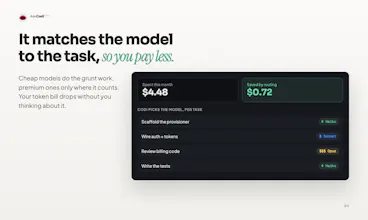
💸 Auto model routing, low cost by default
🗂️ Remembers your whole codebase
🔌 OpenAI-compatible API for any LLM
📊 Analytics and cost controls
This is the 4th launch from AskCodi. View more
AskCodi
Launching today
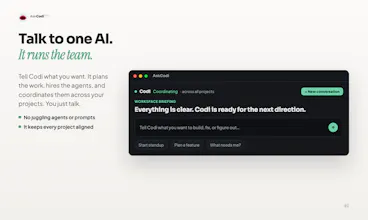
Tell Codi what you want to build. It writes the plan, runs AI agents in parallel across all your projects, and picks the cheapest model that can do each task, so you ship more and spend less. When you add a project it writes the charter and task list itself, and only pulls you in when a decision needs you, through one inbox.



Free Options
Launch Team / Built With


Congrats on the launch guys 🥳! Quick question though I'd usually want to run 2-3 branches on the same repo at once (say a feature, a bugfix, and a refactor in parallel). Does AskCodi isolate that at the branch/worktree level within a single project so they don't conflict, or is the parallelism mainly across separate projects?
MakersClaw
@raunak_bhansali Thanks! 🙌 Great question. Isolation is at the worktree level: each task gets its own branch and git worktree, so a feature, a bug fix, and a refactor never share a working tree or step on each other. Right now Codi runs them isolated and coordinates them rather than firing all three at the exact same instant, and true simultaneous same-repo branches are on the near-term list. Across projects it's already fully parallel.
the auto model routing to the cheapest capable model is the part I'd want to see fail-safes on - if the cheap model starts producing worse output mid-task does Codi notice and escalate, or does that only get caught when you review the final diff?
AskCodi
@sabber_ahamed Definitely, it is tricky to design failsafes mid task. So how we have do it is each agent works with the task in breakpoints with Codi supervising along the implementation. Plan and PRs are already reviewed by Codi.
@shreyans_assistiv breakpoints as the checkpoint unit is a clean answer - keeps a human-reviewable diff at every stage instead of trusting one giant autonomous run.
AskCodi
@sabber_ahamed it has to be the basis of any autonomous long running agentic system
Congrats on the launch. The “AI CTO on your Mac” angle is strong, especially the inbox as the main interface instead of another control room.
The part I’d want to try is how it handles an existing messy codebase, not a clean greenfield project. Can Codi build a useful feature map from a repo with older decisions, inconsistent patterns, and half-finished work, or does it need the project to be fairly well-structured first?
AskCodi
@aditya_harish_2002 It's actually pretty good at mapping repos, I have personally tried mapping 3 of my messiest projects with multiple repos and it covered what I built better than what I could explain
Do give it a try and let me know what you think of it :)
Honestly
congratulations on the launch! What is the differentiation here between AskCodi and me instructing my agents to run in parallel while using the most optimized models for a given task in Cursor or Conductor? In my mind I just create a skill about this but I could be missing something.
AskCodi
@scott_davidson_jr It would be still per project, you would have to still manage atleast one agent per project. Fine at one, starts causing issues as you start working on more. This is not just multi tasking, this is a freelancer on steroids. Plus we have built in systems which actually remove you as a bottle without going off rails. Of course you could build out this system will skills, but skills are still suggestions for agents in long loops.
Do you currently run a multi agent auto model system in Cursor or Conductor? Last time I saw someone's stats, autorouting was still 98% opus. Would love to learn more.
Scarlett.
How does Codi decide which model to route a task to?
Is that automatic or do I configure it?
AskCodi
@byalexai So all you need to configure are the providers - anthropic models through claude code, openai models through openai codex and rest of the models on the market through askcodi gateway.
Model selection is auto by codi based on the best model to complete the task with as much saving as possible. Routing is always of today's performance of the model. So on the day of launch Sonnet 5 would definitely be better than Opus 4.8.
MakersClaw
@byalexai To add one detail: your provider setup defines the pool Codi can choose from. Within that pool, Codi looks at the task type, required capabilities, cost, and current model performance. The selected model still has to satisfy the task’s acceptance criteria and review checks, so routing is not based on price alone. If a task turns out to be more complex than expected, Codi can move it to a stronger model.
Holy Sh*t! I love this! Is this currently limited to Claude or can I use any LLM?
AskCodi
@sm0r3ll It works with claude code, openai codex and rest of the models on the market are served through askcodi gateway at provider api prices. BTW loved your reaction :D
AskCodi
@ankita_singh27 We have a few things built in that improve output quality while reducing cost. Codi acts as both a supervisor and reviewer for the other agents, and it also routes each task to the most cost-effective model using our routing algorithm. The routing doesn't rely only on benchmark scores - it also considers recent model performance and task difficulty. So instead of defaulting to Fable or GPT-5.6 Sol for everything, it'll often choose models like GLM 5.2, Kimi K3, or MiniMax M3 when they're sufficient. Across our benchmark suite, we've seen roughly 50% lower inference costs with only about a 0.5% drop in task completion.