
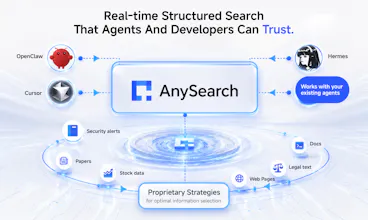
A search tool for agents, not a search box. AI agents are only as good as the information they receive. When connected to AnySearch, your agent gets filtered, de-duplicated, and structured information from trusted sources searched in parallel, helping it produce more reliable results. Free to start.


This feels like it came from actually using agents, not just chasing AI hype.
@eexlkuang_se yes,make agents open their eyes
@eexlkuang_se Bingo. We built AnySearch with real agent workflows in mind, not just AI hype. The goal is to make search work the way agents actually need it to — more reliable info, cleaner context, and results that are easier to use in the workflow.
@eexlkuang_se We’ve built and used agents ourselves, and AnySearch came directly from that experience.
Once agents move beyond demos and start doing real work, search becomes one of the biggest bottlenecks: stale information, noisy results, weak attribution, and messy context. We felt that pain first-hand, so we started building AnySearch as the retrieval layer we wished our own agents had.
The part that stands out is filtering duplicate results and SEO content first.
@nicole_h94 definitely
@nicole_h94 Yep! AnySearch uses its retrieval and ranking pipeline to filter out low-quality, duplicate, and SEO-heavy content.
Given that a significant amount of low-quality content can rank highly on Google, having an agent that can accurately distinguish and prioritize high-quality information is essential. How do you ensure that poor-quality content is effectively filtered out, while only reliable and valuable content is selected and integrated? And congratulations on your launch!
@charlenechen_123 Thanks for comment. We have resolved these issues through algorithms, I think the content in the Gallery can answer your question.
@charlenechen_123 Thank you! And yes, that’s one of the core problems we’re trying to solve.
We don’t rely on ranking alone, because high-ranking does not always mean high-quality. AnySearch looks at a mix of signals: source type, originality, freshness, relevance, duplication patterns, and whether other credible sources support or contradict the same claim.
A big part of the work is reducing obvious noise: ads, SEO farms, repeated copies, and pages that look optimized for ranking rather than usefulness. But we also try not to over-filter, because sometimes a niche source can be valuable even if it is not a big authority.
So the goal is not “hide everything except one perfect answer.” It’s to give agents cleaner, structured evidence with attribution and confidence signals, so they can reason from better inputs and still know where the information came from.
Congrats on the launch @trahant! Filtering SEO spam before it hits the context window is the underrated part, most agents are one bad Reddit thread away from confidently hallucinating.
@vaishnavi_goel Exactly, that's the part we're proud of. One bad info can suddenly break the result your agent gives. Let us know how it works for you!
@vaishnavi_goel That’s one of the core reasons we built AnySearch. Agents and AI workflows need trustworthy, structured information, not just more links. We’re working to help filter out low-quality signals before they enter the context window, so agents can reason with better inputs and hallucinate less. Would love for you to try it!
The "searches trusted sources in parallel" detail is what caught my attention, most agent search tools are still doing sequential calls and the latency compounds fast in multi-step workflows. Curious how you handle source conflicts when parallel results return contradictory information on the same query: does AnySearch surface both versions with their respective sources, or does it resolve the conflict before handing structured output to the agent?
The de-dup is the part I'd poke at. When two of your trusted sources report the same fact but genuinely conflict, does dedup collapse them into one clean answer, or does the agent still see they disagree? In my runs, the moment I hid source disagreement to save tokens the agent got more confident and more wrong at once. A structured 'these three agree, this one dissents' beats a single merged result for me. How do you decide what's a duplicate versus a real conflict?
Finally gave this a spin with a small research task and was honestly surprised how clean the results came back, already sorted and grouped so my agent didn't have to do the busywork.
@azatv0rh Thank you for support, AnySearch is so necessary for agents.