
AllergyTJ
Live pollen risk & air quality for 30 cities in Tajikistan
6 followers
Live pollen risk & air quality for 30 cities in Tajikistan
6 followers
AllergyTJ is a free, open source pollen risk and air quality tracker built for Tajikistan. Uses an inference-based model: a seasonal calendar for 9 allergen species, adjusted with live weather from Open-Meteo and satellite-based air quality from EU Copernicus CAMS. Covers 30 cities, 5-day forecast, interactive regional map, personal allergen profiles, shareable daily snapshots, push notifications, and daily Telegram updates. Trilingual: Tajik, Russian, English. No sign-up, no tracking.

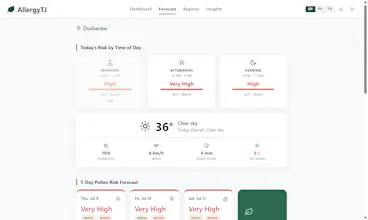


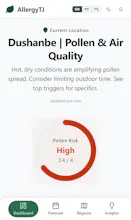


Hi Product Hunt! I'm Eraj. I built AllergyTJ because I wanted a pollen and air quality tool designed specifically for Tajikistan, and nothing I found was tailored to its local flora, geography, and languages.
To my knowledge, dedicated pollen monitoring infrastructure doesn't exist in Tajikistan yet, so the app uses an inference-based model: a seasonal flora calendar for 9 allergen species, adjusted with live weather and satellite-based air quality data from EU Copernicus. It's transparent about being an estimate, not a measurement.
A few things I'm proud of:
- Trilingual (Tajik, Russian, English), reflecting how people in Tajikistan communicate day to day
- Covers 30 cities across all five regions, with pollen timing adjusted for elevation differences
- Daily automated updates posted to our Telegram channel (https://t.me/allergytj), the platform most widely used in Tajikistan
- Personal allergen profiles: select your specific triggers and get a personalized risk score alongside the general one
- Push alerts for pollen, UV, and air quality with customizable thresholds and quiet hours
- No frameworks, no bundler, A+ on Mozilla HTTP Observatory, installable as a PWA
- Fully open source on GitHub
The Insights tab is a full reference section: which allergens are active right now, a 12-month pollen calendar for 9 species, cross-reactivity between pollen and foods (Oral Allergy Syndrome), how elevation shifts bloom timing based on Hopkins' 1918 Bioclimatic Law, regional vegetation profiles, an air pollutants guide with WHO guidelines, AQI methodology, and an honest limitations section. Tried to make it a genuine knowledge base, not just a data dashboard.
Would love feedback on the UI, the risk model, or ideas for improving accuracy without ground sensors. Happy to answer questions!