
AgentLoop
Starts a fresh Codex worker and critic every cycle
92 followers
Starts a fresh Codex worker and critic every cycle
92 followers
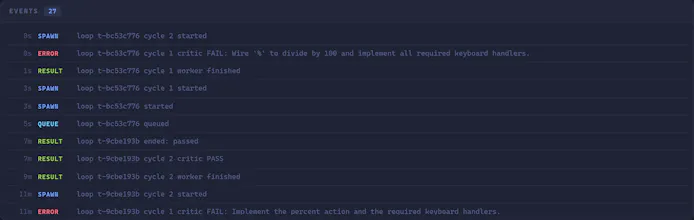
Unlike long-running agent chats, AgentLoop starts a fresh Codex worker and critic every cycle. Set the goal and GUIDELINES.md rubric once; workers build, critics test, and failures become concrete fix notes for the next clean context. Project files carry the memory. Runs stay local, sandboxed, observable, and cancellable from a live dashboard, with ChatGPT control through MCP. Polish mode can continue beyond PASS until the critic says SHIP. Open source and zero-dependency Node.js.




The project-files-as-memory idea is the interesting part for me.
I’ve hit the opposite failure: too much chat context making the agent less reliable.
Which type of work has shown the biggest quality jump so far
bug fixes or multi-file features?
@yusuke_matsuba Bug fixes, easy, not even close. If I can write the pass condition as one line in a checklist file, the critic has something real to check and it just converges. Features work too, but only as well as I break the plan into steps.
The context thing you're describing is actually why I built this the way I did, instead of one long chat holding everything, each cycle is a clean session that just reads the current state from a file, so it never drags the old context along with it.
The fresh worker + critic loop is the part I'd want to test first. Long agent chats usually get weird after a few context turns; using project files as memory feels cleaner, but I'm curious how you keep the critic from becoming the bottleneck on larger repos.
@xiaosong001 Yeah, context management is the whole game here, kept that in mind building this.
For larger repos, critic reads GUIDELINES.md, PLAN.md, and the files, nothing else. So tight rubric, narrow read, fast critic. Vague rubric on a big repo is where it becomes the bottleneck. No repo-size cap built in, the rubric doing the narrowing is the design.