Webhound builds long-running AI research agents that scale quality with time and budget. Our agents can create either structured datasets or fully cited research reports.
This is the 3rd launch from Webhound. View more
Webhound
Launching today
Research has no natural finish line. An agent can spend ten minutes or ten hours on the same question, and both answers can look finished. Webhound lets you choose how much work the question deserves. Give it a question and a dollar budget. It follows leads and checks weak claims until the budget is consumed, then returns a cited report or sourced dataset with the sources and working documents behind it. Run Webhound yourself or call it from your agent through MCP or the API.


Free Options
Launch Team / Built With


Webhound
Hi Product Hunt, I’m Moe, the founder of Webhound. I’ve worked on AI research since 2023.
I started Webhound because research agents have a stopping problem.
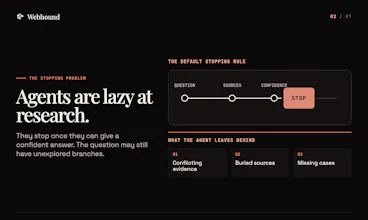
A coding agent can stop when the tests pass. Research has no equivalent finish line. An agent can spend ten minutes, two hours, or twenty hours on the same question, and each answer can look complete. Research agents tend to stop once they have enough evidence to sound confident.
You still do not know which leads they skipped, where sources disagreed, or whether another hour would uncover the fact that changes your decision. The agent makes that stopping decision for you.
Our thesis is that budget should be a research primitive. In plain English, your prompt tells Webhound what to investigate. Your dollar budget tells it how much work to put in and caps what you can spend. At our current rate, $5 funds about 75 minutes of research.
Search finds sources for the query in front of it. Research reads those sources and follows the leads they reveal. One source can change what Webhound needs to search for next.
You get a cited report or sourced dataset, along with the sources and research notes behind it. You can inspect how Webhound reached its conclusions and where the investigation still has gaps.
Extra budget must earn its cost. We judge a larger run by the useful evidence it adds and whether that evidence improves your decision. Extra length does not count.
You can run Webhound in the app or use it behind Codex, Claude Code, Cursor, Manus, or your own software. Your agent can hand off a question, continue working, and retrieve the finished research later.
New accounts include one $5 Report or Dataset. There is no subscription.
I want blunt feedback on the core idea: does a dollar budget feel like a useful way to control how much research gets done? Do the sources and research notes help you decide what to trust?
If you have a question where missing information could cost more than the research, leave it below. We’ll run a few in public today.
dollar budget as the stopping primitive is a genuinely clean idea, most research tools just stop when the output sounds confident rather than when it's actually verified. one thing I didn't see covered - when two sources genuinely disagree on a claim and the budget isn't there to fully resolve it, does the final report surface that disagreement explicitly, or does it pick a side (majority source, more authoritative domain, etc) and present one answer? for a cited research tool I'd actually want to see the unresolved conflict called out rather than smoothed over
Webhound
@galdayan Thanks for asking, this is something we feel very strongly about. Yes, Webhound surfaces the disagreement. It will usually try to resolve it by checking primary records, publication dates, methodology, and independent evidence.
If it does find one source more credible, it gives its conclusion and explains why, while still surfacing all the conflicting information it found. If the conflict remains unresolved, it shows both sides and marks the claim as uncertain. You can click into any claim to see each source that contributed to it, the evidence it contributed, and the caveats.
Really like the "onboarding should be an MCP endpoint" framing — that serial next-step pattern is clean. One edge case I'd be curious about: if the health check passes but step 3 of 5 fails on a config mismatch, does the endpoint expect the agent to retry from that step, or restart the whole sequence? Partial-failure handling in a multi-step handshake like this seems like it'd need its own design pass separate from the happy path.
Webhound
@m_abdullah_ai Good question. The onboarding endpoint gives the agent a structured brief with the steps, checks, and completion criteria. The agent handles the execution.
If a configuration check fails, the agent reads the error, fixes the mismatch, reruns that check, and continues. It would only revisit an earlier step if the change invalidated something it had already completed. Agents can handle that recovery when you give them clear instructions and the right tools.
@mfkhalil That makes sense — treating the agent as capable of self-correcting mid-sequence rather than needing a rigid retry state machine is a cleaner model than I expected. Good luck with the launch.
the budget-as-stopping-primitive idea makes sense to me. curious about the opposite failure mode though - what happens when a topic just doesn't have much written about it, like an internal process at a small company or something too new to have coverage. does it recognize early that more budget won't surface anything and stop, or does it keep spending trying to find sources that don't exist? that seems like the case where the dial wouldn't actually save you money.
Webhound
@omri_ben_shoham1 Good question. Today, Webhound continues until the budget is used unless you stop it. A few failed searches do not prove that nothing exists; we’ve seen apparent dead ends break after multiple failed approaches.
It changes tactics instead of repeating the same search. If evidence remains sparse, the report shows what it tried and flags the lack of evidence as a limitation. For private topics, you would need to give it access to the relevant internal sources.
Moe, blunt feedback on the core idea: the dial only works if I can calibrate it, and I cannot. I do not know whether my question is a one dollar question or a fifty dollar one, and by your own answer to Freya the fourth or fifth lead is often where the apparent dead end breaks. That means people systematically underfund exactly the questions that deserved more work.
So the output I would want is not only the report, it is what another five dollars would likely buy: how many leads are still open, how many claims are still marked uncertain, which of them the run considered load bearing. That turns the budget from a guess into a decision I can make again with information.
It matters more on the MCP path, because there the caller is an agent and nobody is sitting there to feel that the answer arrived thin. Does the run return that unfinished state as structured data, or does it only live inside the report?
Webhound
@clemente_lopez1 Appreciate the blunt feedback. I completely agree: a budget dial is not useful if choosing the number is still a guess.
This was a problem in earlier versions. Webhound now returns structured completion recommendations over MCP: what remains unresolved (if anything), what it could investigate next, and suggested follow-up budgets. It also surfaces them on the UI. The user can decide whether another $5 is worth it.
Budget as the stopping rule makes sense, especially when another agent is waiting on the answer. The trust layer I’d want is a short handoff note: what was checked, what was intentionally skipped, and which unresolved claims could change the decision if someone spends another hour.
Webhound
@krekeltronics Totally agree! Both the MCP handoff and the web app include the output, working documents, claims, sources, limitations, and structured completion recommendations with suggested follow-up budgets. The end user can see what remains thin and decide whether more work is worth the cost.
How does Webhound decide when to stop digging deeper versus continue researching, especially for open ended or ambiguous topics?
Webhound
@aymi_malik Good question. Research stops whenever it reaches the budget you set, rather than when the answer first sounds complete.
At our current rate, $1 corresponds to about 15 minutes of research, so a $5 budget keeps Webhound working for about 75 minutes. If the question deserves more work, you can add budget and keep going.