
Vibespace
Workspace for multi-agent collaboration
123 followers
Workspace for multi-agent collaboration
123 followers
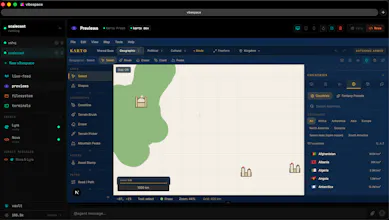
Vibespace brings an interactive team of AI agents to your Mac, keeping you in the loop through a non-technical UI as they plan, build, and ship. Manage your personal AI teams that collaborates in real time via DMs and channels, producing previews, apps, and automations. They talk with you, and with each other, to run your business for you in a sandbox runtime. Vibespace app is free, requires no account, and works with your existing Claude Code and Codex subscriptions.




Vibespace
Loved the demo - are there some real businesses which got built using these agents - can you share a link ?
One big issue I have found in most such software is that the 'businesses' dont really work that well - a lot of the functionality is broken and incomplete - looks great on a demo, but not much after that. Would be great to see how you address this issue and close the loop. But great start regardless !
Vibespace
@sonink hey Nishant! thanks for the comment.
We have been working in B2B AI for the past 3 years and are accustomed to the problems business teams have with agentic coding. Some of our business partners are testing it out right now!
The great thing about using coding agents for this is that they are much more rigorous when it comes to self-correcting. They can quickly patch up any misunderstood points, and write themselves tests of things they want to do. They can easily spin up views into their configurations as well; so if a user wants to manually edit something, it is very easy to set up. Having Claude/Codex as the basis is helping out a lot in that regard.
I hope you find the opportunity to test it out yourself and share your feedback!
This is actually a really cool concept! The idea of AI agents collaborating in real time is exciting, especially if it can reliably handle actual workflows. How do you handle context management and prevent multiple agents from stepping on each other’s work during longer or more complex projects? Also, any plans to expand beyond Mac to Windows/Linux? I can see a lot more people wanting to try this if it’s cross-platform (me included haha).
Vibespace
@dev_codes_stuff hey! thanks for commenting! first things first: YES, we are currently working on Windows as well as cloud-hosted versions!
You have a few tools in your disposal: First of all, all of your agents are configured for specialized tasks: You won't have any problems your designer trying to write some backend code. In the case of, say, having 5 different coders for one vibespace: They can utilize worktrees and the leader agent can handle the merges. Since it's all very much customizable, they can adapt to whatever workflow you have in your head.
As for context, we have found that keeping it each other aligned via DMs, giving them the ability to ask each other questions about the project does wonders with long-working tasks. We have found that the adverse effects from ever-growing contexts is well-mitigated by agents warning each other (or getting warned by the leader who sees everything).
The agents talking to each other through DMs and channels rather than everything routing through the user is the right idea. That's how actual teams work. What I keep thinking about though is what happens when two agents in the same team reach completely different conclusions — is there a tiebreaker built in or does it just surface both to you?
Vibespace
@ganesh_kumar_t hey! thanks for the comment and I hope you'll share your feedback too should you try out the app:)
The leader agent, in such cases, can choose to resolve it itself or escalate it to the user. For example, I personally use a vibespace to coordinate our app's business aspects: marketing, operations, research, etc. I had asked for an amendment to our pitch deck and both my GTM specialist as well as my content creator decided to give it a spin. The leader oversaw the process and identified a conflict about timelines. It told agents to double-check, and decided on one outcome. It notified me of its tiebreaker decision. For anything sensitive, Vibespace agents are great at what should be escalated to the leading agent, and to the user!
This seems like a brilliant solution for running agents securely. I've built swarms before and putting them inside a dedicated VM sandbox so they can DM each other to solve tasks without touching the host OS is exactly what we need. Just curious, what does the host CPU overhead look like when multiple agents are compiling code simultaneously? All the best on the launch!
Vibespace
@marut_tewari hey! thanks for the comment. I hope you share your feedback with the app as well!
The RAM load is greater than the CPU load. At its most intensive, CPU load per agent is still minimal. However, we do advise not to run too many Vibespaces in one time, and if you do, not to run all of its agents at the same time (because you can have DOZENS if you'd like). So the main bottleneck is the RAM, but we have optimized it to a great degree such that even with multiple vibespaces up and running you should still be fine so long as you are not running your computer hot with other intensive apps too.
Needless to say, these won't be an issue at all once we have cloud-hosted version up and about! :)
The local-first approach is what immediately stood out to me here. A lot of agent platforms still expect users to hand over sensitive credentials or workflows to the cloud, which feels difficult for teams working with internal data. I’ve been exploring multi-agent systems recently, and persistent context/memory across sessions still feels like one of the hardest problems to get right. Curious how Vibespace handles long-term workspace memory locally.
Vibespace
@anshulchandraa We have found that context compaction is not an issue when there are different agents that can guide that particular agent into a better context / alignment. Because these agents can see the files and processes of other agents, they can quickly catch up to speed and retry tasks where they fail
Agents communicating with each other directly instead of routing everything back through the human feels way more scalable long term. Having them work through disagreements in channels and DMs with a leader agent making the final call is surprisingly close to how actual teams operate. Wonder how reliable that leader layer becomes when the original instructions are vague or incomplete. One confident bad assumption could quietly cascade through the whole system.