Toki: AI Scheduling & Tasks
Meet your AI scheduling agent that turns ideas into plans
5.0•18 reviews•881 followers
Meet your AI scheduling agent that turns ideas into plans
5.0•18 reviews•881 followers
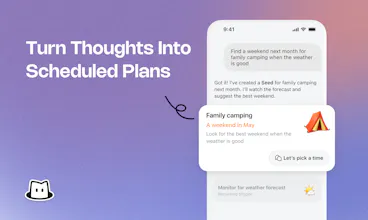
Toki 2.0 is not a calendar. It’s your AI scheduling agent.
It thinks, plans, and organizes your time — before you even ask.
From messy ideas to fully scheduled days, Toki handles everything:
• Plans your schedule intelligently
• Capture early thoughts and turn them into events
• Remembers context and preferences
• Automates actions with triggers
Your time, finally handled.
This is the 2nd launch from Toki: AI Scheduling & Tasks. View more
Toki 2.0
Launching today
Toki 2.0 is not a calendar. It’s your AI scheduling agent.
It thinks, plans, and organizes your time — before you even ask.
From messy ideas to fully scheduled days, Toki handles everything:
• Plans your schedule intelligently
• Capture early thoughts and turn them into events
• Remembers context and preferences
• Automates actions with triggers
Your time, finally handled.


Free
Launch Team


Toki: AI Scheduling & Tasks
We’ll be sharing invite codes throughout the day 🎟️
Each code unlocks 1 month of Toki Super (limited uses per code).
If you’ve been curious to try Toki 2.0 — this is a great time 👀
/get-super 3K1F2HD9
More codes dropping soon ⬇️
@jamieg Thanks! I sent the command to Toki and successfully redeemed Toki Super 🙌
@jamieg How does it learn and adapt to personal rhythms over time, like prioritizing creative work in my peak morning hours while shifting meetings if energy dips?
Toki: AI Scheduling & Tasks
@swati_paliwal Hi Swati! Great question — this is essentially about how Toki learns personal rhythms over time.
We combine a few layers:
First, we start from general behavioral patterns (e.g. typical focus hours, meeting fatigue, cognitive load across the day).
Then we look at your actual calendar history — for example, if we notice you consistently reschedule creative work away from afternoons with heavy meeting blocks, or tend to protect certain time windows, that becomes a signal.
And the most direct layer is explicit preferences. You can simply tell Toki things like “no-meeting Thursdays” or “mornings are for deep work”, and it will remember and apply them going forward.
Over time, these signals stack together — so it gradually adapts to your rhythm, not just generic scheduling rules.
In a sense, you’re really building your personal version Toki!
Product Hunt
Toki: AI Scheduling & Tasks
@curiouskitty Hi Curious Kitty! Great question — this is exactly the kind of edge-case we spend a lot of time thinking about.
Toki doesn’t rely on a single rule to place events — it’s a combination of signals.
We look at:
your past behavior and learned preferences (your personal rhythm over time)
existing calendar constraints and travel time
context like weather, location, and event type (e.g. outdoor activities avoid rain or late-night slots)
general energy patterns for different types of work
On top of that, we’re constantly balancing two things: making the system more proactive vs. preserving user control.
We try to be strongly opinionated in suggestions, but never rigid in execution — users can always override, and we aim to keep decisions explainable when it matters.
Ultimately, the goal is: reduce manual scheduling work, while still making sure users feel they are in control of their time, not the system.
I think the Seed concept is pretty smart. In reality, some of our to-dos don’t come with a deadline, which makes them awkward to put on a calendar—and easy to forget. This app handles that differently. It doesn’t just keep a list of your to-dos; it actually pays attention to your schedule and nudges you at the right time. I’ve seen it suggest using a random 30-minute gap between my meetings to get something done, which is surprisingly useful. That’s something I haven’t really seen from standard to-do apps—they track tasks, but they don’t help you act on them at the right moment.
Toki: AI Scheduling & Tasks
@fleurette Thanks so much for this thoughtful take — you captured the idea behind Seed perfectly.
We’ve always felt that many tasks don’t naturally fit into a fixed time slot, and that’s exactly where they tend to get lost. Seed is our way of bridging that gap by turning those “someday” tasks into something more actionable, based on your real schedule.
Really glad to hear the nudges during those small gaps have been useful — that’s exactly the kind of moment we’re trying to unlock 🙌
Viseal
About the "trigger and track", does it also take care of the tracking part to periodically look for cheap flights in this example?
Toki: AI Scheduling & Tasks
@hwellmake Hi Ji-Ling! Great question — this is exactly where “track” becomes more than reminders but the agent.
In Toki, if you set an intent like “find cheap flights”, it doesn’t just stop at a one-time task. It can actively keep tracking the signal over time and surface updates when something changes (like price drops), instead of waiting for you to check manually again.
So it’s an agent that stays with certain intentions, not just a calendar or reminder system.
We’re still carefully defining the boundaries, but the goal is: for selected intents, Toki keeps monitoring and re-acting in the background.
Feel free to try it out — we’ve shared a one-month Premium code in the comments if you want to explore it more deeply 🙌
Love the idea of going from ideas to scheduled plans automatically. One thing I noticed building Beslisflow: people struggle not with planning but with deciding *what* to plan for. Curious how Toki handles situations where someone is still uncertain about their direction?
Toki: AI Scheduling & Tasks
@youri_grens Love this point — we’ve actually spent quite some time thinking about it as well.
You’re right that the harder problem is often not when to plan, but what to plan for. We experimented with simple suggestions based on time/context, but quickly realized that choices here are deeply personal and need a much richer understanding of the user.
That’s part of what led us to Toki 2.0 — moving toward a more agent-like system that can reason with your intent, context, and past patterns, instead of giving generic recommendations.
Would be really curious how it feels on your side — try asking Toki something open-ended like this. It might surprise you 🙂
(Also dropped a one-month Premium code in the comments if you want to explore more.)
@jamieg That makes a lot of sense — the "what" is deeply contextual and can't be inferred from time slots alone. With Beslisflow I see the same thing: people often need to make a decision before they can even start planning. Really interesting to see Toki tackle that with an agent model. Will try it out with the code!
Very cool concept, I could see this being helpful. Mainly when trying to coordinate between multiple people to make plans. Can Toki work with other members of your family or friends to coordinate based on their schedules and habitual preferences as well?
Toki: AI Scheduling & Tasks
@thealexbattles Hi Alexandra, absolutely — coordination is a core part of scheduling, not just individual planning.
Toki already supports multi-person scenarios today through sharing and invites, so you can coordinate plans with friends or family based on everyone’s availability.
On top of that, we’re actively working on a more seamless coordination experience where Toki can better understand multiple people’s schedules and preferences together, and help surface the “best possible overlap” with less back-and-forth.
This is definitely one of the next big directions for us — more to come soon🚀
I’ve been using Toki for a bit now, and the 2.0 version feels like a meaningful shift. It’s no longer just a place to store my calendar — it actually starts to behave like something that understands what I might want to do next, which changes how I plan my day.
Toki: AI Scheduling & Tasks
@lujjjh Hi Jiahao! Really appreciate you sharing this — this is exactly the direction we’ve been trying to move toward.
The goal with Toki 2.0 was precisely to go beyond “calendar as a system of record” and start acting more like a layer that helps you shape what comes next, not just where things go.
It’s still early, but hearing that it’s already changing how you think about planning your day is incredibly encouraging for the team.