
Soloop
Approval-first Agent OS for solo founders
1K followers
Approval-first Agent OS for solo founders
1K followers
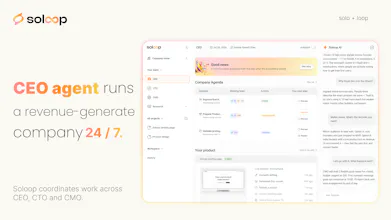
Soloop is an agentic company-building system for solo founders. It takes you from idea to revenue with an AI CEO to plan, manage and prioritize, an AI CTO to build and execute, and an AI CMO to find users and sell. Keep your own judgment and ownership while delegating the unfamiliar work that usually requires a team.





Soloop
Hey Product Hunt,
I’m Wenhao Yu, founder of Soloop.
Before Soloop, I built products at a large tech company. Our team could solve hard product problems, but we spent too much time waiting for decisions to move through meetings, quarterly reviews, reports, and handoffs.
AI coding tools later made it possible for one person to ship a working product. I could build the first version alone, then faced the work code could not cover: choosing an audience, finding users, reading their feedback, and deciding what to build next.
I built Soloop to give a solo founder a coordinated AI team.
You give the AI CEO a company goal. It makes the plan and coordinates the other agents. The AI CTO builds and iterates from user signals. The AI CMO finds potential users, runs distribution, and brings their responses into the next decision.
While building Soloop, we stopped treating each agent as a standalone assistant. Separate assistants left the founder carrying context between chats and reconciling their plans. We organized the team around one company goal and a daily review. Soloop brings decisions that need judgment back to the founder for approval.
Soloop is early, and we want solo founders to shape it with us.
Where does the path between a working demo and a real business break down for you?
Which part would you trust an AI team to run?
Soloop
@michael_vavilov This is indeed a current challenge.
The process of a CMO obtaining feedback to guide iterations involves a very long feedback loop. We remain committed to making this process accessible and visual—lowering the barrier to entry so that solo founders can sustain their efforts.
Soloop
@wenhao_yu @michael_vavilov
Totally agree that distribution and messaging have the messiest feedback loops—this is exactly the space I've spent most of my career in.
Here's the thing though: the noisiness of distribution is why solo founders need AI help there more, not less.
When you're a one-person team, you don't have the bandwidth to run ten messaging experiments, analyze five channels, and synthesize what's actually working. The signal is noisy, sure—but the bigger problem is that you can't even hear the signal because you're drowning in execution work.
Writing copy, scheduling posts, compiling user research, A/B testing landing pages… none of this is strategic judgment. It's just grind.
So the way we think about Soloop's "AI CMO" isn't that it replaces human judgment on positioning or audience strategy—far from it. The human founder still owns the vision and the final call. But the AI can run the experiments, surface the patterns, and bring you the signal so you can make the call in minutes instead of weeks.
@wenhao_yu How do you stop approval from becoming a habit? A founder who approves everything is reading nothing.
Soloop
@peterdigitalis That’s a profound question. I believe judgment should be the last thing humans hand over to AI. If approvals become mindless, we’ve designed it wrong.
I think we’re quickly approaching a future where AI can do anything a person can do. But founders will still need to decide what matters. They will still need to set a direction and stick with it.
The lives we’ve lived give each of us a point of view AI cannot replace.
That’s why we believe in one-person companies, not zero-person companies.
@wenhao_yu Agreed, and here is how to design it right. Approvals should look different by stakes, so a $50 test and a pivot never wear the same UI, and the agent should state what happens if I say no. If declining has no visible consequence, the yes was never a decision. In fraud, my field, every con works by making the yes automatic.
Soloop
@peterdigitalis This is one of the most actionable UX insights I've read today. You hit the nail on the head—especially for GTM and growth strategy.
Approving a $50 ad variant test is a routine calibration; approving a brand positioning shift or a $5k daily campaign budget is a critical decision. They cannot share the same modal.
Showing "what happens if I say no" (e.g., 'Declining means we pause this acquisition channel and save $500, but lose x leads') changes approval from a passive green button into an active trade-off. We are taking notes on this—making UI dynamic based on stakes is officially going into our design focus. Appreciate this brilliant angle!
I designed almost exactly this for my own company — departments instead of loose agents, each with a manager, shared memory, daily reviews. The one place I landed differently is approval. I started approval-first and moved to "execute and report, stop only at what's irreversible", because the approval queue became the bottleneck it was meant to remove. As a solo founder my scarcest resource is attention, and a system that asks me twelve times a day is a slower version of doing it myself. Curious how you're drawing that line — is "requires approval" a fixed category, or does it widen as the founder builds trust?
Soloop
@rodrigo_baigorria Brilliant observation—you’ve hit on the exact friction point of approval-first systems.
As a CFO, I view attention as our most non-renewable capital asset, so micro-approvals defeat the purpose of leverage.
To answer your question: it widens. We don't view approval as a binary toggle, but as a dynamic "trust ladder." Reversible, low-stakes actions (like drafting or routine reporting) shift toward "execute and log," while high-stakes, irreversible actions (capital expenditure, publishing production code, launching ad spend) require hard sign-off. As confidence metrics grow, the threshold moves, keeping founder fatigue low without exposing the business to unbounded risk.
Love how you approached this!
Soloop
@rodrigo_baigorria That’s a very sharp insight! Thank you for your time!!
In practice, we’ve found that many people want to do as little as possible at first. Watching the agents spring into action is almost a show in itself. For many people, that is the first aha moment. Decision quality takes much longer to judge, and many curious users move on before the results have time to show up.
So we’re still trying to find the balance between meaningful approvals and real autonomy. It feels a lot like the tradeoff between reaching more users and finding the right users. We don’t know the perfect line yet, so we’re testing it.
But from a growth and first-time experience perspective, you may be right. I’d love to compare notes again once we have more data.
@qf_meng the trust ladder framing is right, and @wenhao_yu I think your point about the agents in action being the aha moment is pointing at something separable.
What got conflated in my own build was approval and visibility. Early on you need both — the user has to see the work to trust it, and asking permission is part of the show. But they should decay at different rates. Visibility should stay high forever; I still want to read what my agents did yesterday. The gate is what should fall away, and fast. The mistake is tying them together, because then loosening approvals also removes the narration, and it starts to feel like things are happening behind your back — which costs more trust than the approvals ever bought.
So maybe the ladder is time-tiered as well as risk-tiered: same categories, threshold moving with elapsed use, not only with confidence metrics.
Happy to compare notes — I'm shipping my own thing on the 18th, so I'll have fresh data around then.
Soloop
@rodrigo_baigorria "Loosening approvals also removes the narration, and it starts to feel like things are happening behind your back." — You nailed the exact failure mode of most autonomous platforms.
High visibility turns AI execution into a daily executive summary that empowers founders, while friction-free automation scales their time. Decoupling the gate from the narrative layer is brilliant.
Good luck with your ship on the 18th! Let's definitely exchange data—seeing how time-tiered trust impacts active user engagement will be fascinating for both of us.
Congrats on the launch.. Is there a level of autonomy planned to baked in? Also is the product only meant for solo folks - or in future can also accomodate co founders. Last connected issue is that our calendars, emails and usually slack - are filled with discussions and clutter - could those be connected and baked into the plan. Last but not the least -- can real product signals from say feedback widgets, posthog, newrelic/sentry, langfuse traces etc automatically be parsed to create and suggest product stories (sorry having been a PM for so many years - this is something I keep thinking about, product discovery).
Have signed up will try to take this out for a spin soon :-)
Soloop
@himanshu_garg Love these questions—this is exactly the kind of PM-level thinking that makes building this fun.
Quick takes on each:
Autonomy: We're building toward "human sets the direction, AI runs the execution." The bar for when something needs your approval will get smarter over time, but you always have final say. Full autonomy without human oversight isn't the goal—reduced decision fatigue is.
Co-founders: Right now we're laser-focused on solo founders (that's where the pain is sharpest), but multi-person teams are definitely on the roadmap. The handoff and coordination problems get even more interesting with 2-3 people.
Calendar / email / Slack integrations: 100% on the list. The whole point is that your company's context shouldn't live only inside Soloop—it should pull from wherever the work actually happens.
Product signals → product discovery: Okay, this one is the most exciting to me. The idea that real user data (feedback, analytics, error traces) could feed directly into the roadmap and suggest what to build next… that's the good stuff. Our product team has been obsessing over this exact thing.
Really stoked you signed up—would love to hear what you think once you've taken it for a spin. PMs are our favorite users to talk to, no bias at all 😄
Approval-first is the hill I’ve been dying on all year, so congrats, you built my argument.
I’m a solo founder running 25 AI marketing agents, and the two rules that keep that sane are exactly your premise: agents produce drafts, not actions, and when they’re missing information they ask instead of inventing. (Mine once invented an employee named Teri and assigned her support tickets. Approval-first is why Teri lasted one document review instead of reaching a customer.)
So here’s the question I’d ask before subscribing, because it’s where I’ve watched this model strain: how do you fight approval fatigue? At some volume, “approve” stops being a decision and becomes a reflex, and a human rubber-stamping fifty prompts a day is arguably worse than no gate at all, because now there’s an audit trail saying someone reviewed it. Do you do anything structural to keep approvals meaningful: batching, risk-tiering, surfacing only diffs, anything?
Genuinely asking. This is the design problem I think decides whether approval-first scales or becomes approval theater.
Soloop
@tiffany_trboyevich OK. "Approval theater" is such a perfect way to put it—and you're exactly right that it's worse than no gate at all because it gives you a false sense of security. We've had so many internal debates about this.
Here's what we're working on structurally to fight it:
Risk-tiering first. Not every approval is equal. A copy tweak on a landing page? Low stakes, batch it up and show you the diffs once a day. A pricing change or a new feature direction? High stakes, surface it immediately with full context. The goal is that your attention only goes to decisions that actually need your judgment.
Diff-only approvals. You shouldn't have to re-read a whole document to approve one changed paragraph. We show you what moved, why it moved, and let you say yes/no in seconds.
Batching by default. The default mode isn't "ping me for everything"—it's "here's everything that happened since you last checked, organized by what needs your call." You set the rhythm, not the AI.
That said—this is still the hardest design problem we're working on, and we haven't cracked it perfectly. The line between "meaningful approval" and "rubber stamping" is thinner than people think, and it moves as you scale.
Honestly, I'd love to swap notes with you more on this—someone running 25 agents has way more battle scars than we do. Want to chat sometime?
@daidoubledai
This is a genuinely good structure, and the fact that you’ll say “we haven’t cracked it” in public tells me more about the product than the feature list does. One battle scar to add to your tiering model: consider tiering by novelty, not just stakes. The riskiest approvals in my system aren’t the high-stakes ones, because those get my full attention automatically. They’re the ROUTINE ones performed by an agent doing something for the first time. My working rule: any new task type gets full review until it’s produced two consecutive clean rounds, regardless of stakes. Once it’s proven twice, it earns batching. Stakes tell you how bad a miss would be. Novelty tells you how likely one is. You need both axes or the familiar-looking failure walks right through the low-stakes door.
(Ask me how I learned that. His name was a generic mid-market budget template wearing my brand colors.)
And yes to swapping notes, gladly! I launch here on the 18th and my calendar is in lockdown until then, but the week after I’ll have fresh battle scars to share. Grab me then?
Soloop
Hey Product Hunt,
I’m Qingfeng Meng, CFO of Soloop.
I first knew this company as an investor. At Shuimu Tsinghua Alumni Seed Fund, I worked on investments in more than 30 Tsinghua-founded startups. I later worked on global GTM at Zhipu AI. After the fund invested, I crossed the table and joined the team.
Early-stage investing taught me to treat every important decision as an allocation of capital. That capital includes cash, a founder’s time, and the paths given up by choosing one direction over another. Building, selling, and waiting all have a cost.
I measure an AI team by how much uncertainty it removes each week. Soloop helps a founder turn a company thesis into a focused bet, test it in the market, and bring back evidence before making the next commitment. Most AI tools make an individual task cheaper. Soloop aims to reduce the cost of deciding what the company should do next.
That is the vision I joined: a founder with conviction should be able to build a real company without first assembling a large organization.
My job is to help make the economics of that model work. I’d be glad to hear your stories and explore collaborations with founders, operators, and investors building or backing one-person companies.
@qf_meng Congrats on the launch team. How does the tool handle competing priorities between the various c level agents?
Soloop
@zolani_matebese Great question. The way I see it, competing priorities between agents isn't an AI problem—it's a visibility problem.
When you're a founder with a team of people, you walk around the office, you see who's working on what, you overhear conversations, you sense when something is stuck. With AI agents, all of that ambient context disappears unless you intentionally design for it.
So our approach isn't to have some meta-agent that "resolves" priorities top-down. Instead, we built the product so that context handoffs between CEO, CTO, and CMO are visible to you by default.
When the CMO kicks off a landing page test and passes a spec to the CTO, you see that handoff. When the CEO shifts the go-to-market thesis and that cascades into a messaging change, you see the chain.
You don't pick an agent because of their title. You pick the agent whose thread you're currently following—because you can see exactly what they're working on, what they just handed off, and what's waiting on them.
Coming from investing, this reminds me of portfolio management: the hardest part isn't picking investments—it's knowing where your capital is actually deployed at any given moment.
Same here: the founder's attention is the scarcest capital, and the product's job is to make sure you can always see where it's going.
The test I use internally: how much uncertainty does the founder have about what their own company is doing right now? The less, the better.
Soloop
@brent_kilner Spot on. You’ve highlighted a critical transition phase. Right now, our core focus is taking users from 0 to 1 (ideation). However, scaling from 1 to 100—structuring a GTM plan, driving traffic, and optimizing acquisition for an existing site—is exactly where we are heading next.
We are actively building the infrastructure to onboard existing products for this exact purpose. Since you are facing this bottleneck now, I’d love to connect and hear more about your current site to ensure what we're building solves your specific growth hurdles.
Soloop
@brent_kilner Thanks for asking! It’s not available yet, but we’re shipping support for existing products within a week. Then the CMO can build your marketing plan, find users, and help sell what you’ve built.
CapCut AI Suite
I love the concept, but what do you mean by "approval-first"?
Soloop
@lavana_cricko We chose an "Approval-first" architecture. The AI agents handle the execution and handoffs, but they bring critical choices back to you. You supply the vision; they do the legwork.