I have been testing an early version of this and find it really practical and allows me to better understand "who" is behind the website and accelerate our scouting process. What are your plans to extend its functionality over the next few months?
Hi @jd - our roadmap for the next couple of months will first see us double-down on the data; so you'll see us experiment with some new data sources, such as the markets a business operates in, who their competitors are etc. We'll then try and drill down into the fundamentals - we want to make sure sales teams have as much of the right information as possible for researching and qualifying.
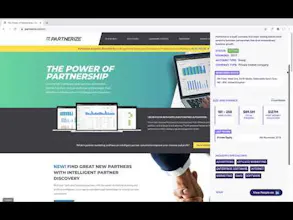
After that, we're hoping to get into the really interesting stuff - how you can use this data to start automating research and qualification; opening Ricochet on any website and knowing immediately if the business fits your customer profile. Once we better understand the (anonymised) behaviour of users, we can then start utilising some of the deep learning models we've developed to automate lead generation and qualification.
I've been trying out the beta of this for a while. Been fascinating to watch the evolution of it. And so useful to get really quick company insights in-browser. Are there any particular tools/services that Ricochet is best suited to work with when it comes to building sales funnels and automations? I'm really guilty of having access to good tools, but not really synching them well in order to make my life easier.
@neilcocker Hi Neil - we haven't build any integrations yet; we've Hubspot on our roadmap, and likely Pipedrive too. There are some interesting possiblities for integrating with services that are great for people information, but in the short-term we're staying focussed on how we make sense of siloed business data.
Excited to see this up on Product Hunt! Sales is super hard, and as a maker, anything that helps you manage the process is welcome.
It's been great following along with the team on your journey building this.
So - what's been the most surprising challenge you've faced around this problem space?
Hey @stef, great to hear from such an inspirational maker!
Personally, I think what surprised and possibly disappointed me, is how long it took me to appreciate how little structure there is at the very start of the sales funnel. The more you investigate, the more everything feels like an edge case:
- There's no right way to do lead generation, and very little best practise
- Customer profiles are subjective, and often determined by instinct or hunch
- Business information is highly fragmented, missing and siloed
It took a long time to get a handle on this, and to distill these subjective behaviours out from the more objective processes of sales engagement, which is where you find marketing automation and SDR platforms.
@paul_a_smith In my experience, whenever I focus on a particular area, there are lots of "surely it's not like this" and "surely technology has solved this problem by now", and in the main, there's still someone cranking away at a spreadsheet solving the problem by hand.
This part - "Business information is highly fragmented, missing and siloed" is particularly interesting, because there have been a few attempts at solving that part. Clearbit springs to mind there. What I find interesting is that you seem to be focusing on more of the human side of the problem here. The data is messy, it will probably always be like this!
A few years back there was a Gmail/Linkedin tool that everyone used until it was bought out (the name escapes me). Did you look at other more tightly-platform-integrated approaches?
@stef sounds like you're thinking of the brilliant Rapportive founded by @rahulvohra. A few people have referred to Ricochet as a Rapportive for business information, which is quite the compliment.
We did consider directly integrating into existing platforms, but they provide their own limitations. LinkedIn is a good example of this; plenty of sales professionals act like LI is the entire universe of business information, when in fact it actually represents a minority; it's a legacy player in a messy space. Choosing that as your starting point feels like you're already compromising your potential.
That's not to say we can't consider integrations where they make sense; one of the features we're really excited to try is actually a Hubspot integration. There shouldn't really be anything surprising or new in something like a CRM integration, but it touches on your previous point; there's a problem we keep seeing in the sales workflow that involves back-and-forth between tabs and manual entry, multiple times an hour. We initially assumed it'd been addressed but it hasn't, so we're going to try solving that and see what happens.
Report
Awesome job @paul_a_smith and team! This will be an awesome productivity tool 👌🏻 What are your post-MVP plans?
Hi @petejsc - for the next few weeks, we'll be doubling down on improving the quality of data, so making sure we're not getting tripped up by JS sites, starting to think about non-UK company registers etc. We'll also be introducing some more data sources around markets and competitors, and there's some exploration to do around hiring and location. After that, we'll start poking at some of our plans around automation.
Lots to do, but we're keen to get more signal on some of this from early users before we move on.
Report
@paul_a_smith sounds great, excited to see this evolve 🙌🏻
Hi @daz_lester - we've found during beta-testing that the tool is useful in all commercial settings:
- SDRs doing outbound and needing to qualify new leads
- Marketing managers doing inbound and needing to sensecheck leads before passing them onto BD
- BDRs, AEs and Customer Success managers wanting a quick brush-up on what a business does before contacting them
However, we're intending to focus our data efforts and the automation tools on sales development, which in turn helps us start to automate discovery and qualificaiton.
Lots of folks here have been testing the beta (and seeing great results by the looks of things). What have you learned through that process, and what's changed the most in the product as a result of that user feedback? Also, is there anything where you ignored the user feedback and backed your gut?
Hey @eamonncarey - great question! I'm going to write up what went on during beta-testing another time, because parts of it ran like clockwork, while other aspects radically changed the product.
The biggest change we made was to pull out all the functionality around personal email addresses. The beta version presented a lot of information like emails, but not neccessarily the context, like names or job titles - it's hard to identify non-formatted information at scale without a lot of cleaning up. But without that context, users told us we were missing data from whatever we displayed - so lists of email addresses became "noisy" rather than useful.
To do people data really well - to the point that there are so few gaps that customers don't doubt the credibility of your product - that's a product in itself, or you have to make the decision that you're going to spend your days scraping LinkedIn. More to the point, there's no need for another extension or database that does that - there are plenty already.
So what we took away from the feedback was that unless we executed brilliantly on people information, users would never feel we were doing the job well enough, and always feel Ricochet was broken or missing "obvious" information, so we stopped doing people data altogether.
In terms of trusting our gut, there were a few users adamant we needed functionality around use cases we'd never seen before. I understand how founders get nervous, and start thinking of user feedback as a to-do list of features they must build to keep everyone happy, but we've talked to enough sales teams in the past few months to recognise what edge cases look like, so where stuff didn't fit behaviour we'd seen before, we put it to one side and tried to focus on solving the problems we had plenty of evidence for.
Report
Very cool! Have you got plans to add features for finding individual employees of companies? Perhaps their socials too?
@dannychickenegg Hey Danny, great to hear from you!
We're not going to attempt to do people data in the short-term; it's really hard to do well, and we don't want to start scraping LinkedIn and guessing email addresses - that doesn't feel sustainable or the best way to build value. And we know from experience that if you don't do it consistently well, it looks like you're missing more than you find, and it reflects badly on the product overall.
Since there are plenty of other services and extensions that do people information well, we'll leave them to it, and consider revisiting when we have more time and resource.




The Notion Capital Podcast 01 — Chris Tottman, Co-Founder at Notion Capital
Pollen for LinkedIn
Ramp T-shirts
Pollen for LinkedIn
Year of Colour
Pollen for LinkedIn
Year of Colour
Pollen for LinkedIn
Pollen for LinkedIn
Pollen for LinkedIn
Pollen for LinkedIn
Hired Goons
Pollen for LinkedIn
Pollen for LinkedIn