Launched this week

Privora
Giving brands visibility in answer engines!
10 followers
Giving brands visibility in answer engines!
10 followers
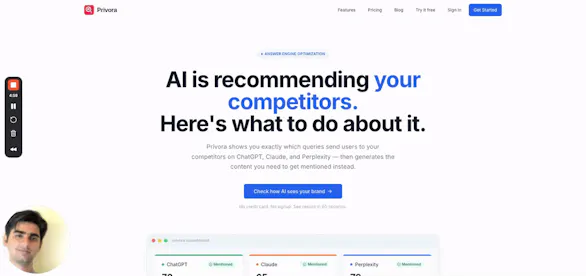
Privora shows you exactly which queries send users to your competitors on ChatGPT, Claude, and Perplexity — then generates the content you need to get mentioned instead. Other tools show you the problem. Privora fixes it. Every AEO tracker will tell you your visibility score. Only Privora tells you the exact content to create — FAQ sections, JSON-LD markup, comparison tables — ranked by how much they'll move your score.



Hi Product Hunters!
I built Privora because I experienced the problem firsthand.
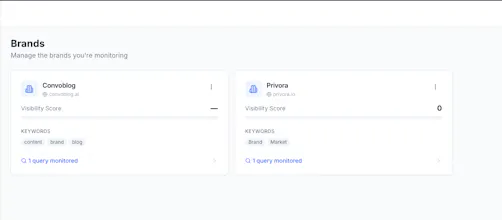
I was launching a product called Convoblog and doing everything "right" — SEO, content, landing pages. Then I noticed something strange: when I asked ChatGPT and Perplexity about my category, they recommended every competitor except me. Worse — there was no way to even know this was happening, let alone fix it.
I went looking for tools. The few that existed would show you a visibility score and charge $300+/mo for the privilege. But none of them told you what to actually do about it. You'd stare at a number and guess. I wanted something affordable but effective for indie developers, solo founders like me who cannot afford a huge team/agency to build up online presence for my brand especially in the answer engines.
The core idea is simple: don't just show the problem, close the gap. Privora queries ChatGPT, Claude, Perplexity and Google AI Overview for searches relevant to your brand, spots where competitors get mentioned instead of you, and then generates the exact content — FAQ sections, JSON-LD markup, comparison pages — ranked by predicted impact on your score.
The approach evolved a lot. I started with just monitoring, but quickly realized that tracking without action is just expensive anxiety. The content recommendations became the whole point.
Free tier is live — you can check your brand's AI visibility in 60 seconds.
Would love your feedback: what queries would you want to track for your brand?
"tracking without action is just expensive anxiety" is a great way to put it, that's the actual gap in most AEO tools right now. question about the measurement side though - since these models are non-deterministic and can give different answers to the same query in different sessions, do you sample each query multiple times to get a stable score, or is one query per check treated as the reading? asking because a single-sample score could swing a lot run to run and make it hard to tell if a content change actually moved the needle or you just got a different roll of the dice.
@galdayan Thank you! That is a great point about the swing! The product right now runs one query per generative engine as I wanted to quickly put it out for feedback. For the next version I am considering some of these and giving exclusive attention to scores. I am considering testing sentiment, repeated runs on generative engines and aggregating scores from them for lesser false positives, etc. Do give it a try and let me know what you think!
@bharathkallurs makes sense to ship the simple version first and see if anyone actually uses it before building out the sampling logic. aggregating repeated runs is probably the right fix once you have real usage data to know how much the scores actually swing in practice. good luck with the beta.
@galdayan Thank You! Please do give it a spin and let me know if you think its fine. I will be continuously updating the versions to keep making ti better. Just wanted it to be out there and keep improving as and when.
This feels like the SEO equivalent for the AI-answer era — brands optimizing for how ChatGPT/Perplexity describe them instead of just Google rankings. How do you measure "visibility" here — mention frequency, sentiment, ranking within a generated answer, or a mix?
@ark_y_k I use mention frequency + ranking and a bit of "appeared first" visibility bonus points scoring for now. Testing sentiment in the beta now and will soon be there in the product. Thank you! Give it a spin and let me know how it feels.
@bharathkallurs Appearing first as a separate signal from being mentioned at all is a smart split — position carries a lot of weight in how people read a generated answer, and a brand buried in paragraph four isn't really winning the query.
Sentiment sounds like the harder half. Models often mention a product accurately but with a hedge attached, and I'd guess "mentioned negatively" and "mentioned with a caveat" need to score differently even though they'd look similar to a classifier. Is that a distinction you're planning to draw, or is it directionally positive/negative for now?
@ark_y_k My current plan has been to accurately score the sentiment behind the product/brand mention in answers in a range from negative 1 to positive 1, negative being on the side of "what people are not liking", and positive the opposite. So the beta testing I am doing right now is exclusively that. How do I ensure the overall score while it contains the sentiment analysis, can clearly predict the score and not vary it or cause a massive swing just based on LLM judgement. So the direction you mentioned is what I am on too.
@bharathkallurs A continuous −1 to +1 handles the hedge case better than buckets would. "Solid, but the pricing is steep" isn't negative and isn't clean positive either, and forcing it into one of two boxes throws away the part a brand would actually want to act on.
The stability problem you're testing for is the right thing to be worried about, and it's a nasty one because the noise isn't random — the same answer scored twice can land differently depending on how the judging model happened to weight one clause. If a brand watches their score drift from 0.4 to 0.2 and it turns out nothing changed except the judge, that's the kind of thing that quietly kills trust in the whole dashboard.
Are you leaning on scoring the same mention multiple times and taking the center, or on tightening the rubric so there's less room for the judge to improvise? I'd guess the second scales better on cost but takes longer to get right.