
Pawesome
Your AI Native Inbound Marketing Engine
106 followers
Your AI Native Inbound Marketing Engine
106 followers
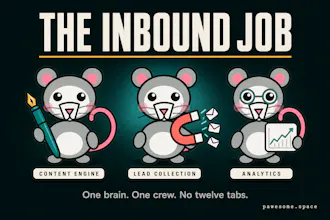
Pawesome is a full AI-native inbound engine for B2B SaaS: Content Engine, Lead Collection, and Analytics, built on a brain that knows your company.
Interactive



Free Options
Launch Team / Built With


Render: Get up to $100K in startup creditsThe fastest way to deploy and scale apps and agents
Promoted
Hey Product Hunt!
I'm Charan. @vidushee_geetam and I built Pawesome because AI made writing cheap but didn't make inbound any cheaper.
You can generate a blog post in twenty seconds. Then you spend the rest of the week on everything else - making it sound like your company instead of the internet's average opinion, structuring it so search and LLMs can read it, sticking a form on it, tagging the click, and guessing which post earned the demo. That's five tools, and none of them know what the other four know. We got tired of being the glue.
So Pawesome starts with memory instead. You feed it your site and a handful of docs once, and that becomes your Company Brain: product, ICP, voice, proof, objections. Everything else runs off it.
Content Engine writes blogs, landing pages and social from that Brain, with SEO and AEO built into generation and a brand and fact check before a draft reaches you. Lead Collection gets you a form in minutes and auto-UTMs every submission back to the post that earned it. Visibility audits what GPTBot, ClaudeBot, Google and the rest can actually read on your site. Whatever performs feeds the next brief.
Honest bit: We're early. Free to start, no card, and a waitlist instead of an upsell when you hit the limit. We'd rather onboard slowly than badly.
If you try one thing, run the visibility check on your own site and tell me whether the score matched what you expected. Those disagreements have taught us more than anything else so far.
Thank you. I'm around all day. Looking forward to interesting questions and comments.
Lead collection + Content creation in the same platform is such a great combination. I just tried out the AI visibility and SEO scores for my website and I did get useful feedback that I can implement on my website right away. However, I can see that SEO is only tracking the content part of the page. Any plans in tracking page speed and performance metrics?
@zoya_aziz - thank you for the thoughtful comment. Yes, we started out with static content analysis for SEO. But you're right - performance metrics also contributes a good share of SEO score. We are working on adding more dimensions of SEO as well as AEO to the product. Stay tuned.
@moh_codokiai - thanks you. Good question. For now, the company brain and positioning and their alignment are user managed. But I see the importance of your question. We have been working towards deriving the positioning and company brain data directly from the website and also from the competition because positioning is always relative. This will help the teams to keep up with the dynamic nature of positioning. Thanks for highlighting this.
@vidushee_geetam Congrats on the launch! The visibility check stood out to me, especially being able to see what Google, GPTBot and ClaudeBot can actually read on a site. Does it show the exact pages or sections each crawler is missing?
@josh_bennett1 - Charan here. I am one of the makers of Pawesome. Currently, the analysis is run on only the single page that the user submits for analysis. But analysing the health of the overall website is a valuable addition to this. Noted. Thanks!
@vidushee_geetam Congrats on the launch! The brain relevance score showing which chunks were actually pulled is such a smart touch. Most AI writing tools just give you a draft and you have no idea if it's grounded in your real positioning or just sounds like it could be. Being honest about low relevance matches instead of hiding them behind a confident output is exactly the kind of thing that builds trust with early users.
Ran the visibility check too and the crawler by crawler breakdown was genuinely more useful than I expected. A single score would've hidden the fact that different AI assistants index your site very differently. Curious how the UTM attribution handles content that gets shared multiple times before someone fills the form, do you track the original source or the last touch?
@better_shaya Appreciate this a lot — especially calling out the low-relevance honesty. That’s intentional.
On UTMs: both. First-touch is stored (so reshared content doesn’t overwrite the original source), and last-touch is captured at submit. Touches currently fire when the form loads; site-wide first-touch would need a page-level tag, which is next if people want it.
Curious what site you ran the visibility check on.
Congrats on the launch, Charan and Vidushee. I ran the AI Visibility check on my own site and it caught real things — it knew my homepage isn't long-form content and shouldn't be graded like an article, and the technical fixes were specific (JSON-LD, single h1, canonical). Most tools just throw a vague score at you, so this actually felt useful.
One small, friendly note as someone building in the same space: the Page SEO tab has a lot of good stuff, but in the first 10 seconds it's a little hard to know where to start. If the top showed just the 1–2 highest-impact fixes first, and let me open the rest below, I think new users would feel the value faster and stick around. Honestly just a polish thing — the depth underneath is already strong.
@saied_alimoradi - Thank you for the thoughtful feedback. Very insightful. Giving everything the user needs to prioritise the fixes is the best way of presenting this. Point taken and we are excited to incorporate this into the product. Glad to hear that you are also building in the same space. As a marketer, I know we need all the innovation that we can get. Appreciate your thoughts.
A Slack integration would be huge, getting pinged the moment a high-intent lead lands instead of having to check the dashboard all day. Otherwise loving how the company brain keeps the content on-brand.