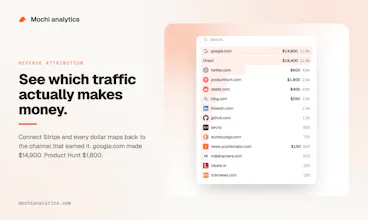
Tying anonymous web traffic directly to your actual revenue without forcing teams to wrestle with enterprise tracking architectures or disjointed data pipelines is an exceptional design choice. Most standard web analytics tools treat a pageview and a customer purchase as completely isolated events, forcing founders into an exhausting routine of splicing CSV spreadsheets just to trace a sale back to its source. Mochi closes this operational gap by natively mapping your Stripe transaction events directly back to client-side referrer strings, delivering immediate, single-dashboard attribution across specific marketing channels—whether it's an organic search, a Product Hunt launch, or a single link buried inside a niche Reddit thread.
Beyond pure financial attribution, packing behavioral heatmaps, conversion funnels, and Google Search Console keyword queries into a single, unified Javascript snippet eliminates massive third-party script bloat. The standout modern detail here is the dedicated AI-crawler logging chart. With modern search behaviors rapidly shifting toward conversational discovery, separating automated LLM scrapers from live human interactions ensures your traffic metrics aren't artificially inflated by background bots indexing your codebase.
Because Mochi’s core ingestion layer operates strictly through a standard client-side script tag, it remains structurally vulnerable to browser-level ad-blocking. If a security-conscious developer or privacy-focused buyer visits your site with aggressive content blockers engaged, the tracking script can be dropped entirely before it boots. When this occurs, the user's initial traffic footprint is completely lost; if they eventually convert, the backend Stripe webhook will still trigger correctly, but it will surface inside your dashboard as unclassified, orphaned revenue with zero structural channel history.
Additionally, the zero-configuration layout is deeply coupled with Stripe's ecosystem. If your application handles monetization through alternative merchant-of-record networks (such as Paddle, Lemon Squeezy, or specialized regional payment gates), the seamless automated mapping breaks down, shifting the data engineering burden back onto you to pipe custom events manually. Finally, tracking multi-touch attribution funnels—such as a user who discovers your product on a mobile device via social media but completes the final transaction days later on a desktop browser—can stress the boundaries of simplified cookie tracking frameworks.
I’ve previously balanced running monolithic setups like Google Analytics 4 (GA4) against lightweight privacy tools like Plausible, or heavy product telemetry suites like PostHog and Mixpanel. GA4 offers near-infinite custom tracking capabilities, but it buries them inside an over-engineered dashboard that demands specialized integration work just to build basic conversion pipelines. Privacy-first alternatives like Plausible or Fathom are beautifully responsive and load instantly, but they restrict their features entirely to surface-level traffic numbers, keeping you completely blind to true customer conversion metrics.
On the high end, developer tools like PostHog or Mixpanel deliver masterful session recordings and event lifecycle analysis, but they demand a high degree of codebase management and can introduce steep volume-based pricing spikes as your application scales. Mochi carves out an incredibly effective middle ground: an explicit, budget-friendly workspace that strips away the structural tracking friction, ensuring lean teams know exactly which specific corner of the internet is driving their actual growth.
For solo developers and indie hackers, enterprise analytics platforms introduce unnecessary pricing stress and overly complex event setup loops. Mochi Analytics delivers a highly practical solution by focusing entirely on essential campaign performance metrics and clear revenue attribution paths. It strips away the configuration bloat, providing lightweight tracking that gives side projects exactly the level of data visibility they need to make strategic iterations without draining their operational budget.
The current core ingestion framework handles standard event paths cleanly, but the platform would benefit from expanded integration documentation for popular backend ecosystems and low code frameworks out of the box. Additionally, adding simple preset webhook triggers for payment handlers like Stripe or Lemon Squeezy would remove manual data tracking configuration steps entirely, allowing indie creators to sync their primary cash conversion metrics even faster.
I evaluated traditional high volume analytics suites alongside specialized attribution setups like DataFast. While established tools offer massive tracking ecosystems, their premium pricing tiers and complex dashboard layouts are completely misaligned with the needs of early stage minimum viable products. I chose Mochi Analytics because it strikes the perfect balance for bootstrapper workflows, keeping infrastructure maintenance low while capturing the exact data vectors needed to identify driving traffic channels.


Parseflow.io
the "which visit became money" pitch sounds great until you hit the reality that most B2B and even a lot of DTC purchases aren't single-touch - someone finds you on reddit, forgets, comes back via google two weeks later, then buys after an email. mapping the dollar to "the channel that earned it" as one line kind of implies last-touch or first-touch under the hood, which is the same oversimplification every attribution tool eventually gets called out for. is this last-touch, or actually multi-touch weighted?
different question from the attribution model debate above - what happens when a Stripe charge gets refunded or charged back after Mochi has already credited it to a channel? does the dashboard retroactively pull that revenue back out, or does the channel just keep the credit for money that didn't actually stick? for subscription products especially, day-1 revenue and month-3 churned revenue can tell very different stories about which channel is actually worth the spend.
How does Mochi handle attribution when a customer signs up via organic search but only converts after clicking a retargeting ad weeks later?
I like the shift from "who visited" to "what actually made money." That's a much more useful question for founders.
One thing I'm curious about: attribution is getting noisier every year with AI assistants, dark social, and cross-device journeys. How does Mochi decide when a revenue source is genuinely responsible versus just being the last visible touchpoint? That distinction seems like where the real value is.
Congrats on the launch! 🚀
Congrats on the launch. I live in PostHog for my own product and honestly most dashboards go unopened until something feels wrong. What makes Mochi get opened on a normal day when nothing is on fire? That habit gap always felt like the real competitor, more than other analytics tools.
Finally connected Stripe and instantly saw which Reddit thread actually drove sales instead of just traffic. Heatmaps in the same view is a really nice touch.