Launching today

LemonLime
Automates your existing workflows with a single prompt.
115 followers
Automates your existing workflows with a single prompt.
115 followers
LemonLime lets teams automate their workflows in minutes with a single click. It connects to your existing tools, studies your business, and self-creates specialized AI agents and automations that support your team. Don’t know where to start? LemonLime helps with that, too, automatically surfacing suggested automations that you can implement with a single click.


LemonLime
PicWish
@jordanlemon what happens when tool APIs change or data structure shifts in connected apps like Linear? does it flag drift or auto adjust the agent?
The per-business adaptation is the right instinct, but it's also the thing that bites at scale, and I say that as someone who built custom AI implementations before productizing. Every bespoke automation you ship is a maintenance liability the day an underlying API deprecates an endpoint or a model update shifts a prompt's behavior. Ten custom builds is fine, a few hundred and you're spending all your time patching drift instead of onboarding. How are you keeping the per-customer customization from turning into per-customer upkeep? Some shared automation core underneath, or is each one genuinely hand-built?
LemonLime
@dipankar_sarkar Yep, you're onto it. Good catch. We came from customer consulting as well, and pivoted because we realized so much of the work upfront was actually just finding and organizing things, the "company brain" buzzword being used. This is the shared automation core you're talking about, which acts as the roads for which our cards (agents) can operate much more effectively for them.
Foyer
"Single prompt" automation is an interesting promise, but the hard part is usually the step after the prompt, where the tool has to understand the actual shape of your workflow well enough to not break it when an edge case shows up. Curious what "existing workflows" means in practice here. Are you parsing something structured like a Zapier chain or a documented SOP, or is it inferring the workflow from a freeform description the user types? Those are pretty different problems, and the second one gets messy fast.
LemonLime
@fberrez1 There's two things that happen here, so I'll share both.
First, it's inferring the workflow from the context it's able to gather from your existing tools.
For example, let's say there's around 5 emails that go back and forth when your business closes a customer. Somewhere in there, there's a written proposal, and somewhere past that, you include a social media mention announcing the partnership/sale.
Once you've connected your tools, LemonLime is going to pick up on this pattern, with greater strength and accuracy the more tools connected (partially because it's better able to differentiate between repeat patterns and one-off work). So, the next time a sales lead comes in, LemonLime is basically going to propose "here's what normally happens in a sales flow, I already know your language, what we should be pushing for, and what to include in the proposal." Then, if everything looks good, you can literally click a single button and it'll follow through. This is the self-learning, self-creating side.
For people looking for more control or building new automations/flows that don't already exist or haven't been surfaced by LemonLime, that's where the freeform description comes from. Instead of inferring (which, you're right, can be messy), LemonLime recognizes the difference between taste and measured result, and plans around that. What that means is things that are more subjective will actually come back to the user asking for input, or it'll show them options to choose from. Things that are more objective ("we A/B tested these strategies, and option B is performing best") it's going to make the more optimal decision, and where applicable bounce that decision to you for approval first. Instead of "inferring", it's getting the actual answer.
"studies your business and self-creates agents" is the part i'd want to understand better before committing. most automation tools require you to map out the workflow yourself, so if this genuinely infers what needs automating from how your tools are already being used that's a meaningful step up. what does the study phase actually look at? connected app data, usage patterns, something else? and how long before it surfaces suggestions that are actually relevant to how your team works?
LemonLime
@shubham4real Exactly. That's why we're so excited about this. Mapping out the workflows yourself is a huge pain in the
Our whole goal is to eliminate that, because it's way too much work for busy teams.
To your point, yes, it looks at your connected tool usage, any existing outlined processes (like maybe an uploaded document like "Sales Funnel"), your CRM stepping to determine what funnel might implicitly already look like, etc. The suggestions relevant to your team/role specifically are surfaced immediately upon finishing the onboarding learning period (after you connect your tools, it takes an average of 15-30 minutes to finish studying everything it finds).
Over time, it'll get even smarter (intuitively, because more context/usage helps inform it and create more patterns), but you should get really strong answers on day one. If not, give it more context, it can only see what you show it!
Congrats on the launch! A lot of workflows break down not on the automation logic but on messy, inconsistent inputs. When LemonLime builds an automation around that kind of variability, does it need clean structured data upfront, or is handling that part of what it figures out on its own?
LemonLime
@benjouss Benjamin you win the golden ticket for asking this question. This is my favorite part to talk about.
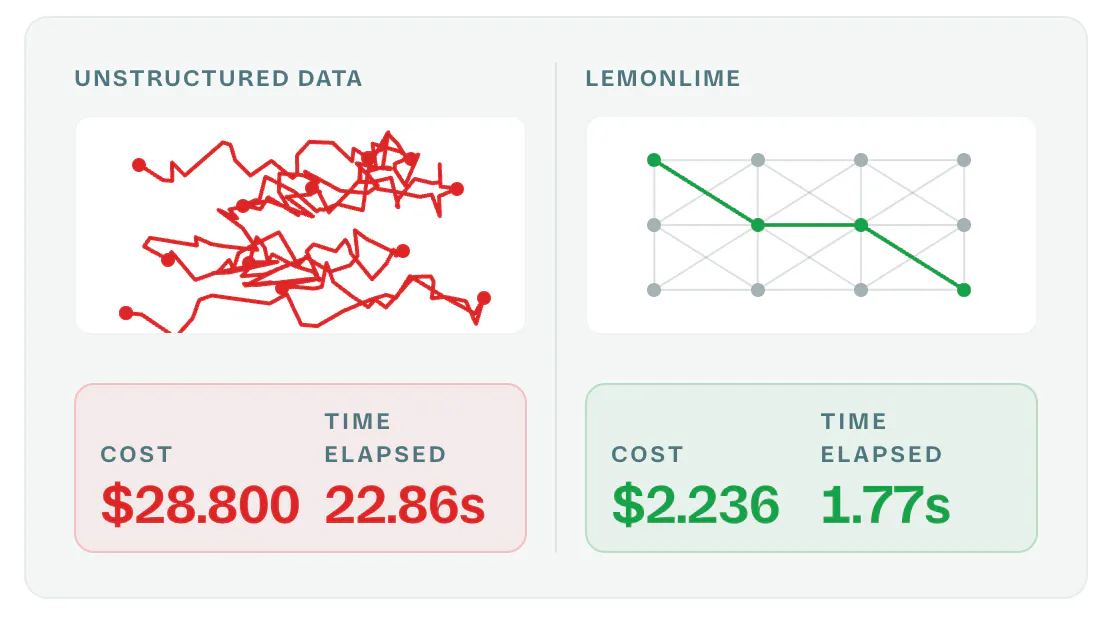
AI completely breaks down on messy inputs. This isn't even the half of it. Data in the wrong format, inconsistency (like you mentioned), missing entirely (hallucination risk), poor efficiency of retrieval/context windows growing (becomes dumber AND more expensive), there's so many issues.
LemonLime's self-creating automations were actually the second step in our product building journey. The first was building knowledge layers that handle these spaghetti cases. Navigating the same amount of data points, structured architecture purpose-built for AI retrieval and reasoning is faster, cheaper, and smarter.
This was one of our biggest learnings from working with so many companies even before LemonLime. Data is messy, and that's killing AI initiatives by harming outcomes and bank accounts. Not ideal.
So, the layer underneath that runs LemonLime is actually a unique knowledge layer built on your company's context. That's what makes deploying automations on top quick and accurate. Your data can stay human (messy), and on the backend, we take care of translating it and "organizing your books" before passing it to your agents.
@jordanlemon That's a great insight, the "knowledge layer" approach makes sense. Out of curiosity, how deep does that translation layer go? E.g. does it handle actual document parsing/extraction (PDFs, scanned files, Office docs) itself ?
I like the focus on adapting to each business instead of forcing a one-size-fits-all workflow. This could make AI much more accessible for startups and SMBs. Congrats on the launch! One question: how long does it typically take for a new customer to get their first useful automation up and running?
LemonLime
@aren_barseghyan Hey Aren!
Yep, you hit the nail on the head. The effect of accessibility in AI (or lack thereof) is accelerating in magnitude. The disparity between those using AI and those without it is going to widen and widen, and the way it's happening right now, I believe we're seeing a lot of massive enterprise companies walking over the small businesses under them, and part of our mission is to bridge that gap. To give small businesses the same metaphorical firepower to succeed and scale with AI that their enterprise counterparts are blowing billions on.
After a new user signs up and connects their tools, it starts an automatic learning period, where we send out a LOT of concurrent agents across all the resources we can to gather as much company specific knowledge as possible. That knowledge then informs the quality and success of the first few automations you set up. Setting up your first automation can vary depending on where the data lives, in what formats, etc, though our knowledge retrieval makes it significantly faster than alternatives (shoutout @dani__munoz).
But, the answer you're looking for: Roughly ~5-10 minutes, or <3 minutes if you let me walk you through it and optimize your LemonLime to get the most out of it for your specifics use cases. And I'm VERY happy to give walk throughs, shoot me an email and we can set one up! jordan@lemonlime.ai
Congrats on the launch!
Most of the AI initiatives I've seen die because nobody owns them after week two. How does your team handle that?
Also, is there an onboarding period before LemonLime is useful, or is it delivering from day one?
LemonLime
@grace_knowhow Hey Grace! Totally, you've got a great point. There's a research study that found 95% of internal AI initiatives fall flat of tangible ROI (it's a 2025 survey, but hey, still a good reference point for what you're talking about).
One of the key points of LemonLime is that it's not designed to be a new tool you have to learn how to use, that's often why we saw things fall flat – if somebody has to own it, that's work, and people don't want additional work, they want less of it. LemonLime connects to tools and self-creates the automations and agents that help you, so you don't have to build a single thing and you can STILL get value out of the product (or at least that's the idea!).
Yep, there's absolutely an onboarding period (during which we deploy a LOT of concurrent agents to do deep research and reasoning on your business, product, industry, competitors, etc), though it's pretty quick, right now it's usually around 15-30 minutes after all tools are connected. So yes to both of those, there's onboarding, but it's still able to deliver from day one.