Recruiters are drowning in resumes and a lot of them end up screening the wrong ones manually (👀 7 seconds per resume, on average!).
So we built AI interviewers S(ai)na to do the first round of interviews for Recruiters. It’s saving teams 20+ hours and shaving off 10+ days in time-to-hire.
We’re already seeing love from early users, now we just want to share it with the PH Community.
This is the 3rd launch from HireHunch. View more

JusRecruit
Launched this week
Cut time-to-hire by 10 to 15 days with AI that handles your first hiring bottleneck. JusRecruit phone-screens every inbound applicant, runs structured AI interviews, and surfaces only qualified candidates. Teams skip low-signal first rounds, free up ~20 recruiter hours per role, and move faster without sacrificing fairness or quality.


Free Options
Launch Team / Built With


HireHunch
Interesting approach to cutting hiring bottlenecks — phone screens are one of the most time-consuming parts of the process. How does the AI handle edge cases where candidates give unexpected or creative answers?
HireHunch
@fairpay Great question. In early screening, most questions are designed to capture structured signals like experience, skills, availability, compensation expectations, or problem-solving approach.
When candidates give unexpected or creative answers, the system doesn’t try to force a rigid interpretation. The responses are transcribed and analyzed for key signals, but recruiters can always review the full response and context.
In many cases those “unexpected” answers are actually useful, because they reveal how a candidate thinks or communicates. The AI helps surface those responses efficiently, while the final judgment still stays with the recruiter.
So the goal is not to over-automate decision making, but to make it much faster for recruiters to review and identify promising candidates.
Automating phone screens and first-round interviews with AI targets the exact stage of the hiring funnel where the most recruiter time gets burned on candidates who won't advance — handling that initial qualification layer frees up human recruiters to focus on the nuanced later-stage conversations where judgment actually matters. The key question for any AI-driven interview tool is candidate experience; how do candidates typically react to the AI interviewer compared to a human phone screen — do you see differences in completion rates or candidate satisfaction scores between the two formats?
HireHunch
@svyat_dvoretski That’s exactly the problem we’re trying to solve. A large portion of recruiter time gets spent on early screening that often doesn’t move candidates forward.
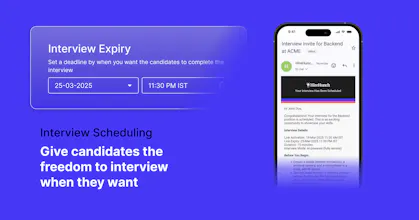
On the candidate side, what we’re seeing so far is that most candidates appreciate the speed and flexibility. Instead of waiting days for a recruiter to schedule a call, they can complete the screening when it’s convenient for them and move ahead in the process faster.
Completion rates have been quite strong, especially when the expectations are clearly communicated upfront. Candidates generally respond well when they understand that this step helps accelerate their application rather than delay it.
We also see this as a complement to human interaction rather than a replacement. The goal is to automate the initial qualification layer so recruiters can spend more time on meaningful conversations with shortlisted candidates.
Candidate experience is definitely something we’re closely tracking and continuously improving as we scale.
Phone screening was always the fastest way to filter candidates, but also where the first connection happened. Some people simply prefer talking to a human — it is how trust starts. Have you seen any pushback from candidates on the AI-led screening, or does the speed trade-off make up for it?
HireHunch
@klara_minarikova That’s a great point. Phone screening has always been both a filtering step and a way to start that first human connection.
What we’ve seen so far is that most candidates actually appreciate the speed and flexibility. Instead of waiting days for a recruiter call, they can complete the screening immediately and move forward faster in the process.
We’re also careful about positioning it clearly to candidates. It’s not meant to replace human interaction in the entire hiring journey. It simply handles the initial screening so recruiters can spend more time having meaningful conversations with the most relevant candidates later in the process.
That balance between efficiency and human connection is something we’re paying close attention to as we continue improving the product.
Trufflow
AI interviews can feel robotic and cause a high-potential prospect to lose interest in a company. Are there ways to avoid this when using an AI interviewer?
HireHunch
@lienchueh That’s a fair point. AI interviews can feel robotic if they’re just scripted questionnaires.
The way we approach it is by keeping them short, conversational, and role specific. The goal isn’t to replace human interaction, but to remove the repetitive screening step so strong candidates reach real conversations with the hiring team faster.
HireHunch
@henry_kojo_owusu Great question. Hiring workflows can definitely get cluttered when candidate volume increases.
With JusRecruit, we try to keep things clean in two ways. First, we automate the initial screening through AI phone screening and AI interviews, which collect structured responses, summaries, and key signals automatically. This helps filter and prioritize candidates early so recruiters are not manually reviewing hundreds of profiles.
Second, JusRecruit also includes a fully functional ATS within the platform. So candidate data, screening results, interview feedback, and hiring stages all stay in one place instead of being spread across different tools. The goal is to keep the workflow simple and organized even as the number of applicants grows.
HireHunch
@henry_kojo_owusu Good point. That’s something we’ve seen happen as well.
In JusRecruit, we handle this by allowing teams to add hiring managers and team members with different access levels inside the platform. This makes it easy to assign ownership for specific jobs, so everyone knows who is responsible for moving candidates forward.
Since JusRecruit also includes a built-in ATS, candidate stages, screening results from AI phone calls and AI interviews, and team collaboration all happen in one place. That way, hiring managers can directly review candidates, give feedback, and take action without things getting stuck between stages.
HireHunch
@henry_kojo_owusu That’s true. Tools can only help if the team actually uses them consistently.
We’ve tried to keep JusRecruit flexible enough that it naturally fits into the recruiter and hiring manager workflow. Since screening results, candidate summaries, and the ATS pipeline are all in one place, hiring managers can quickly review candidates and take action without switching tools.
The goal is to reduce friction, so it becomes easier for teams to stay consistent with the process day to day.
Really interesting, especially focus on removing the bottleneck at the screening stage.
Curious how you're thinking about false positives early on.
HireHunch
@edgeghost False positives are definitely something we think about carefully, especially at the screening stage.
Our approach is to use AI mainly to structure and surface signals, not to make irreversible decisions. Recruiters can still review the full responses, transcripts, and evaluation signals before deciding whether a candidate should move forward.
The goal is to significantly reduce the manual screening workload while keeping the recruiter in control of the final judgment. That helps minimise the risk of strong candidates getting filtered out too early.