
Flowdy
Turn product descriptions into shoppable links automatically
87 followers
Turn product descriptions into shoppable links automatically
87 followers
Turn content into shoppable links. Flowdy uses AI to highlight keywords in your blogs and descriptions automatically. Most readers leave without buying. Flowdy fixes this. When clicked, instant product recommendations appear—boosting conversion without page reloads. Why Flowdy? ⚡ Zero Friction: Shop seamlessly while reading 🧠 Neural Flow: Personalized suggestions based on browsing history 📈 Monetize Content: Track revenue per keyword Turn readers into buyers today.



Free Options
Launch Team / Built With


EneyProactive AI for Mac. Free test, 20,000 credits.
Promoted


Flowdy
Most blog readers leave without buying. I built Flowdy to change this.
The problem:
Merchants write great content, but readers bounce when they're done. That's wasted traffic.
The fix:
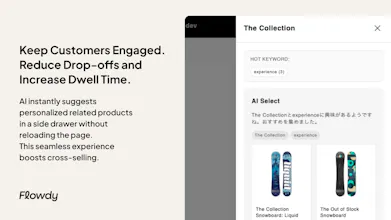
Flowdy auto-highlights keywords in your text. Click → side drawer opens → products appear. No page reload. No friction.
🧠 What makes it different:
"Neural Flow" It remembers what you click. Tap "cotton" → next suggestions prioritize cotton products. Like a shop assistant that learns in real time.
✨ My favorite feature:
Opportunity Radar It scans your store and shows: "This keyword gets 500 clicks/month but has no products linked. You're losing $2,000."
Built solo. Privacy-first. Works with any Shopify theme.
🙏 Question:
Does the "lost revenue visualization" concept resonate with you? Hanging out in comments—ask me anything!
This is a sharp approach—using AI to match keywords in content with products in real time, turning reading traffic into direct revenue. The tech keys are:
Accuracy of keyword extraction (avoid turning the page into a "hyperlink jungle")
Compliance of the recommendation model (balancing privacy vs. personalization)
Front‑end performance impact (especially layout shift and scroll smoothness)
If executed well, this could be an efficient monetization tool for content sites. Waiting for public performance benchmarks and an integration demo.
Flowdy
@nancelu
Sorry for the late reply!
Thanks for the detailed feedback.
You're right — keyword accuracy and front-end performance are really important. I've tried to make it configurable in the dashboard so it doesn't turn into a "hyperlink jungle," but I'm still learning and improving.
Your points are really helpful. I'll keep working on it. Stay tuned!
PurrrrrFocus Pomodoro
This is a really thoughtful take on content → commerce.
The “lost revenue visualization” idea actually resonates a lot — not because of the dollar amount itself, but because it makes an invisible problem suddenly concrete.
I also like that the interaction stays in-context (no page reload, no popups). Curious how merchants react to seeing those missed opportunities for the first time — motivating or overwhelming?
Flowdy
@louis_chen5
Thank you!
The revenue loss visualization was intentional—merchants need to see impact, otherwise the app feels pointless.
That's why we show them what they're missing.
If there are only a few potential keywords, it's manageable. But too many can overwhelm merchants—"this is too much work to set up." So we use AI purely as a suggestion layer with one-click activation.
My hope is: easy setup → relevant products appear → sales increase → merchants feel motivated to keep going.
The Opportunity Radar really stands out to me. Quantifying missed revenue instead of just showing “analytics” feels like the difference between Interesting data and actionable urgency.
Curious how merchants typically act on it—do they manually link products once they see the gap, or does Flowdy suggest matches automatically over time?
Wow, Flowdy looks amazing! Love the idea of zero friction shopping right in the blog. How well does the personalized suggestion engine adapt to very niche product categories?
Flowdy
@jaydev13
Thank you! Great question! Flowdy is actually designed to excel with niche
categories. Unlike AI-driven tools that guess what to show, Flowdy lets
merchants control exactly which products appear through keyword-tag mapping.
The merchant knows their niche best—so they set keywords like "organic cotton"
or "handcrafted leather," link them to product tags, and only those productsappear.
AI assists by suggesting keywords and optimizing display order, butthe merchant stays in control.
This "AI as assistant, not autopilot" approach means niche stores get precise,relevant recommendations without generic AI guesses.
Kudos on your launch. As a founder, this resonates. Content often drives intent but not revenue.
Making lost opportunities visible feels like the right thing.
Flowdy
@anupamsingh0211
Thank you so much!
Hearing that from a founder means a lot to me as a developer. You nailed it with "intent but not revenue"—bridging that exact gap was my goal. I'm just happy if Flowdy can help turn those lost opportunities into actual growth for merchants.
Build Check
Yeah Kosuke! Making it easier than ever cause I see that problem. Blogs aren't made to convert and it's a big mistake. Luckily you're helping a lot with Flowdy and I'm sure many founders gonna see the same. All the best!
Flowdy
@german_merlo1
Thank you! I'm really happy to hear that.
I felt that pain deeply too. I also realized that most recommendation engines focus too much on past history rather than the now.
I wanted to capture the immediate "heat" (intent) generated by the blog content and descriptions.
Your comment is incredibly encouraging! Thanks again!