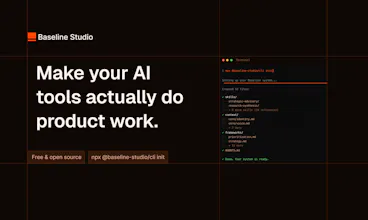
Hey. I'm launching Baseline Core tomorrow. It's a free, open AI workflow system you install via CLI (npx baseline init). It gives you a complete set of AI skills, frameworks, and context files that actually make AI useful for real work. Would love to hear what you think and answer any questions.




Hey everyone! I'm Trent, founder of Baseline Studio. I research how product teams can work better with AI.
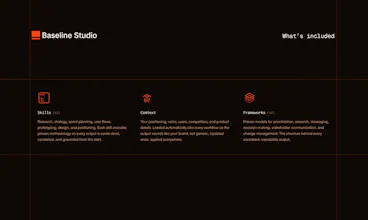
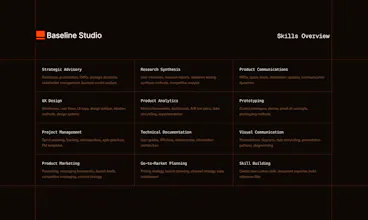
Baseline Core is a free, open-source skills system that wires your business context into any AI tool. You run one command, answer a few questions about your business, and your AI agents can start doing real product work -- research, PRDs, sprint planning, user flows, design, prototyping, positioning, and more.
It works with Claude Code, Cursor, Codex, ChatGPT, Gemini, Windsurf, and GitHub Copilot. Tool-agnostic by design.
I built this because I kept seeing founders and small teams either skip product work entirely or get generic AI output that didn't sound like their business. Baseline fixes that.
Would love to hear what you think. Happy to answer any questions!
@baseline_studio Trent, how flexible is the configuration regarding what exactly gets fed into the context? For example, if I'm making a skill for DB refactoring, can I feed it only the database schema and migrations, ignoring the marketing docs? I want to keep the focus narrow so the model doesn't get distracted or start hallucinating
@baseline_studio Hey Trent. Congratulations on the launch! Are skills represented as prompts, workflows, or state machines? Can skills encode decision logic and thresholds?
Trent showed me this system about a month ago and I've been experimenting with it since then; and my honest take is, this is a great unlock! With this system I have been able to supercharge my claude-code usage (tbh I also got into claude-code because of this system) to the extent where I am effectively only reviewing PRs now! Another thing this has really done for me is unblock me on all the non-technical tasks (like voice and communication or customer profile and positioning) and concretely articulated my ideas and documented them! I am now adapting the @Baseline Core system to fit my exact workflow and exploring how I can build without any employees but with the impact of a team of ten.. That is what this system truly unlocks!!
@isthispalash This is incredible feedback. The fact that you've gone from experimenting with it to adapting it to your own workflow is exactly what the system is designed for. The context layer is what makes that possible. Once it knows your business, every skill gets more specific to how you work. The "impact of a team of ten" framing is something I think about constantly, that's the real unlock here. Not replacing people, but giving a solo founder or small team the structured output that used to require dedicated roles across product, design, marketing, and strategy. Really appreciate you sharing this!
The thing I keep running into with AI coding tools is the context problem - every new conversation starts cold, no memory of past product decisions or constraints. Makes it feel like you're constantly re-explaining your own product. Does Baseline Core persist context across sessions, or is it more of a 'load once at session start' thing?
@mykola_kondratiuk Context doesn't persist automatically across sessions, but the system handles this in two ways. First, for best results you work out of the Baseline Core repo so every session has your full context available. Your business identity, voice, users, competitive landscape, all of it loads through the manifest when a skill runs. So you're not re-explaining your product, the context files do that for you.
Second, for larger work that spans multiple sessions, the system has a session planning framework that scopes deliverables across sessions, defines what context to load in each one, and generates a project plan with handoff notes so continuity survives between sessions.
Also worth noting, Claude just rolled out Auto Memory which does persist learnings across sessions. That pairs really well with Baseline Core since the system handles structured context and methodology while Auto Memory handles the session-to-session continuity.
This is awesome! Does it integrate with OpenClaw? How did you curate the skills?
@dan__cleary Thank you! I haven't used OpenClaw yet, but Baseline is modular by design. The skills, frameworks, and context files are all standalone markdown, so in theory they should be portable into other systems but I'd love to explore that more!
As for how I curated the skills, they come from my experience across the full product development spectrum. Each one maps to a phase of pre-engineering product work that I've done hands-on and refined across client engagements.