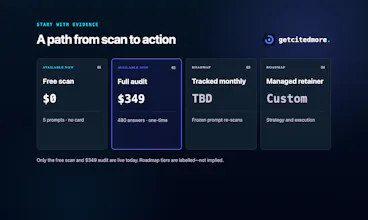
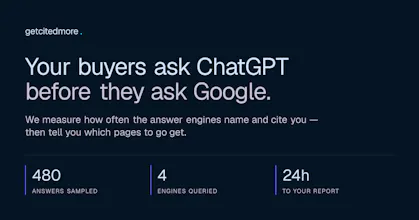
Get Cited More measures whether ChatGPT, Claude, Gemini, and Perplexity name and cite your brand for buyer-intent questions. Unlike a rank tracker, the one-time audit samples 480 grounded answers, maps the competitors and sources winning instead, and returns a prioritized fix list. Start with a free five-prompt scan—no account or card.
Framer AI AgentsDesign and publish professional sites with AI
Promoted
Maker
📌
The problem I kept running into was simple: SEO tools could tell me where a site ranked, but not whether an AI answer named the brand, cited its domain, or built the answer from a competitor’s pages.
I built Get Cited More for B2B SaaS teams that need a decision before they need another dashboard. It asks ChatGPT, Claude, Gemini, and Perplexity the buyer-intent questions that matter for a category, samples the answers, and measures presence, citation rate, share of voice, average position, competing brands, and cited sources. The full audit turns those gaps into a prioritized fix list.
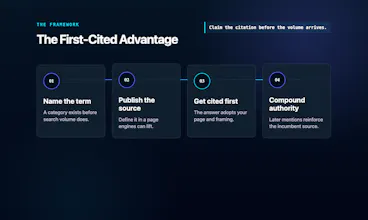
The first-cited advantage is the thesis behind it: the company that becomes the trusted source for a new category term early gets a head start that later competitors must displace.
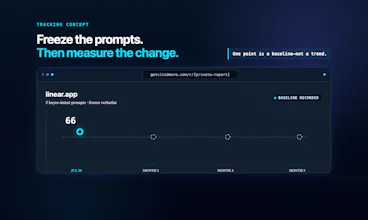
One finding from our first live validation run changed the product itself: Gemini returned grounded citations as redirect URLs, and our original adapter discarded every one until we resolved them. It was a useful reminder that an impressive dashboard is worthless if the collection method quietly drops evidence. That’s why every report discloses its methodology, sample size, dates, denominators, and failed runs.
The free scan takes a domain, not an account or card. I’d especially value your feedback on which is more useful: the source map or the prioritized fix list.