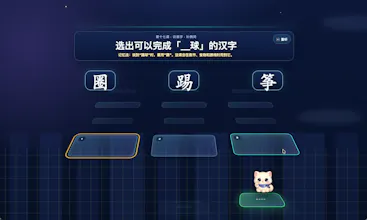
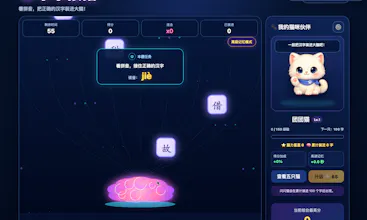
XiaoMaoLi is a playful Chinese learning web app for children, built and iterated with GPT-5.6. It combines lesson activities, three mini-games, five unlockable cat companions, shared XP and stars, and gentle daily goals—without leaderboards, punitive streaks, or open chat. Progress stays on-device, making it simple and parent-friendly.

How did GPT-5.6 change the ambition or scope of what you shipped?
Maker
GPT-5.6 changed XiaoMaoLi from a collection of standalone Chinese learning activities into a cohesive, launch-ready web app.
It helped me expand the scope to include three connected mini-games, shared XP and stars, five unlockable cat companions, daily missions, persistent on-device progress, parent and privacy information, feedback collection, and launch preparation.
More importantly, GPT-5.6 helped me work through product structure, debugging, mobile usability, regression testing, deployment issues, and positioning for parents and educators. This allowed a solo founder to move beyond a simple prototype and ship a complete early public beta.
Earlier AI tools also contributed to parts of development, but GPT-5.6 was central to integrating, refining, testing, and preparing the final product for launch.
Report
Maker
📌
Hi Product Hunt!
I originally built XiaoMaoLi for my daughter, who is learning Primary 2 Chinese in Singapore.
What began as a simple learning page gradually became a small browser-based learning playground with three mini-games, five original cat companions, shared XP, stars, unlockable progress and gentle daily goals.
I wanted to explore a different kind of gamification for children—one without public leaderboards, punitive streaks, pressure to compete or open chat.
GPT-5.6 played a major role in helping me refactor the original standalone games, build the shared progression system, debug the experience and prepare the product for launch. Other AI tools also contributed during earlier development, so this has been a genuinely collaborative AI-assisted building journey.
XiaoMaoLi is still an early public beta, and I would especially appreciate feedback from parents, educators and builders:
Does the experience feel clear and enjoyable for a child?
Does the progression feel encouraging rather than stressful?
What would make you comfortable letting a child use it regularly?
Thank you for trying XiaoMaoLi!