
nxt
Talk to your to do list and get what's next
243 followers
Talk to your to do list and get what's next
243 followers
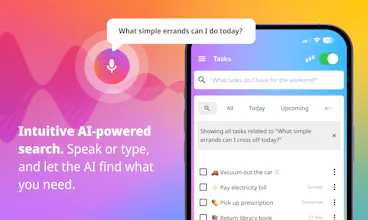
nxt is the AI task manager you talk to like a human assistant. Brain-dump your thoughts in plain language - nxt reads between the lines, extracts tasks, infers priorities, and files everything automatically. It understands what you mean, not just what you say. nxt learns your personal context, so your tasks flex around your life. When you're ready to act, nxt cuts through the noise and gives you one clear task, one reason why. No scrolling, no paralysis, no overwhelming list to wade through.



@heather_a_perkins Voice input for task management is clever — are people actually using voice to *add* tasks or mostly just asking 'what's next'? Feels like the real win is freeing up friction.
The "get what's next" framing is interesting because it implies the app is making prioritization decisions, not just surfacing tasks by due date. That's the actually hard part of any task system, knowing which of the 40 things on your list is the right one to start right now given context, energy, and dependencies. Curious whether nxt is doing genuine prioritization reasoning or whether "talk to your to do list" mostly means natural language input and query. Also wondering how it handles tasks without clear deadlines or urgency signals, since those tend to be the ones that rot at the bottom of every list forever.
@fberrez1 It's genuine prioritisation reasoning, not just smart input. nxt builds up a picture of you over time: your habits, your schedule, your energy patterns, what you've been putting off. Then it uses all of that to decide what's actually right to do right now, not just what's overdue.
The rotting tasks problem is one I find personally infuriating, so it was high on the list to solve. Tasks without deadlines get surfaced based on context rather than urgency: a free 20 minutes, the right location, the right headspace. They don't just sit there gathering dust.
An example from yesterday: mid-morning, working from home, nxt suggested a small house chore with reasoning "take a 10 min break, move around, knock this off your list." I wouldn't have thought to do it. But it was exactly right. That's the kind of thing we're going for - not just what's urgent, but what's right for right now.
We're early, so it keeps getting smarter, and I would love to know if the reasoning lands the way you'd hope once you try it!
The "one clear task, one reason why" framing is what actually caught me. For me the failure point in every task manager was never capture, it was the decision paralysis of staring at a 40-item list and abandoning it. Two genuine questions: when I brain-dump a rambling voice note with five half-formed thoughts in it, does nxt split that into separate tasks or treat one recording as one task? And how transparent is the "reason why" — is it surfacing the deadline/priority it inferred, or my stated context (heads-down week, travelling)? Keeping that recommendation from feeling like a black box seems like the whole ballgame. Congrats on the launch.
@hung_tran_from_notebook_os Thank you! And yes, decision paralysis over the list is exactly the problem we're solving for.
Brain dumps are my jam too - I free-ramble through my mental checklist at nxt all the time. Once I even decided to get all the house maintenance jobs in, so I just went room to room and narrated everything I could see that needed sorting!
nxt takes those brain-dump voice notes and splits them into discrete tasks, then applies real-world knowledge to fill in the gaps: how long something is likely to take, whether it's high energy or something you can do on autopilot, whether it's the kind of thing that should repeat and on what schedule. Then it layers in everything it knows about you - your schedule, your habits, how your life works. Are you away this week? Are the kids off school? By the time the tasks land on your list, they have a sensible title, a context-filled description, and practical prioritisation and scheduling - all of which you can tweak if needed.
On transparency: the reason is specific, not generic. It shows its working rather than just handing you a task and expecting trust.
Would love your take on whether the reasoning feels genuinely useful once you've had a go!
@shubham4real nxt stores context as you go, so if you said something like "the marketing summary points need to be ready for the 10am meeting Friday, and my boss Jeff has asked me to look at last months figures to pull out the key changes" - this would turn into two tasks, one with a set deadline pre that 10am meeting) and one without, and it would also add a context entry along the lines of "Boss is called Jeff". For priorities will then work with that info - it knows a deadline for one, and it knows your boss asked you about the other one and can factor that in. It also learns from behaviour: if a task gets snoozed every time it's surfaced at a particular moment, nxt takes note. Same the other way: patterns around when things actually get done stick over time.
No clarifying questions upfront (yet!), so we recommend giving it as much context as you can when doing the verbal brain dump. You always have full visibility over the context it's working with, so it's never a black box. You can see exactly what it knows and correct it if it's off.
The context engine adapting when I tell it I am on holiday is the part that would actually make me switch — most task apps just keep nagging with the same list. Two day-one questions: when I brain-dump by voice and it extracts the wrong priority, do I correct that in text, and does the correction actually teach the context engine, or is it a one-off edit? And is the learned context tied to one device, or does it carry over if I capture on my phone and review on desktop?
@leo404 Glad you like the time-boxed context! The holiday example is one of our favourites too.
On corrections: you can edit any task directly, and while the act of correcting doesn't explicitly retrain anything, the updated state becomes part of what nxt works with going forward, so if you adjusted the priority of a task for example, it factors in that priority for that task when making future recommendations and creating similar tasks.
On context across devices: everything syncs in real time, so whether you brain-dump on your phone and review on desktop, it's all the same picture. Nothing is tied to a single device.
I absolutely love the explicit 'ADHD friendly' tag on your launch assets. From a Go-To-Market perspective, did you find that leaning heavily into neurodivergent accessibility and minimizing cognitive overload helped you cut through the noise of the crowded productivity space faster?
@andika_fadhilah Great question! Honestly, reducing cognitive overload wasn't a conscious GTM decision as much as it was baked into how we built it - the thing we found is that in this space, for the problem we are looking to solve, what's good for neurodivergent users is just good design for everyone. One task at a time, no overwhelming lists, celebrating wins - these things help all of us, not just a specific group. The ADHD friendly badge felt like an honest reflection of that rather than a positioning play.
Curious whether you think leading with it more explicitly would resonate - we've gone back and forth on it!
How does nxt actually handle the "between the lines" part in practice - does it just run everything through an LLM each time, or is there some kind of learned model on your device that gets smarter as you use it more?
@enaypbab Great question! The best analogy is ChatGPT's memory feature. As you use nxt, it stores discrete facts about you and your life, and hands those to the alongside your tasks to the recommendation engine. So it's not getting smarter in a model sense, it's getting smarter because it knows more about you.
You have full visibility and control over exactly what it's stored - you can see every fact it's working with and edit or remove anything that's wrong or out of date, or even add extra context directly.