
Launching today

QoreDB
The fast, open-source database client built with Rust
76 followers
The fast, open-source database client built with Rust
76 followers
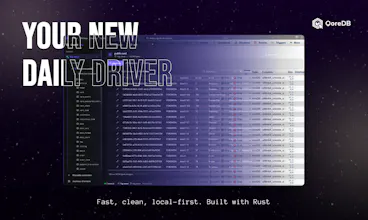
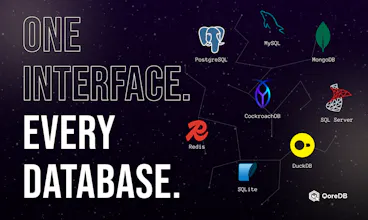
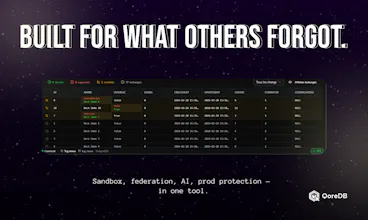
Database tools haven't kept up. DBeaver is slow, pgAdmin feels stuck in 2010, and you're juggling 3 apps for 3 databases. QoreDB fixes this: one desktop app, 9 databases (PostgreSQL, MySQL, MongoDB, Redis, SQLite, DuckDB, SQL Server, CockroachDB, MariaDB), powered by Rust. Local-first : your credentials stay in an encrypted vault, your data never hits a cloud. Modern SQL editor, inline editing, SSH tunnels, production safety guards, full-text search. Core is Apache 2.0, free forever.


@raphplt How did you decide on the top 9 DBs to support first? Any wild ones you cut?
@swati_paliwal Pragmatic process honestly.
Started with what I used daily: Postgres, MySQL, MongoDB. That's probably 80% of projects out there. Redis and SQLite were obvious. DuckDB felt like the right bet for the analytics crowd that still wants a desktop client
SQL Server came from early users : devs working in companies with SQL Server have zero good modern client options. CockroachDB users were basically stuck with the Postgres client and hoping for the best. MariaDB was free once MySQL was in.
The ones I cut: Oracle (licensing nightmare), Firebase/Firestore (querying model is too different to unify cleanly), InfluxDB (strong demand but time-series is its own world).
The honest filter was: can I build a genuinely good experience for this driver, or just a mediocre wrapper? If the answer was the latter, it got pushed.
I'm using TablePlus which supports all the databases you mentioned and it's fast enough for my needs. What's your differentiation?
@tbson87 Fair point, TablePlus is solid and fast. Honest answer:
If TablePlus works for you, you probably don't need QoreDB.
But a few things we do differently:
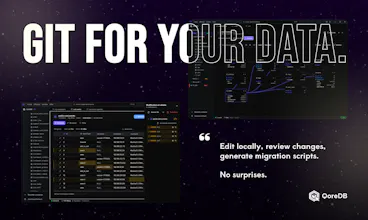
The Sandbox. You edit locally, see a diff of every change (Insert/Update/Delete), and generate a clean SQL migration script before anything hits your database. TablePlus has no equivalent.
Cross-database federation. You can JOIN across two live connections in a single SQL query. Postgres table joined with a DuckDB file, for example. That one's hard to replicate elsewhere.
AI with your own keys. Ollama, OpenAI, Anthropic, Mistral, no subscription, no middleman, schema-aware context.
Production protection. Read-only mode per environment, mutation blocking, local audit log. Not just a visual flag.
And the model: open-source core (Apache 2.0), one-time payment for Pro. No subscription.
TablePlus nails the basics really well. QoreDB is more opinionated about the workflows around the data, not just the querying.
The production safety guards are underrated in DB tooling. Destructive query protection is the kind of thing you only care about after you have made a painful mistake. Rust for a desktop DB client is an interesting call - curious how startup time compares to DBeaver in practice.
@mykola_kondratiuk Exactly, it's one of those features that gets ignored until someone drops a prod table on a Friday afternoon, then suddenly it's the most important thing in the codebase.
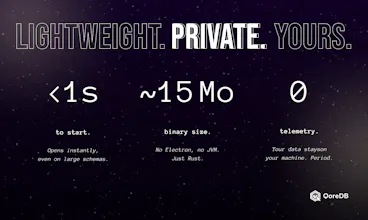
On startup time: DBeaver typically takes 8-15s on a cold start depending on the machine, QoreDB is consistently under 1s. The Rust + Tauri combo avoids the JVM warmup entirely, so there's no "waiting for the app to be ready to be ready" phase. It's just open.
Under 1s vs 8-15s is not a small gap. That alone will win converts who have given up on DBeaver just because of the wait.
@vouchy
Haha yes, absolutely. The day I had DBeaver, Compass, RedisInsight and pgAdmin all open at the same time (each eating RAM, each with their own shortcuts, their own quirks) and I just thought: this is insane. We have amazing dev tools in every other category, and our database client is still a 2010 Java app. That was the day I started building QoreDB.