
Crow
Make your product AI-native via AI Copilot
322 followers
Make your product AI-native via AI Copilot
322 followers
After 100+ conversations with app builders, the same thing kept coming up: Everyone wants an AI copilot in their product. No one has time to wire it up. So we built Crow to add a chat-first copilot that can take real actions on any product within minutes.




@jai_bhatia2 I’m curious how you handle security and permissions. If the agent can execute API calls, making sure it doesn’t overstep or expose sensitive actions seems like a critical next step.
@masump Good question. The agent never bypasses your auth.
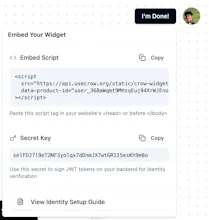
We verify every request using your existing JWT/session and a shared secret, so each tool call is authorized exactly like a normal user action. If a user can’t do something in your app, the agent can’t either.
You also control access with a strict tool allow-list, so the agent only sees the endpoints you explicitly permit.
@jai_bhatia2 Really clean UI! I like how simple the workflow feels. Curious—what gap did you see in the market that inspired this?
@brent_kom3344 Thanks! I’ve seen this shift up close. I worked at a company that went fully chat-native from a UI-first workflow, and it completely changed how people used the product.
Now I’m seeing the same move across products like Notion AI, Apollo AI copilot, and Rilla Intelligence.
The gap is that everyone wants a copilot, but building one that actually takes actions can be painful. Crow is about making that shift fast for teams building heavy workflow software or going AI-native.
@jai_bhatia2 We don’t have AI in our product yet, but I’ve saved it to my collections, we’ll probably add it someday. Congrats on your launch!
Hi @jai_bhatia2, do you use native AI agents under the hood that learns from the knowledgebase uploadd or scrapes the website based on the URLs provided? Also, when you kept seeing people take screenshots and pasting to GPT, what kind of questions were asked?
I suggest based on the adoption, you can let users build flows and run inside the widget making it a good rule-based and AI based web bot.
@hetvee_sanghani
The agent learns from any docs, files, and websites the user uploads.
Real queries I saw people running on insurance sites, the AWS console, and Clay were "how do I" followed by: “cancel this policy,” “rotate this API key,” “add a new user,” “pull last month’s usage,” or “turn this setting off.”
Flows are a core next step for us. We’re building a visual agent builder with guardrails so teams can run agents safely in production. Appreciate the suggestion.
Congrats on the launch! Access to BE endpoints on one hand means the agent is powerful and can make useful tool calls, but not without risks. As a malicious user, can't do funny things?
Is the onus on the provider of the endpoints to add grade A security, or does Crow add a proxy in the middle to handle things like rate limiting (so the endpoint isn't spammed either by a malicious user or LLM gone rogue), strong schema validation etc.?
If you manage to add a proxy, it can change the perception of users who are more on the cautious side i.e., some extra confidence beyond the JWT auth
@ohansemmanuel Great point!
We’re rolling out a managed proxy that sits between Crow and your backend. It adds rate limiting, OpenAPI validation, shared-secret verification, and full request logging so the agent can’t spam or send malformed requests.
We’re also adding an analytics dashboard so teams can trace every action back to a user and see exactly what the agent is doing in production.
@jai_bhatia2 Now that's added value! Ship it, and congrats again on the launch!
I would love to see:
1) Conditional semantic workflow set up
2) API to get just responses, without the chat UI
@pasha_tseluyko Hi Pavel, thanks for the feedback.
Are you thinking of semantic workflow set up that chains together the application's internal endpoints (which Crow turns into tools)? We were thinking about how Browser Automations are being used to automate certain workflows on applications, and if the applications' functionalities were exposed as tools that any user of the product could chain together into workflows - it would eliminate the need for browser automations which are more of a 'hack' to automate GUI tasks.
Do you mean direct access to the internal APIs of any application? Without having to access the GUI or even interact with the Chatbot?
P.s. when I say 'application' I am referring to any application that is using Crow.
This is an intriguing idea. Loved your approach for solving the general pain of the customers.
I love the name Crow — super memorable.
Congrats!! but what sets it apart from all the similar projects out there?
@mrrabbar Hi Savvas! Do you mind sharing which other projects you have in mind?