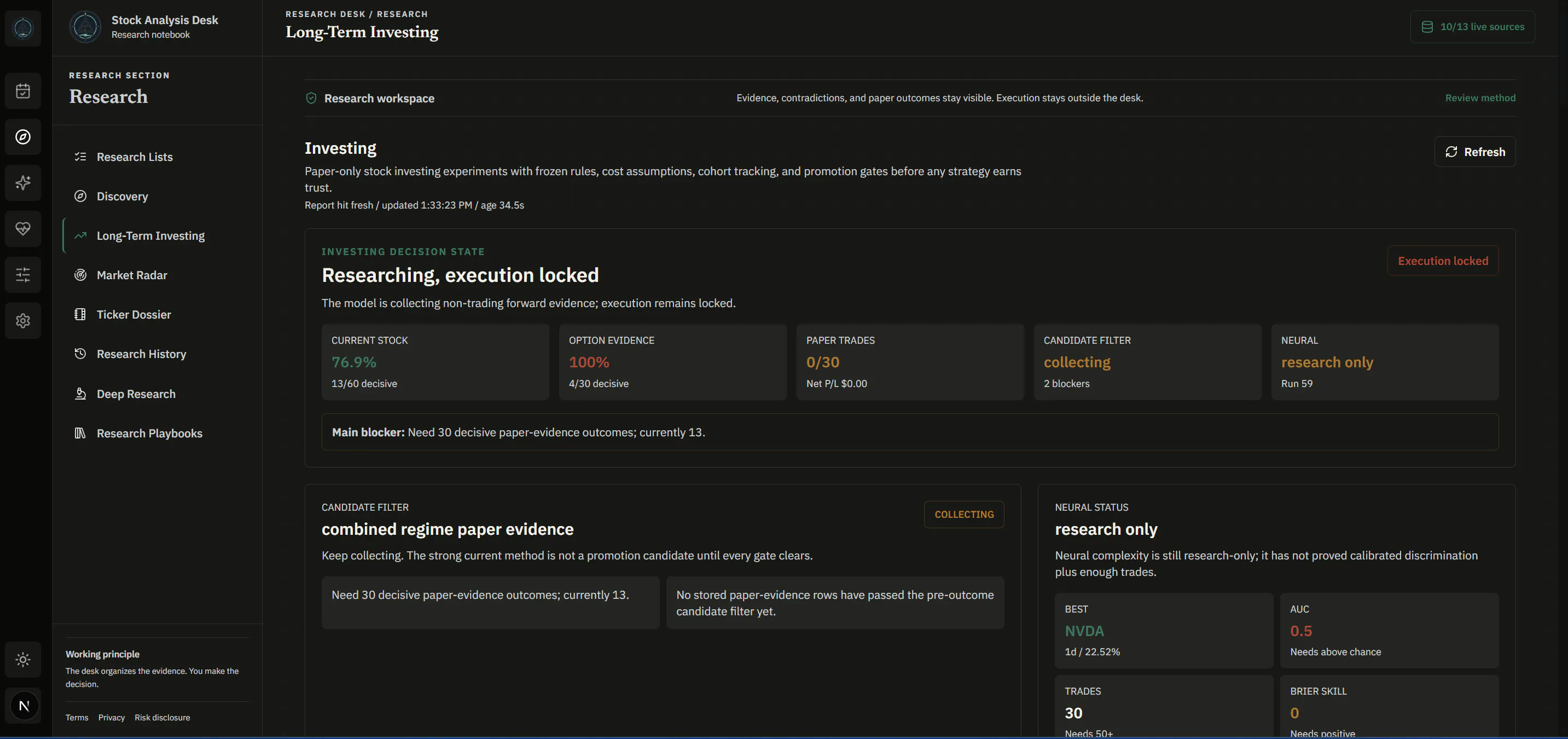
The biggest change so far has been the data collection layer.
At first, the product was mostly about organizing a trade idea thesis, evidence, contradictions, risk, and outcome. But once the site started collecting forward evidence, the more interesting question became.
A few early numbers:
Current stock evidence is showing 81.8%, but only across 11/60 decisive samples, so it is still too early to trust.
Options evidence is showing 100%, but only across 4/30 decisive samples, which is exactly the kind of fragile result the system should avoid overreading.
One signal family, price-volume momentum, is at 0% across 12 decisive samples, so it is being treated as a failure instead of being promoted.
A stronger combined-regime method is showing 75% across 16 decisive samples, but it still needs more evidence before it can be trusted.
Howdy, I m Javier! I'm a materials engineering student with a deep passion for the market. I decided to build SAD as a smarter trading tracker for traders who want more clarity, discipline, and insight from their trades. SAD helps users track trades, review performance, spot patterns, and better understand what s working and what needs improvement, turning trading activity into meaningful data that supports better decisions over time. I'm pretty new to this stuff I've been working on this project for a couple months now and I've finally made it live! I would love if anyone is interested if they could give me word of advice or critques on the site itself!!
Stock Analysis Desk is a founder-built market research workspace for self-directed traders and investors.
It helps users preserve their original thesis, supporting evidence, contradictions, source quality, options/liquidity context, risk, and paper-trade outcomes in one reviewable workflow.
The goal is not to generate buy/sell signals. The goal is to make market research more structured, honest, and easier to review after the outcome is known.