
About
Independent developer building open-source AI workflows and cross-platform tools. I maintain MoneyPrinterTurbo, MangoDisk, and FlashVoice.
Links
Badges

Forums


👨💻 Do you have customer support for your product?
What do you think about support - or have you even thought about it? =D
Do you think every product must have some kind of support?
Should it be a bot?
A human?
Email?
An AI agent?
Or all together?
In our case, with a complex workspace, I think working support is definitely a must.
 •
•1mo ago
Why people rage quit my app 😡
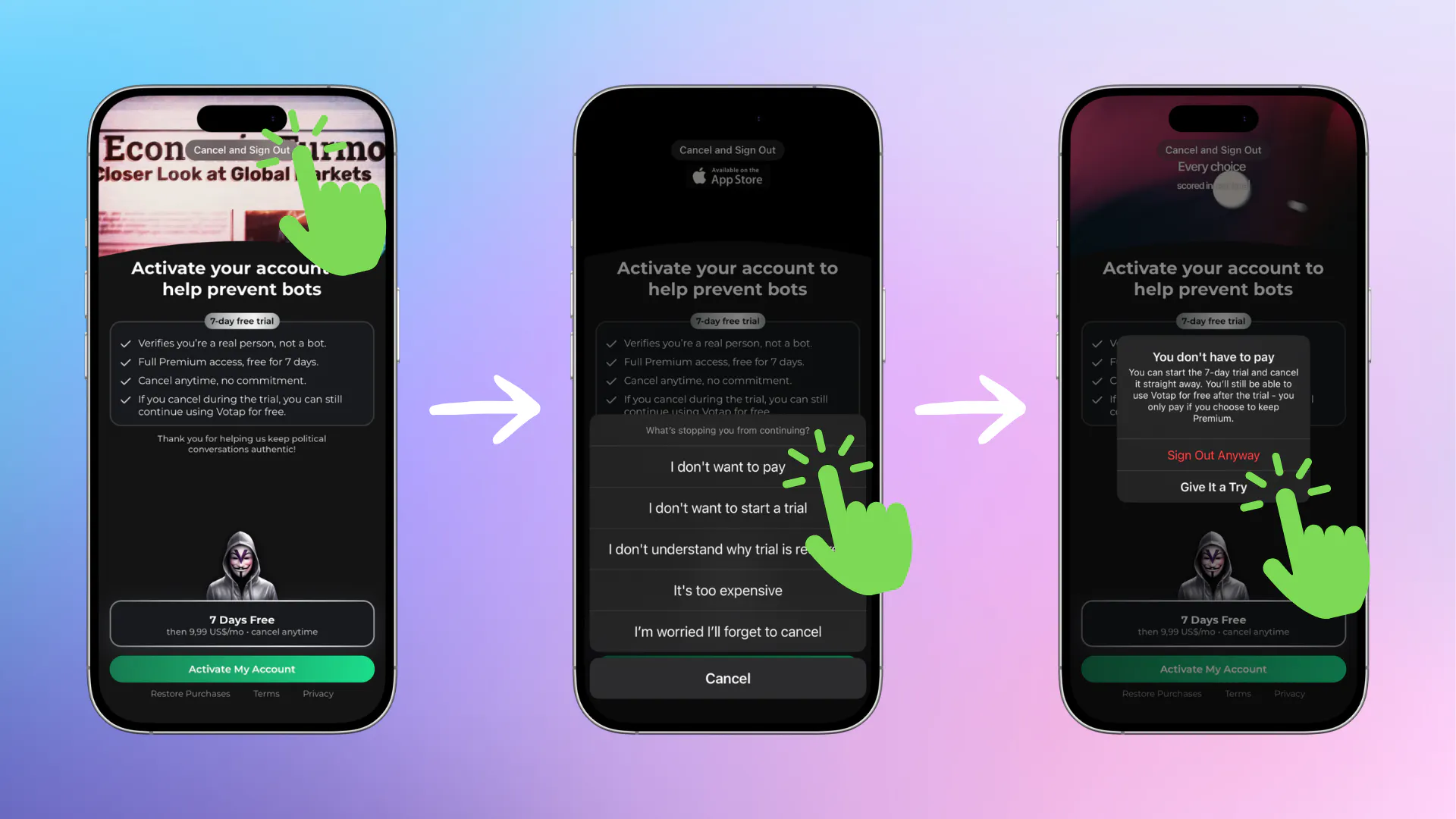
Road to 1,000,000 Votap users - Day 81 | Current: 1469
We currently use a mandatory 7-day trial during onboarding. You have to start it to enter, but you can cancel immediately and continue using the app for free. It gives us another bot-prevention layer and lets people experience the full app first.
What REALLY surprised me: of the people who didn t start the trial, around 80% tapped Cancel and Sign Out. They didn t just close the app.
So I turned that button into a tiny win-back + analytics flow. When someone wants to leave, I ask why: maybe they don t want to pay, don t want a trial, think it s too expensive, or don t understand why it s required.
Based on the answer, Votap shows a short explanation specific to that concern and gives them one more choice: give it a try or sign out anyway.
And every reason gets logged in analytics, so instead of guessing why people drop, I can see the actual pattern. Even if the win-back converts nobody, knowing why people leave is extremely valuable. What do you think about this approach? Let me know!
Download Votap in the App Store!
More tomorrow.
 •
•2mo ago
Your AI subagent's report is all you'll ever see. Make it hand in receipts
If you use AI agents that spawn helper agents (audits, research, big refactors), here's the mechanical fact that changed our setup: the parent never sees the work. The helper runs in its own context; when it finishes, one final message comes back. The forty tool calls behind it the searches that found nothing, the test that failed twice before passing, the edge case quietly ruled out of scope stay behind. What you receive is a summary, compressed by the thing being evaluated.
That's not a bug. Isolation is why delegation is affordable at all. But it means every "Done, all tests pass" is testimony, and nothing in the loop charges the helper for optimism. A caveat is a paragraph; "done" is one word. Guess which survives compression.
Ours got caught the memorable way: an audit subagent confidently reported that a sourced claim had no source behind it. The source existed. We found the exact sentence in the original docs and ended the argument in minutes.
What we require now, roughly in order of payoff: evidence formats written into the dispatch prompt (every finding arrives with a verbatim quote and a file path), artifacts over adjectives (test output and re-runnable commands instead of "thoroughly checked"), and spot-checks scaled to blast radius anything we'll act on gets one finding re-derived end to end. The re-check is deliberately cheap: when a claim comes holding a quote, verifying it is a text search.