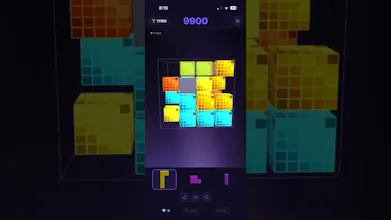
ZenCubed turns the familiar block puzzle into a genuinely 3D challenge. Rotate the cube game board, clear lines, and watch the visual world evolve as you progress. There are no timers or frantic taps - just satisfying clears, beautiful blocks, and spatial decisions that make you pause. What began as a family project with my children became a hands-on return to building, using AI tools as development partners.
No reviews yetBe the first to leave a review for ZenCubed: 3D Block Puzzle
Maker
📌
ZenCubed began as a family project with my children. What started as something we explored together gradually became a more ambitious effort to design, build, and ship a complete game.
I have always loved the satisfying moment in a block puzzle when a line clears. But I wanted to create a more elevated experience: a 3D spatial puzzle that makes you stop and think, set to calming music, with game pieces that evolve as you progress.
In ZenCubed, the game board is a rotating cube. A placement that looks obvious on one face may block a better setup elsewhere. Sometimes the challenge is simply working out where a piece can fit.
One of the funniest parts of building ZenCubed was testing it with my kids. They kept telling me it was too easy. So I made it harder. Then harder again. That is how ZenCubed ended up with three difficulty modes: Lite, Classic, and Master. Since launching, I have continued hearing stories about children grasping the game faster than their parents. Are adults overthinking it? Are we really not smarter than a fifth grader?
I have always wanted to build something of my own but my career took me into legal, strategy, and partnerships at tech companies, and I haven't written code since my Symbolic Systems days at Stanford, where I studied AI in the olden days (as my kids like to call it).
But I continued to have the desire to create and build. More than a decade ago, a friend and I wrote a caper about twin teenage founders pretending their AI product actually worked (ironic now). We signed with a prominent literary agent, but despite years of effort, the book has yet to be published. Still, turning a wisp of an idea into a book isn't so different from building a product. You need imagination, persistence, structure, judgment, and a willingness to keep responding to feedback.
Today’s AI tools allowed me to find the time to turn a game idea into something real - ZenCubed. I used Replit Agent as my primary development environment, with Claude and ChatGPT helping me cross-check architecture, implementation choices, and bugs. AI accelerated the implementation, but key aspects remained deeply human: deciding what the game should feel like, testing whether the cube was understandable, recognizing when an implementation was not working, and repeatedly refining the experience.
I would especially value feedback on three things:
How quickly did rotating the cube and placing pieces make sense? Did the tutorial explain enough without over-explaining? Did the game feel calming, challenging, or both?
Thanks for taking a look. I’m happy to answer questions about either the game design or the AI-assisted development process.
Report
The way the cube rotation ties directly into line clearing creates such a natural puzzle flow. Love that it came out of a family project too.
Report
Maker
Thank you, Zvonimir! That balance - calm on the surface but genuinely challenging - was exactly what I was aiming for. I’m already experimenting with another math-based puzzle concept, so it’s especially encouraging to hear this. Really appreciate the support!
Really exciting to see ZenCubed: 3D Block Puzzle launch! A calm 3D block puzzle that makes you think feels like a thoughtful approach. Congratulations, and best of luck today! 🚀




ZenCubed began as a family project with my children. What started as something we explored together gradually became a more ambitious effort to design, build, and ship a complete game.
I have always loved the satisfying moment in a block puzzle when a line clears. But I wanted to create a more elevated experience: a 3D spatial puzzle that makes you stop and think, set to calming music, with game pieces that evolve as you progress.
In ZenCubed, the game board is a rotating cube. A placement that looks obvious on one face may block a better setup elsewhere. Sometimes the challenge is simply working out where a piece can fit.
One of the funniest parts of building ZenCubed was testing it with my kids. They kept telling me it was too easy. So I made it harder. Then harder again. That is how ZenCubed ended up with three difficulty modes: Lite, Classic, and Master. Since launching, I have continued hearing stories about children grasping the game faster than their parents. Are adults overthinking it? Are we really not smarter than a fifth grader?
I have always wanted to build something of my own but my career took me into legal, strategy, and partnerships at tech companies, and I haven't written code since my Symbolic Systems days at Stanford, where I studied AI in the olden days (as my kids like to call it).
But I continued to have the desire to create and build. More than a decade ago, a friend and I wrote a caper about twin teenage founders pretending their AI product actually worked (ironic now). We signed with a prominent literary agent, but despite years of effort, the book has yet to be published. Still, turning a wisp of an idea into a book isn't so different from building a product. You need imagination, persistence, structure, judgment, and a willingness to keep responding to feedback.
Today’s AI tools allowed me to find the time to turn a game idea into something real - ZenCubed. I used Replit Agent as my primary development environment, with Claude and ChatGPT helping me cross-check architecture, implementation choices, and bugs. AI accelerated the implementation, but key aspects remained deeply human: deciding what the game should feel like, testing whether the cube was understandable, recognizing when an implementation was not working, and repeatedly refining the experience.
I would especially value feedback on three things:
How quickly did rotating the cube and placing pieces make sense?
Did the tutorial explain enough without over-explaining?
Did the game feel calming, challenging, or both?
Thanks for taking a look. I’m happy to answer questions about either the game design or the AI-assisted development process.
The way the cube rotation ties directly into line clearing creates such a natural puzzle flow. Love that it came out of a family project too.
Thank you, Zvonimir! That balance - calm on the surface but genuinely challenging - was exactly what I was aiming for. I’m already experimenting with another math-based puzzle concept, so it’s especially encouraging to hear this. Really appreciate the support!
Pazi
Really exciting to see ZenCubed: 3D Block Puzzle launch! A calm 3D block puzzle that makes you think feels like a thoughtful approach. Congratulations, and best of luck today! 🚀