I'm working with Yosa for a couple of months now, so I can share my thoughts. I've been using this tool mostly for creating content for multiple clients (I'm a copywriter) – so I'm gonna focus on that matter. Yosa helped me to speed up my work around 30-40%, comparing to ChatGPT. Why?
1) Easier to use – while using ChatGPT, you have to build this really complicated and accurate prompts. With Yosa, there's no need for that. You just put some info about your company in database, prompt some basic things (i.e. how many headings you want in your article) – and that's it.
2) Not only for content creating – Yosa combines many tools, that are usually used by marketing teams. You don't need Google Keyword Planner or Senuto anymore – just use Yosa to find keywords for you, create titles, create a decent content, all in one.
3) Faster – this tool is indecently fast! Usually creating a good-researched article in decent quality takes 3-4 min tops. However, the real power lies in a tool, called group generation. Yesterday I made 8 pretty good articles in less than 6 mins, just using that option.

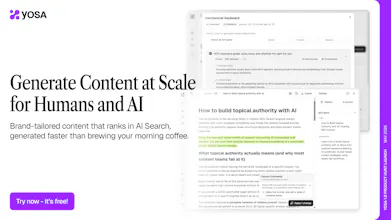

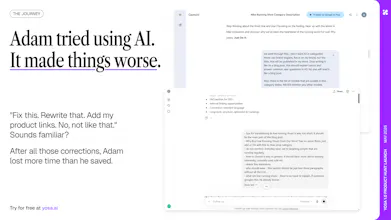
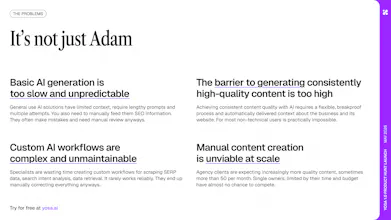



YOSA founder here.
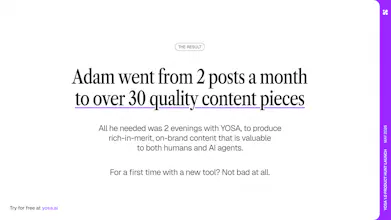
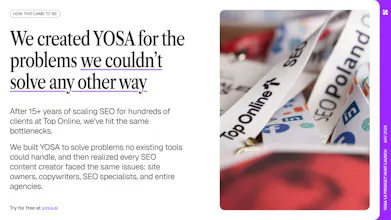
For 15 years we've run an agency doing SEO for hundreds of clients. We know the content bottleneck first-hand. You need speed, you need scale, but you also need quality that actually ranks and converts.
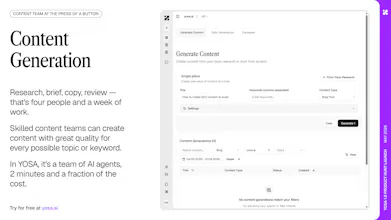
When AI writing tools hit, we thought "finally" - but it was the opposite. Most tools hand you a draft and call it a day. That's not how content works. Real content is research → brief → writing → SEO review. That's four people in an agency and a week of back-and-forths.
We built YOSA to automate that entire workflow. As a tool that does what we do - just faster.
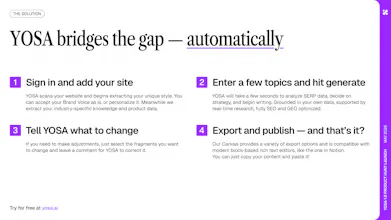
How it works:
- Enter a topic or keyword
- Research agent pulls live SERP and AI answer data
- Brief agent builds structure based on intent signals
- Writing agent drafts in your brand voice, grounded in your website
- Review agent checks for SEO alignment and coherence
- You get a review-ready copy in minutes
Same process, but without four people, and a week of emails and waiting.
Your content needs to be written fast, at scale, and with real value. YOSA does this through a Knowledge Base that learns from your site and automates the workflow.
We're launching today with blog content, product descriptions, category pages - and we're shipping Topic Research so you never run out of ideas.
We're here to listen, iterate, and build the tool we wish existed when we started.
Questions? Let's talk!
@marcin_kaminski Hi Marcin, Congrats on the launch. How do you avoid sounding the same as other ai content gen engines?
Great question, @zolani_matebese .
The best content happens when a human brings their own input and style. YOSA automates that process.
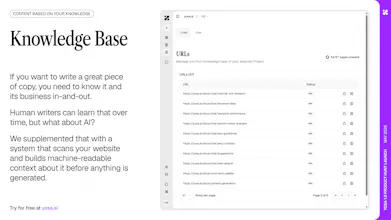
Add your website - YOSA learns it inside out and uses the best parts when creating content. Add extra materials to the Knowledge Base (your book, a podcast script, an interview) and it's like feeding in your own unique expertise. The right technology makes sure that knowledge actually shapes the output - so the content sounds like you, not like everyone else.
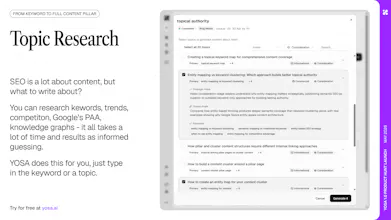
On top of that, Topic Research helps you find real topics worth writing about - not just keywords like most other tools.
Example: you run a YouTube channel with 100 interviews. Drop the transcripts into YOSA, run Topic Research, and generate hundreds of articles packed with unique insights that exist nowhere else on the web.
That's what Google actually rewards and people want to read.
@marcin_kaminski The agency-workflow framing is the right wedge - most AI writing tools optimize the artifact, not the process. Question on the Review agent: is it checking against a static SEO rubric (E-E-A-T, schema, internal linking), or does it pull live SERP context for the target keyword and adjust? The second is where most "SEO-aware" tools quietly fall back to the first.
Brand-tailored content generation often loses its edge when forced to fit standard SEO keyword stuffing patterns. Balancing search optimization with a distinct brand voice is tricky. What parameters are in place to help the AI keep a consistent tone across different content pillars?
@rivra_dev Great question. We don't use "standard keyword stuffing patterns" - it kills readability and conversion rates, which defeats the purpose.
YOSA creates a Brand Voice instruction by analyzing your existing content. This becomes a deterministic ruleset it applies to every piece it creates across all your content pillars.
This instruction captures sentence length, vocabulary complexity, formality level, unique phrases, values you emphasize, and how you address your audience. In the content generation process, every generated copy is checked against these parameters.
About SEO, keywords get placed where they're actually useful - where they improve readability and just fit the context. We just make sure that they are there. But optimization is more than just keywords, for e.g. every generated copy has its own SEO research and is created based on search user intent.
Result: your voice stays recognizable, keywords are there, content represents what people are actually searching for and nothing feels generic or forced.
Do you include source links and citations in the draft so writers can verify fast?
Thanks for the question @othman_katim!
Content generations have a panel with all sources used, which includes web research and our Knowledge Base sources (pages from your website).
We're working on a feature that actually lets you hover over a text paragraph and display all sources inline, but it's gonna take a while ;)
I've been using YOSA for around 2–3 months mainly for blog articles and product descriptions, and honestly the workflow feels much smoother than with most AI writing tools I've tested before.
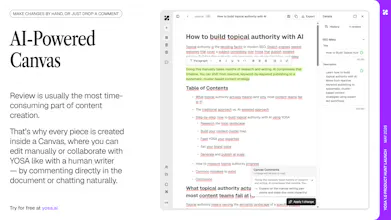
What I like most is the ability to leave comments directly inside the editor and guide the AI through revisions instead of regenerating everything from scratch. The brand voice setup is also surprisingly useful once you add enough context about the company.
One thing I noticed is that when you provide too much information at once, YOSA can occasionally miss some details in the output — but usually it's easy to fix through follow-up comments inside the editor.
I use YOSA for content creation. It works great for semantic SEO, and you can do brilliant topic research with it, but the only thing missing for me (and my clients) is the ability to tailor texts for landing pages and, of course, money pages. Are you planning to introduce any changes in the future?
@aleksandra_kolodziejska Thanks so much for the clear feedback. This is exactly the workflow we need to solve for - teams that need consistency across their whole content stack.
We're building landing page generation now. It's more complex than blog content because the dynamics are different (persuasion vs authority), so we're taking the time to get it right.
Question: when you say "money pages," are you thinking product pages, service pages, or both? And would you want the same Brand Voice applied, or different tone for conversion-focused copy?
@adam_przybylowicz Actually, I'm talking about service pages. When it comes to product pages, YOSA already meets my expectations. The e-commerce descriptions come out really great and to the point. Especially now that I can scan my website.
In practice, I always want copy that is highly conversion-focused, but also provides value to the user – Google likes that, so keeping the brand voice is a great solution. Thanks for that!
We've been using YOSA at our agency since the MVP days. It helps our copywriters generate really high-quality content thanks to the client knowledge base integration. Highly recommend it and rooting for you, the new version is already looking great!!!
Yosa made my content better and faster. I don't waste my time prompting, looking for internal links form sitemap or trying to find perfect topic form my site. Everything happens in this tool, so it brings what i need