Launched this week

YAGNI
Proactive agent teams you manage like humans
484 followers
Proactive agent teams you manage like humans
484 followers
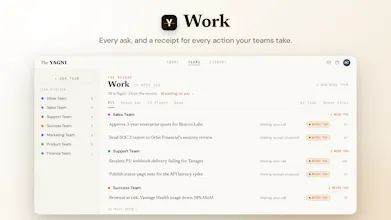
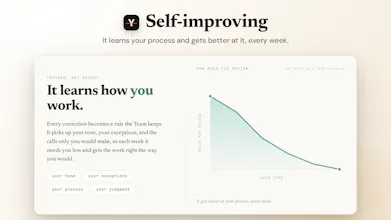
AI today is reactive: it waits for your next prompt. YAGNI is proactive agent Teams you manage like people. Give a Team responsibilities and guardrails, review its work, and it earns autonomy through a track record you can read, while you keep the calls that matter. Paste your company's URL and YAGNI drafts your first team in seconds. You aren't gonna need more software. You need a team that gets better every week. Become a self-improving company.




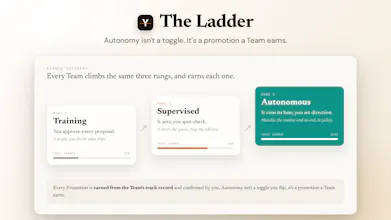


the training→supervised→autonomous ladder is the honest part, most agent tools ship straight to autonomous. does a team ever drop back a rung, and why?
YAGNI
@andrewzakonov Yes, a Team can drop back a rung. Here's how it works: once a Team has earned some autonomy, it can do certain things on its own without waiting for you to approve each one. If it does something on its own and you later undo it, that undo isn't just logged and forgotten. It costs the Team a rung on the ladder. Autonomy is earned from a track record, and it can be un-earned by that same track record.
The reason we treat an undo as the signal, rather than something softer, is that it's the one thing an approval can't fake. When you click approve, all that really tells us is that someone clicked approve. It doesn't tell us the work was good. An undo tells us something stronger: the Team acted, and once that action met the real world, it turned out to be wrong. That's a signal worth reacting to. So when it happens, the Team's track record takes the hit, it can cross the line that the next level up depends on, and it steps back down a rung until it rebuilds trust.
This only applies to work the Team did on its own. If you personally approved something and it later turned out wrong, that doesn't count against the Team, because a human made that call, not the agent. The ladder only reacts when the Team acted without you and got it wrong.
Let me know if that makes sense - happy to dive in deeper!
OpenMarkdown
I really like the idea that we need to 'recruit a team member' first, which sets the tone for the agent's role within the team.
The 3-step ladder feels more tangible than simply claiming that an all-star AI team will just work out.
YAGNI
@xueyanzhang Thank you, that's exactly the intuition we were hoping would land. The recruiting step isn't just onboarding UX, it's doing real work. Before you hand an agent anything, you're deciding what it's responsible for and where it fits. That framing is what makes everything after it make sense: an agent with a defined role can earn trust in that role, the same way a new hire earns it on their actual job, not in the abstract.
And you put your finger on why we avoid the "all-star AI team, just add water" pitch. Nobody manages that way with people, and it's not how trust actually forms. You bring someone in, you give them something small, you see how it goes, you give them more. The ladder is just that instinct made explicit, so the trust is legible instead of a leap of faith.
Really appreciate you seeing the intent here. Let me know if you have any other questions!
Great work! How quickly do teams tend to become autonomous and once they're autonomous what are the checks in place for new work?
YAGNI
@ssadtler Great question!
Getting to Supervised is usually fast (within a matter of days). For Autonomous, honestly I recommend at least two weeks in Supervised before promoting. You can do it faster, but a few weeks of works provides a better level of confidence that the agent is on the right track.
On checks once autonomous: autonomy is never a blanket switch. Every action is still clamped by its own risk ceiling, so newer, higher-stakes work stays gated even for a Team that's earned autonomy on its routine work. Anything irreversible, anything touching money, anything going out broadly never auto-runs regardless of status. And even the work that does run on its own is recorded to the Feed and its work item, never silent, stays under a daily volume cap, and is still subject to reversal: if something it did autonomously turns out wrong, undoing it claws back a level. So "autonomous" means trusted on the work it has a track record for, not trusted on everything from here on.
Thanks again for your thoughts! Let me know if I can provide more context.
@jackcollinshq Upvoted YAGNI today. "Manage agents like humans" is a concept that's easy to under-explain, curious how the onboarding handles that.
YAGNI
@alex_iliescu The short version is that onboarding teaches it by having you do it, not by explaining it. You start by recruiting the Team and setting what it's responsible for, the same first move you'd make with a hire. Then it starts in training mode, drafting everything for your approval and acting on nothing, so from minute one you're managing: reviewing, editing, approving. You learn the loop by living it rather than reading about it.
The scaffolding is deliberately the curriculum. Seeing a Team draft real work and earn its way toward more responsibility is what makes "manage like humans" click, in a way a tooltip never could.
Thank you for your support!
@jackcollinshq That's a smart design choice, learning by living the loop instead of reading a manual sticks a lot better. Congrats on the launch, curious to see how it scales past the training-mode phase.
YAGNI
@alex_iliescu Thank you - much appreciated!
Epsilla (YC S23)
Congrats on the launch! "Earns autonomy through a track record you can read" is such a sharp answer to the trust problem with agents. What does the actual track record look like day to day, is it a log you review, or does the team surface its own wins and misses to you proactively?
Congrats on the launch! Excited to see this in the wild. There's lots of "personal assistants" popping up, but figuring out how to manage context, guardrails and memory across an organization can be so tedious. I like that you can get started fast and train these teams over time.
YAGNI
@aaron_stachel Thank you Aaron, means a lot to have you watching this go live!
You've put your finger on the whole bet. The single-user assistant part is getting commoditized fast, and it was never the hard problem. The hard problem is the org layer: shared context, guardrails that hold, and memory that accumulates across a team instead of living in one person's chat history. That part is genuinely tedious to get right, which is exactly why we think it's worth building and defensible once it exists.
And the "start fast, train over time" arc is the thing I most wanted to be true. You shouldn't have to configure trust up front, because nobody actually knows what to configure on day one. You get going in minutes, and the system earns its way into more responsibility off a real track record. Fast to start, slow to fully trust, and honest about the difference.
Grateful for the backing that let us take the harder path here. More soon!
EverTutor AI
"Don't hire an AI employee. Run a team." That positioning alone is fantastic. Congrats to the entire team on building something genuinely different. Excited to see where this goes 🚀
YAGNI
@suryansh_tiwari2 Thank you for the kind words! I appreciate it.