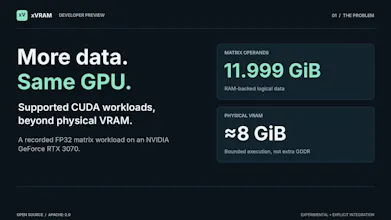
An experimental open-source CUDA SDK with RAM backing and a bounded VRAM cache. The recorded RTX 3070 demo processes 11.999 GiB of matrix data on an 8 GiB GPU. Includes a Windows build, C API example and local validation. Explicit integration required.
What real task does your product handle with GPT-6 Astra?
Maker
xVRAM uses GPT-6 Astra as an engineering and validation copilot for a real low-level systems task: developing, reviewing, and hardening a C++20/CUDA memory runtime that lets explicitly integrated CUDA workloads operate on data larger than physical VRAM.
Beginning at commit 98e41acc, Astra has been used across lossless host backing, explicit CUDA/cuBLAS integration, compatibility diagnostics, test design, release tooling, and verification workflows. The product’s real task is not text generation: it is building and validating a memory-management system with strict correctness boundaries, numerical checks, resource accounting, and hardware evidence.
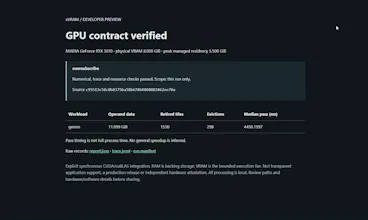
The current developer preview demonstrates ~11.999 GiB of matrix operand data processed on an RTX 3070 with 8 GiB VRAM, with 1,530 retired tiles, 298 evictions, 5.5 GiB peak managed residency, and zero numerical mismatches under the project’s validation tolerances.
xVRAM does not call the Astra API at runtime; Astra is used in the engineer
Report
Maker
📌
Hi Product Hunt! I’m TheLitis, the developer of xVRAM.
My GPU has 8 GiB of VRAM. Some CUDA workloads have more data than that, even when their individual operations can be tiled to fit. xVRAM keeps backing data in system RAM and manages a bounded VRAM execution cache for explicitly integrated applications.
In the attached recording, I run the downloadable developer preview on an RTX 3070. The report shows 11.999 GiB of matrix operands, 5.500 GiB peak managed residency, 1,530 retired tiles and 298 evictions. The local numerical, trace and resource checks pass. These are results from this specific run, not a universal performance claim.
The preview includes a Windows x64 package, an installed-C-API example, reproducible demo commands and local JSON/trace/HTML reports. Its focus is explicit synchronous FP32 CUDA/cuBLAS integration.
I began xVRAM with earlier GPT models and moved development to GPT-6 Astra starting at commit 98e41acc. Subsequent work covered lossless host backing, explicit CUDA/cuBLAS integration, compatibility research and the developer preview. I direct development and run the hardware tests. xVRAM does not call an OpenAI API at runtime.
This is not transparent VRAM expansion for arbitrary applications, not general LLM support and not production-ready software. System RAM does not become GDDR-speed memory.
I’d value feedback from CUDA developers: does the preview work on your configuration, is the integration boundary clear, and which supported operation would make it useful for your workload?