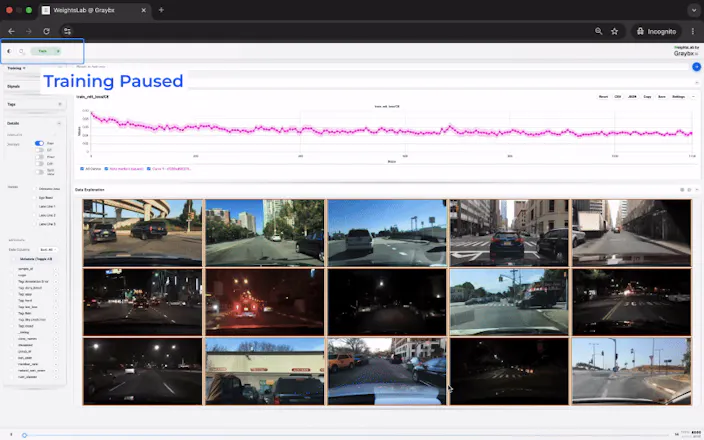
Build your models anywhere between the black box and the white box with full control, flexibility, and scale. People trade clarity for speed, but then repeat the iterations many times because of the lack of clarity. We believe that gaining greater clarity and more granular insights during the training of AI models is key to making development cheaper and more trustworthy.
No reviews yetBe the first to leave a review for Weightslab
Hunter
📌
Hey Product Hunt!
I'm Alex, co-founder of Graybox.
We're a team of AI engineers building what we think is a missing piece of the model-training stack.
When you train a model, most of what's actually happening, how each sample behaves, where the model struggles, and which data is hurting you, stays invisible until a run is over.
WeightsLab captures granular, per-sample signals during training, so you can see what's going on and make adjustments on the fly rather than finding out hours or days later.
Today we focus on perception systems and the data behind them (images, video, LiDAR). But the longer-term vision is full end-to-end traceability, connecting the patterns a model learns back to the exact data that produced them, across all model and data types.
We'd genuinely love your feedback, especially if you've ever wasted experiments because of a data problem you caught too late.
Report
How granular can I actually get with these insights during training, and does it slow things down noticeably on larger models?
Report
Hunter
@kadersusuzlu Right now, we cover the data part, so you trace and attach different signals (numbers) produced by the models to the individual samples, so you get better insights into the loss landscapes. Because of this, it does not slow down one forward pass by more than 5%.
Report
How granular can I actually get with the insights during training, is it per-layer per-step or more of a higher-level summary?
Report
Hunter
@abdulsametvgoc At the moment, the supported granularity refers to per-sample (e.g., one image in a detection setup) or per-instance (one bounding box in a detection setup) stats and signals. Very soon, we will have per-layer and potentially per neuron/head stats as well.
Report
How granular can the insights actually get during training, like per-layer behavior or something deeper, and does that come with a noticeable hit to training speed?
Report
Hunter
@keremkorni1924 You can trace individual samples, or even individual segmentation maps or bounding boxes, depending on the task. As we capture these signals and make them available for processing, the training overhead is not noticeable.
How granular can I actually get with these insights during training, and does it slow things down noticeably on larger models?
@kadersusuzlu Right now, we cover the data part, so you trace and attach different signals (numbers) produced by the models to the individual samples, so you get better insights into the loss landscapes. Because of this, it does not slow down one forward pass by more than 5%.
How granular can I actually get with the insights during training, is it per-layer per-step or more of a higher-level summary?
@abdulsametvgoc At the moment, the supported granularity refers to per-sample (e.g., one image in a detection setup) or per-instance (one bounding box in a detection setup) stats and signals. Very soon, we will have per-layer and potentially per neuron/head stats as well.
How granular can the insights actually get during training, like per-layer behavior or something deeper, and does that come with a noticeable hit to training speed?
@keremkorni1924 You can trace individual samples, or even individual segmentation maps or bounding boxes, depending on the task. As we capture these signals and make them available for processing, the training overhead is not noticeable.