
WAIL
AI Runtime Control & Governance Layer
3 followers
AI Runtime Control & Governance Layer
3 followers
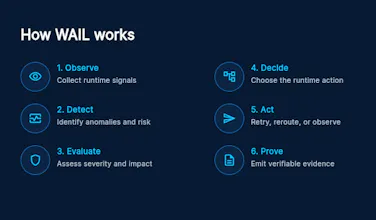
WAIL is an on-prem AI runtime control and governance layer. It detects unhealthy model behavior and can retry or reroute when intervention is justified. Decisions can apply to the next request, while entitled plans can reroute in-flight on TTFT degradation before the first token. WAIL records signed evidence of what happened and why. It wraps your existing provider SDK; it is not a gateway. Prompts, responses, and API keys stay in your environment.



The gap I kept hitting: the model call returns 200, the answer looks fine, and the request was still 5× slower than baseline. Monitoring showed a chart. App code needed custom recovery logic. None of that decided what should happen on the next call or left signed evidence of why.
WAIL wraps the provider client you already use (OpenAI, Anthropic, Gemini, OpenRouter, Ollama, and compatible runtimes). It is not a gateway. When runtime health is bad enough, it can retry or reroute the next request without changing the model your app asked for, and it writes a signed artifact of the observation, decision, and outcome.
This is WAIL 1.0. I’d love to hear what runtime failures you’re seeing in production that your current observability stack can detect but can’t act on.