
Voxelo - 3D & AI Platform for Ecommerce
Build Buyer Confidence, Fast.
72 followers
Build Buyer Confidence, Fast.
72 followers
Voxelo is a new type of 3D and AI content studio that enables ecommerce teams to generate immersive product content - including photorealistic 3D, AR, product and lifestyle imagery - from a single product video.
Build buyer confidence, fast.
1. Capture a digital twin from ~3 minutes of video.
2. Create 3D, AR and AI content in one platform.
3. Convert new customers.
Voxelo's is built around a proprietary solution called User Generated 3D - or UG3D® - leveraging 3DGS, computer vision and AI.
This is the 3rd launch from Voxelo - 3D & AI Platform for Ecommerce. View more

Voxelo 3.0
Launching today
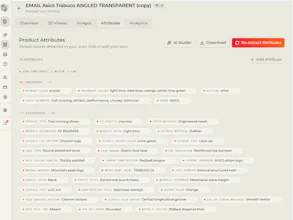
Your products now have two shoppers: people and AI agents. Voxelo turns a three-minute phone video into a photoreal 3D twin in around an hour, and both can read it: interactive 3D, place-in-space AR with nothing to install, AI product and lifestyle imagery, and 2-3x the product attributes of a typical product page, published as JSON-LD. Already have splats? Host 100 free with viewer, AR links, editor and API. New in 3.0: API, analytics, publish to SuperSplat. Captured, not generated.
Interactive




Free
Launch Team / Built With


@vladimir_mulhem This could be a game changer for e-commerce product pages. Can the generated 3D models be embedded directly into existing Shopify stores ?
@dipanshu_kushwaha5 Thanks Dipanshu! Yes. Every twin gets its own viewer and link, so you can put it on a Shopify product page today. A one-click Shopify integration is already a feature. Start free at voxelo.ai/3-0 and try it on one product 🙏
Love that it captures real textures instead of generating them. And making products easier for AI shopping agents to understand is a pretty interesting angle too.
@henry_habib That's very much the aim! Where other AI solutions deliver plausible reconstructions, we deliver faithful representations of the real physical product. You don't want 'good enough' when you're buying a new pair of shoes, if they didn't turn up exactly as seen you'd not be happy!
Roman here, CTO, here to share a few technical details. 🤓
UG3D® (User Generated 3D) is built in part on 3D Gaussian splatting. Capture needs around three minutes of video, or a set of images, on a phone, a rig or a lightbox. Reconstruction takes around an hour, and every twin comes out of a pipeline tuned for the web, so a whole catalogue stays light on a phone.
Now, you can also bring your own! Pull in the splats you already have, from any pipeline. Each gets a viewer and a place-in-space AR link, and you can take it out again as PLY or SOG, or publish straight to SuperSplat. Your scenes stay yours.
Then there's attributes: derived from the product, adjustable by hand. Materials, construction, styling, details, made available via JSON-LD and the API, which is on the free account. This is the part that makes a product page legible to an agent, so it can find you e.g. a jacket that fits properly for your body type.
Splats capture and visualise, but they're specialised to different use cases vs meshes. But the adoption of splats for creative workflows seems to be on the up and up...
Upload the ugliest splat you have and tell me where the viewer falls over. That'll help me figure out what needs fixing next! 🚀
Hey Product Hunt 👋 Vlad here, CEO and co-founder of Voxelo.
I built and sold a 3D agency, so I've spent twenty years wanting good 3D to be faster, cheaper and easier to share. Voxelo 3.0 is us opening the doors.
Our 3D twins are Gaussian splats, a new 3D format that captures the real product as the camera saw it instead of modelling it. Two ways in, one free account. Bring the splats you already have (we host 100 free, each with a viewer, a link and place-in-space AR), or capture a product for three minutes, on video or as a set of images, and get a photoreal UG3D® (User Generated 3D) twin in around an hour.
The new bit I care most about: one capture now does every output. Photoreal 3D, AR, AI imagery, and product attributes read off the scan and published as JSON-LD, which is what AI agents read. Your product page has two shoppers now, a person and the agent shopping for them, and one capture serves both.
Go bring a splat. Tell us what breaks. We're here all day. 🤘
So good @ben_mckay , Vlad and team! Great to see Voxelo in action two weeks ago in Reading - so many use cases for ecommerce
Coming from the SEO side, the JSON-LD part caught my eye. How does it end up on the shop's product page? Do you hand over markup that goes into the HTML, or is it added with JavaScript?
Asking because we just looked at a few hundred AI-built sites, and on a lot of them the content only showed up after JavaScript ran. Most AI crawlers don't run JavaScript, so they never see it.
@michael_weber Hey Michael, great question!
It’s in the HTML of the public page we host for each product i.e. the page the shop embeds. We generate that markup on the server, so it’s in the response before any JavaScript runs. We don’t hand over a block to paste into the theme, and we don’t inject it into the shop page with JavaScript.
The 3D viewer does need JavaScript, but the product facts don’t: they’re in that HTML both as JSON-LD and as a plain list. A crawler that requests the viewer URL sees them without running JavaScript.