Verilot is the verification layer between your 1099-DA and on-chain reality — it finds the phantom gains your tax tool booked on transfers you made to yourself, with a tx-hash on every line.
No reviews yetBe the first to leave a review for Verilot
Maker
📌
I built Verilot after watching a wallet report a taxable gain on coins that had only ever moved between my own addresses.
Consumer crypto tax tools mostly reconstruct your history from exchange CSVs. When you bridge, or move funds from one wallet you own to another, many of them drop the cost basis and book the transfer as a disposal. The gain was never real, but it lands on your return anyway.
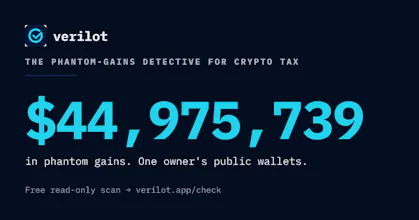
To see how large that gets, we ran five publicly tagged Vitalik-linked wallets through one engine twice. Same data, same disposals, same prices — the only difference was whether the engine knew the wallets belonged to one owner. Wallet linking off: $164,130,459 in "realized gains". Linking on: $119,154,719. The $44,975,739 difference is phantom.
The free scan is read-only: paste public addresses, get a report. No sign-up, no wallet connection, nothing to sign or approve. Every flagged line cites its transaction hash and the rule that fired, because the point is that you can check us rather than trust us.
Limits, up front: it reads Ethereum mainnet, Base or Arbitrum One — one chain and up to 5 addresses per free scan, 500 events. It is built around US cost-basis conventions, Form 1099-DA and Form 8949. It is in beta and there is no paid plan yet.
If you don't have an address handy, there's a "Try a small real wallet" button that fills in one that completes inside the free limit.
I'd especially like to hear from accountants: which of these misreads do you see most often in client data?