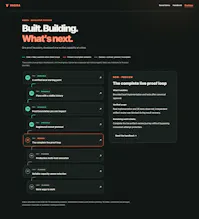
VADRA is a local-first control plane for AI work across models, registered machines and user-controlled cloud runners. It keeps plan changes visible and proof-gates protected actions so repairers cannot certify their own fixes. Its usage-aware routing layer is designed to monitor connected plan capacity/reset windows and shift eligible work before a provider becomes constrained. Multi-runner control is live; capacity routing is Preview.
What became possible in your product with Astra that was not practical before?
Maker
Astra helped me build VADRA; VADRA is my way of making AI help people see beyond what they already know. I’m still learning to code, and I know I have real knowledge blind spots. Astra helped me turn an idea I could describe into VADRA — a working system I would not have been able to build alone.
That experience also shaped the product itself. VADRA is designed to make frontier models challenge and verify one another, expose disagreements, and search for blind spots that I — or any single model — might miss.
Instead of trusting one model’s answer, VADRA preserves plan revisions, asks independent models to question assumptions, and requires fresh verification after repair. The model that fixes a problem should not be the one that certifies its own fix.
For me, Astra did more than help write code. It helped bridge my own knowledge gaps, and VADRA extends that idea by using multiple AIs to reduce blind spots and improve the quality of the final result.
Report
Maker
📌
Another problem we’re targeting is plan fragmentation. People already pay for multiple frontier AI subscriptions, but work often stops at the worst moment because one provider hits a usage window or reset limit. VADRA’s usage-aware routing is designed to track available capacity and reset windows across connected plans, then move eligible work to another provider without weakening review or proof requirements.
But using more models is not enough. VADRA is designed to make frontier models challenge one another. Instead of accepting a single model’s answer as truth, independent models can question assumptions, expose disagreements, and search for blind spots that the user—or the first model—may not have considered. Disagreement becomes a signal to investigate, not something to hide. If a problem is found, one model can repair it, but that repair must be checked again by a fresh independent verifier before protected actions are allowed.
VADRA does not ask, “Did another AI review it?” It asks, “Did an independent model challenge the repaired result before we let it act?”
The goal is not “more agents.” The goal is justified confidence.