UX Agent helps ecommerce teams find why shoppers leave before checkout, why they add to cart but do not buy, and what visible friction hurts conversion. Instead of manually watching hundreds of session replays and guessing why shoppers leave, UX Agent helps Shopify and DTC teams analyze user behavior across sessions and turns it into clear, evidence-backed insights. Built for ecommerce founders, growth teams, and CRO teams who want fewer dashboards and clearer decisions.
No reviews yetBe the first to leave a review for UX Agent
Maker
📌
Hi Product Hunt 👋 I'm Icey.
For years I did UX and conversion work the slow way: watching session replays one by one, trying to figure out why people bounced — and honestly, mostly guessing. A store would lose sales and the whole team would debate "is it the price? the page? the shipping?" with no real evidence.
That's the problem I wanted to kill. So we built UX Agent: instead of you watching thousands of replays, the AI reads them for you — across the whole journey, from product page to each checkout step — and tells you where the friction is, why it's likely happening, and what to fix first, with the actual sessions as proof.
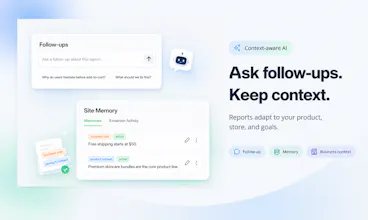
What changed most while building it: at first it just summarized sessions. But "what happened" was never the hard part — "why, and what do I do Monday morning" was. So we pushed it toward causal answers (joining behavior with Shopify order data) and made reports something you can argue with — follow up, correct it, and it remembers your store next time.
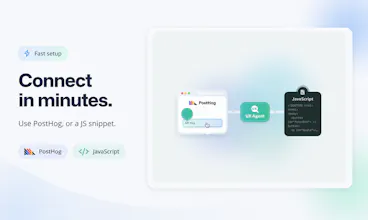
It's built for Shopify / DTC teams, connects in 15 minutes, and there's a free plan.
Would genuinely love your feedback — what's the hardest "why did they leave?" moment you've had with your store? I'll be here all day answering. 🙏
Report
@icey_uxagent Congrats on the launch! 🎉 Love the focus on actionable insights instead of more dashboards. What's the most common checkout friction UX Agent has uncovered so far?
So far, the most common pattern we’ve seen is not a single “checkout bug,” but a trust breakdown before checkout: shoppers hesitate around shipping cost/timing, return policy, sizing or product fit, and whether the product will actually match what they expect.
What’s interesting is that these moments often show up before the final checkout step: repeated scrolling, going back to product details, opening policy pages, comparing variants, or abandoning after shipping info appears.
That’s exactly why we built UX Agent to look across the full journey, not just the last page before drop-off.
Report
What has been the most surprising friction pattern UX Agent has found in early Shopify stores?
One surprising pattern is that a lot of “checkout friction” actually starts much earlier than checkout. Shoppers often show hesitation on product pages: switching variants repeatedly, checking sizing or return info, scrolling back to reviews, then only abandoning later in the cart or checkout.
So the symptom shows up at checkout, but the root cause may be trust, product clarity, or expectation mismatch earlier in the journey.
That’s one reason UX Agent looks across the whole path instead of only analyzing the final drop-off page.
Report
I'm curious whether you've seen teams use UX Agent more for catching obvious usability issues or for uncovering subtle friction that traditional testing tends to miss.
So far, the more interesting use case has been uncovering subtle friction, not just obvious usability issues.
Obvious issues are usually visible once someone watches a few replays. The harder part is noticing repeated hesitation patterns across many sessions: users comparing variants, returning to shipping or return info, rereading product details, or dropping later because trust was weakened earlier.
That is where UX Agent is most useful: connecting small behavioral signals across the journey and turning them into something the team can actually investigate or test.
I agree. Isolated demos can make an agent look impressive, but real user journeys are messy: incomplete sessions, hesitation, repeated actions, unclear intent, and lots of noise.
That messiness is exactly why we wanted to build UX Agent around real ecommerce behavior instead of polished demo cases. The product gets better when it has to reason through real friction.
Report
I like that it connects qualitative behavior with conversion outcomes. That is where many growth teams struggle.


Hi Product Hunt 👋 I'm Icey.
For years I did UX and conversion work the slow way: watching session replays one by one, trying to figure out why people bounced — and honestly, mostly guessing. A store would lose sales and the whole team would debate "is it the price? the page? the shipping?" with no real evidence.
That's the problem I wanted to kill. So we built UX Agent: instead of you watching thousands of replays, the AI reads them for you — across the whole journey, from product page to each checkout step — and tells you where the friction is, why it's likely happening, and what to fix first, with the actual sessions as proof.
What changed most while building it: at first it just summarized sessions. But "what happened" was never the hard part — "why, and what do I do Monday morning" was. So we pushed it toward causal answers (joining behavior with Shopify order data) and made reports something you can argue with — follow up, correct it, and it remembers your store next time.
It's built for Shopify / DTC teams, connects in 15 minutes, and there's a free plan.
Would genuinely love your feedback — what's the hardest "why did they leave?" moment you've had with your store? I'll be here all day answering. 🙏
@icey_uxagent Congrats on the launch! 🎉 Love the focus on actionable insights instead of more dashboards. What's the most common checkout friction UX Agent has uncovered so far?
@nicole_hynek Thank you, Nicole!
So far, the most common pattern we’ve seen is not a single “checkout bug,” but a trust breakdown before checkout: shoppers hesitate around shipping cost/timing, return policy, sizing or product fit, and whether the product will actually match what they expect.
What’s interesting is that these moments often show up before the final checkout step: repeated scrolling, going back to product details, opening policy pages, comparing variants, or abandoning after shipping info appears.
That’s exactly why we built UX Agent to look across the full journey, not just the last page before drop-off.
What has been the most surprising friction pattern UX Agent has found in early Shopify stores?
@phoenixhu Great question.😄
One surprising pattern is that a lot of “checkout friction” actually starts much earlier than checkout. Shoppers often show hesitation on product pages: switching variants repeatedly, checking sizing or return info, scrolling back to reviews, then only abandoning later in the cart or checkout.
So the symptom shows up at checkout, but the root cause may be trust, product clarity, or expectation mismatch earlier in the journey.
That’s one reason UX Agent looks across the whole path instead of only analyzing the final drop-off page.
I'm curious whether you've seen teams use UX Agent more for catching obvious usability issues or for uncovering subtle friction that traditional testing tends to miss.
@harini_mukesh Great question, Harini.
So far, the more interesting use case has been uncovering subtle friction, not just obvious usability issues.
Obvious issues are usually visible once someone watches a few replays. The harder part is noticing repeated hesitation patterns across many sessions: users comparing variants, returning to shipping or return info, rereading product details, or dropping later because trust was weakened earlier.
That is where UX Agent is most useful: connecting small behavioral signals across the journey and turning them into something the team can actually investigate or test.
Teable
This looks useful for deciding what to test next. It is much better to test from observed friction than from random best practices.
@jocky Exactly. The best test ideas usually come from observed friction, not guesses or generic best practices.
That’s what we’re trying to make easier with UX Agent: find the real friction, understand why it happens, and turn it into a clear next step.
Thanks for checking it out, Jocky!
Love the ambition here. Public competition is a much better test of agent capability than isolated demos.
@shirley_hsia Thank you, Shirley.
I agree. Isolated demos can make an agent look impressive, but real user journeys are messy: incomplete sessions, hesitation, repeated actions, unclear intent, and lots of noise.
That messiness is exactly why we wanted to build UX Agent around real ecommerce behavior instead of polished demo cases. The product gets better when it has to reason through real friction.
I like that it connects qualitative behavior with conversion outcomes. That is where many growth teams struggle.