Launching today

tiun.
Auth, billing, and payments for AI builders
359 followers
Auth, billing, and payments for AI builders
359 followers
One system for auth, payments, customer data, and analytics. One command to install. Launch a paid product the same day you start building.




RunEvr
@byalexai @nikolaos_chr Always voting for one tool instead of many! Good luck guys =)
Scarlett.
@nikolaos_chr @adana Thank you Adana! Simplicity > any other solution.
tiun.
@adana thank you for your support!
Great idea of having MoR with all the heavy setup of backend!
tiun.
@kunalukey Thank you Kunal for your kind words!
HeyZoku
tiun.
@dangibuilds Thanks Priyanshu for the kind words!
tiun.
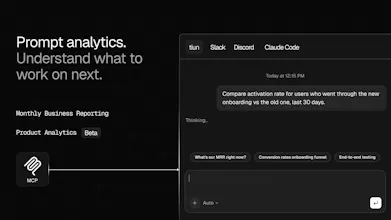
@avinashvagh1 Thanks for the question Avinash! You can already ask tiun today which products drive your MRR and how it has changed over time. In terms of expansion you can ask what plan drives most sales in various countries. In the future you can even correlate product updates with conversion numbers, and attribute revenue. All of this you can ask tiun without exporting anything. AI Analytics is currently in Beta, and you can directly request access in tiun.
Build Check
I’m an indie hacker and I lose way too much time wiring auth, payments, webhooks, and subscription logic together.
How close does tiun get me to shipping a monetized SaaS? And realistically, how long does setup take?
tiun.
@german_merlo1 This is pretty much exactly why we built tiun :)
Installing the tiun skills and connecting to our MCP takes about 3 minutes.
From there, you can tell your AI agent to create your products and integrate tiun directly into your app.
Realistically, the full setup from there until you can start selling takes another 5–10 minutes.
So if your product is ready, you can go from no commercial backend to auth, payments, subscriptions and customer management in around 15 minutes.
Dial
the "one system instead of stitching together Stripe, Clerk, a database, invoicing" pitch is real, but it also means auth, billing, and customer data all live behind one vendor instead of three swappable ones. if I ever needed to leave, is there an export path for the customer/revenue data, or does going all-in on tiun mean the migration cost later is the price of the simplicity now?
tiun.
@galdayan Thanks Gal — very fair question! We definitely don’t want simplicity now to lock you in later. Our ambition is that as your startup grows, you choose to stay with us because the product keeps being the best option for you — not because we make it difficult to leave.
That said, all your customer, subscription, transaction and usage data is yours and can be exported. So if you ever decide to leave tiun, there’s a clear path to migrate it elsewhere.
Of course, if you use tiun for auth + billing + customer data, there will be more to migrate than if you only use a small part of it. But we don’t want to make leaving artificially difficult. The goal is to remove complexity, not create lock-in.
EverTutor AI
This is a really interesting approach. Auth, billing, customer data, and analytics are usually the parts you end up stitching together once a product starts growing. Having that foundation in one place could save builders a lot of time. Curious to see how far Tiun takes the “one backend” vision.
tiun.
@suryansh_tiwari2 Thanks Suryansh! That’s exactly the idea. We kept seeing small teams spend more and more time stitching infrastructure together as their product grew.
We want tiun to be the backend you can start with and keep as you scale — with auth, payments, customer data and analytics all built around the same user and the same data.
And we’re definitely not done with the “one backend” vision yet :)