
TierOnePrep
Interactive system design prep for FAANG & AI-era companies
11 followers
Interactive system design prep for FAANG & AI-era companies
11 followers
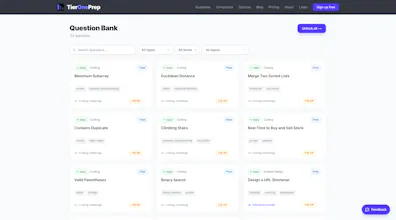
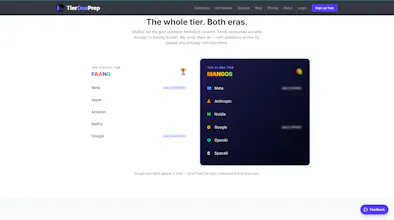
Interactive interview prep for FAANG and AI-era companies (Meta, Anthropic, Nvidia, Google, OpenAI, SpaceX). System design questions are 4-phase simulations of real interviews — vague brief, clarifying questions, architecture, hard follow-ups. Coding questions show algorithms running live with step-by-step visualizations. Written by engineers who've conducted hundreds of interviews at top companies. 12 free questions, no credit card.



Free Options
Launch Team

Viktor.comAn AI coworker that actually does the work
Promoted
The system design simulations feel closer to a real interview than any Leetcode-style prep I've tried. Wish the coding visualizer ran a bit faster on bigger inputs, but the clarifying question phase alone is worth the sign up.
@canselgzeyahv8 This is really useful feedback, thank you — and you're right about the visualizer. On larger inputs the step-through rendering starts to chug; it's animating every state change, which gets expensive as the input grows. It's on my list to fix, likely by letting you adjust playback speed and skip/batch steps on bigger inputs so it stays smooth. Genuinely helpful to hear it called out, because it tells me it's worth prioritizing.
And glad the clarifying-questions phase earns the signup on its own — that's the part I most wanted to get right, since it's where a lot of strong candidates quietly lose points in real loops.
If you hit any specific question where the lag was worst, I'd love to know which one — helps me test the fix against the actual worst case.
The 4-phase system design format is genuinely smart, treating it like a real interview instead of just tossing a prompt at you. Really wish more prep tools approached it this way instead of just grading a single answer.
@erturul42135743 Thank you — that "single answer" gap is exactly what bugged me about most prep out there. Real interviews aren't one question graded once; they're a conversation that evolves as you make decisions, and each decision opens the next set of trade-offs. Grading a lone answer misses the whole thing that's actually being tested.
That's why the follow-up phase matters as much as the initial design — it's where interviewers separate "designed something that works" from "understands why it works and what breaks at 10x scale."
Curious: what's tripped you up most in real system design rounds — the open-ended start, or the scaling follow-ups? That's the tension I'm always trying to tune the questions around.
The system design simulations actually feel closer to a real interview than anything else I've tried, especially the way it forces you to ask clarifying questions first. Live algorithm visualization is a nice touch too.
@melahatemicyh7 Thank you — that's exactly the reaction I was hoping for. The clarifying-questions phase was the part I most wanted to get right, because in real interviews that's where a lot of strong candidates quietly lose points: they jump straight to architecture without scoping the problem. Glad it lands the way it does in a real loop.
And happy the visualizations clicked for you — watching a data structure actually change state beats reading pseudocode every time.
Out of curiosity, which track were you practicing — classic FAANG system design, or the AI-era ones? Always keen to hear which questions feel closest to the real thing so I know where to invest next.