
The Git Observatory
GitHub charted as a night sky. Every star is a real star
9 followers
GitHub charted as a night sky. Every star is a real star
9 followers
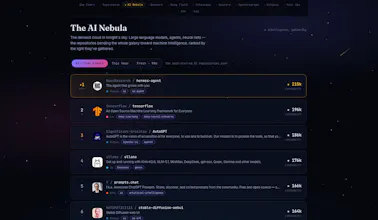
The Observatory turns GitHub into an astronomical instrument. Tonight's fastest-rising repos become the brightest stars. Repos that suddenly explode get real supernova designations (SN 2026-07-14A) with Δ-magnitudes calculated the way astronomers do it. Point the telescope at any month back to 2008, get a stellar classification for any repo (Protostar → Hypergiant), or see your own GitHub account drawn as a constellation. 100% client-side, $0 to run, no signup, no tracking.




love how it classifies my old college repos as "protostars" and my neglected ones as "white dwarfs". the supernova naming for sudden spikes is such a nerdy detail, exactly my kind of thing.
@asyadizili Ha, "white dwarfs for neglected repos" — exactly the fate they deserve 🔭 The supernova math is the real formula astronomers use, built for precisely this kind of nerd. Glad you found it!
Love the supernova naming and the constellation view is genuinely charming. One idea: add a way to filter by language or topic in the telescope view, so you can see which Python repos or AI tools had the biggest brightness spikes in a given month without scrolling through everything.
@nazrpafr Thank you! Fun fact: you can partly do this today — Ask the Sky understands queries like "python repos from March 2021", so language + time window already compiles to a search. But you're right that filters belong inside the Telescope itself, right where you're already browsing — adding it to the list. Thanks for the idea 🔭
Genuinely fun way to browse GitHub history. Pointed the telescope at July 2023 and watched some random ML repo get classified as a hypergiant right before it blew up. The constellation map of my own account was the cherry on top.
@zelihayapa Love that — July 2023 was peak ML gold rush, the sky's full of hypergiants that month 🔭 Glad your constellation was the cherry on top. Thanks for actually pointing the telescope back in time — that archive is my favorite instrument.