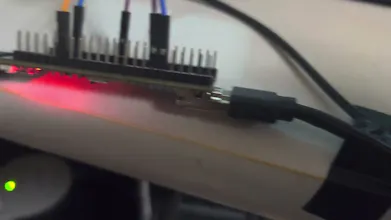
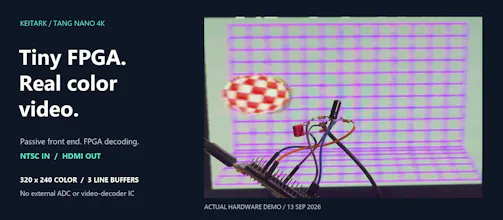
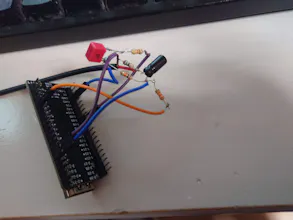
Open-source hardware that turns NTSC composite video into color HDMI on a Tang Nano 4K. One FPGA I/O plus a passive R/C feedback network acts as a one-bit ADC; sync and color decoding drive three line buffers and 640x480 HDMI—no external ADC or decoder.
What real task does your product handle with GPT-6 Astra?
Maker
GPT-6 Astra helped me turn a vague hardware goal into a working, resource-bounded FPGA video path: inspect the Tang Nano 4K repository and constraints, reason about the passive R/C one-bit front end, write and debug Gowin RTL for sync and color decode, three-line buffering, and HDMI timing, and iterate against live bench captures. The real task was recovering color NTSC video from a single comparator-like FPGA input without an external ADC or video-decoder IC, while keeping the implementation small enough for the GW1NSR-4C. Astra also kept the evidence boundary honest: an external HDMI capture device records the HDMI result; native FPGA USB-UVC is not claimed.
Report
Maker
📌
I built this as a small, practical video experiment: one Tang Nano 4K FPGA I/O pin plus a passive resistor/capacitor feedback network serve as the fast one-bit ADC—no external ADC or video-decoder IC. The digital pipeline reconstructs the composite waveform at 13.5 MSamples/s, separates sync from picture processing, tracks the NTSC color burst, and uses three line buffers to produce RGB565 HDMI.
The result is a real bench capture from a NEO FAMI source. It is deliberately honest about the boundary: the FPGA produces HDMI and an external HDMI capture device records it; native FPGA USB-UVC is not part of this milestone. The circuit, RTL, build evidence, and MIT-licensed source are public.
Built with GPT-6 Astra during the challenge. I would love feedback on the analog front end, lock stability, and where to take the next version.