
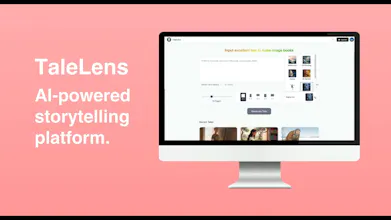
Transform your imagination into beautifully illustrated children's books with AI-powered creativity. Create personalized storybooks in minutes. Perfect for parents, educators, and dreamers.


What's great
I’m an early user of TaleLens and have been using it for a while now. What I really like about TaleLens is its ability to automatically split a long story into multiple picture-book scenes according to the desired length. It also refines and simplifies the text, making the language more natural and suitable for picture books.
In terms of illustration, TaleLens does an impressive job maintaining character consistency, even when multiple characters appear in the same story — something that’s often difficult for AIGC tools. It can even slightly adjust each character’s appearance to fit different story scenes, which feels surprisingly coherent and creative.
The platform also offers a variety of illustration styles, which makes it accessible for creators of all ages. Personally, I really enjoy the cartoon style, which works perfectly for children’s picture books.
Another great feature is that after generating a full picture book, creators can regenerate individual images to fine-tune their work, solving the common AIGC challenge where a single generation rarely meets the creator’s full expectations.
Overall, TaleLens has become one of my favorite AI storytelling tools — intuitive, flexible, and truly inspiring for creative storytelling.
What needs improvement
Of course, like most AI art tools, it still struggles with hands and limbs occasionally. However, with a few regenerations and adjustments, these issues can be resolved. TaleLens also works beautifully when combined with other AI art tools or Photoshop for further refinement.
vs Alternatives
I chose TaleLens because it makes story visualization incredibly easy and creative.It automatically structures long stories into picture-book scenes, keeps characters consistent, and allows both manual editing and AI-assisted adjustments.The illustration quality stays quite stable between re-renders, and it even supports multiple art styles — perfect for creating children’s picture books.
Ratings
Ease of use
Reliability
Value for money
Customization
Report
1 view
Got! Thanks for ratings with so many comments, we'll work hard to make it better!
Report
What's great
TaleLens is a well-positioned AI children's book maker with a clear target audience. The ability to download stories as presentation slides adds practical value for educators, and the flexible pricing structure accommodates everyone from casual users to professional creators. It's a smart application of AI technology in the children's content space with good scalability potential.
vs Alternatives
TaleLens is a well-positioned AI children's book maker with a clear target audience. The ability to download stories as presentation slides adds practical value for educators, and the flexible pricing structure accommodates everyone from casual users to professional creators. It's a smart application of AI technology in the children's content space with good scalability potential.
Ratings
Ease of use
Reliability
Value for money
Customization
Report
2 viewsWhat's great
TaleLens is an absolute gem for anyone who loves storytelling. It’s is an impressive AI-powered tool for creating illustrated stories with ease and creativity. The interface is clean and straightforward, making the process of creating a visual story accessible to everyone, regardless of their technical skills. I simply enter an idea, choose a style, and the AI quickly delivers engaging text paired with visually appealing illustrations.
What truly sets TaleLens apart is the tangible outcome: it turns text into a ready-made visual storyboard. For writers, it's a rapid prototyping kit for ideas; for educators, it's a dynamic classroom asset; for marketers, it's a cost-effective way to create compelling content.
Ratings
Ease of use
Reliability
Value for money
Customization
Report
1 view
I’m Novie, a member of TaleLens .
My work is to weave fairy tales and myths into our TaleLens Galaxy, giving ancient stories a chance to breathe and shine again. My role is like a dream-weaver.
Literature and art have always been lovers, and both of them have accompanied me for a long time.
So when I first saw the idea of TaleLens, one thought came to me :
“I want to make a gift for our children.”
We may live in different countries, speak different languages, and watch different seasons pass outside our windows,
but the hearts of parents everywhere are same—
Our children grow up to be brave, kind, and guided by integrity.
In this restless age where everything rushes forward,
We chose to pick up the books and brushes long left in silence,with honest language and luminous color.
Our team spent three months building a platform that transforms traditional written stories into AI-visualized picture books.
TaleLens now offers eight illustration styles:
Watercolor – Gentle and Dreamy
Oil Painting – Classic and Epic
3D Render – Immersive and Dimensional
Comic – Lively and Dynamic
Sketch – Minimalist and Nostalgic
Digital Art – Modern and Detailed
Realistic – True-to-Life and Documentary
Cartoon – Cute and Playful
You can choose your preferred style, generate up to 30 illustrated scenes,
and fine-tune each page directly in the Edit interface.
Our Tale Galaxy is now open—
a space where you can explore the stories you love,
or publish your own creations and let them shine.
Perhaps you’ve just become a parent, wondering how to introduce this vast new world to your child.
Maybe you’re considering ways to nurture a child’s imagination, empathy, or artistic sense.
Perhaps you’re a teacher who wishes to make classroom stories come alive,
or an artist or designer seeking inspiration through words and images.
You might even be a picture-book creator —if so, TaleLens will make your process smoother, faster, and lighter.
And perhaps… you’re simply someone who still carries a child’s heart,
untouched by the weight of the world.
Whoever you are,
Open TaleLens, and step into the dreamscape of words and colors.
As a story editor at TaleLens, I often think:
TaleLens can be a tiny bed in the tower of a child’s dream,
an invisible armor that wraps them before they enter a complex world,
a small pillow castle built from imagination and language.
Perhaps one day our children will grow into brave knights who cross unknown lands,
or clever little tailors who conquer giants with wit alone.
Some may become princesses who see with their hearts,
or steadfast tin soldiers who never waver in their devotion.
Or like Eliza, who endures all to redeem those she loves.
Through TaleLens, we hope to place this quiet gift in every child’s hands—
a small light resting deep within their hearts.
May the stories we create become gentle lights within them—
small stars that, one day, will softly shine again.
This webpage has a good style and the quality of the picture book generation is also good.