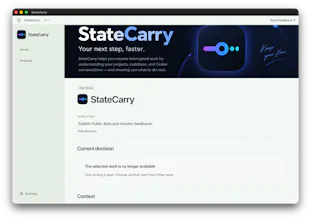
StateCarry helps you return to interrupted coding work without replaying the whole history. It looks at the project as it exists now, along with relevant Codex conversations, and helps you answer three questions: What was I doing? What changed? Where do I continue? Close the project. Come back tomorrow. Pick it up again.
What real task does your product handle with GPT-6 Astra?
Maker
Astra changed StateCarry from a simple project-state tracker into a system focused on helping developers resume interrupted work.
Instead of only summarizing what happened, I used Astra to challenge the product assumptions, inspect edge cases, and refine the underlying model around observable project state, user decisions, and the next valid action.
That pushed the scope beyond “remember my context” toward a harder question: how can a tool determine what is still valid when someone returns to a project after hours or days away?
Astra also helped me iterate across architecture, UX, invariants, and implementation while keeping those decisions connected. The result is a more ambitious product: not just storing context, but reducing the cost of reconstructing work after interruption.
Report
Maker
📌
I built StateCarry because I kept running into the same problem while working across multiple projects and AI coding sessions: coming back was expensive.
The code was still there. The commits were still there. The conversations were still there.
But I had lost the meaning of the current state.
What was I doing? What changed? What still mattered? Where could I continue?
I kept spending the first part of every resumed session reconstructing work I had already done.
So I started StateCarry with a simple question:
What if returning to interrupted work felt more like continuing than reconstructing?
StateCarry looks at the project as it exists now, along with relevant Codex conversations, and helps you understand what the work was about and where you can continue.
This is an early public beta. I’m releasing it now because I want to find out whether this problem is specific to my workflow, or something other developers working across repositories and AI coding sessions run into too.
If you try it, I’d especially love to hear:
When you come back to a project after a few days, what do you usually have to figure out first?




I built StateCarry because I kept running into the same problem while working across multiple projects and AI coding sessions: coming back was expensive.
The code was still there. The commits were still there. The conversations were still there.
But I had lost the meaning of the current state.
What was I doing? What changed? What still mattered? Where could I continue?
I kept spending the first part of every resumed session reconstructing work I had already done.
So I started StateCarry with a simple question:
What if returning to interrupted work felt more like continuing than reconstructing?
StateCarry looks at the project as it exists now, along with relevant Codex conversations, and helps you understand what the work was about and where you can continue.
This is an early public beta. I’m releasing it now because I want to find out whether this problem is specific to my workflow, or something other developers working across repositories and AI coding sessions run into too.
If you try it, I’d especially love to hear:
When you come back to a project after a few days, what do you usually have to figure out first?